As an Amazon Associate, we earn from qualifying purchases. Read our affiliate disclosure.
The best toddler booster chair is a dining seat that fits both the child and the adult chair underneath it. Compare OXO Tot Nest for a high-backed removable-cushion design, Chicco Bento for a folding booster with two height positions, and Bumbo Multi Seat for a compact system with removable foam and a stowed tray. Bumbo’s checked selected finish was sold out, so it is a conditional alternative requiring verified stock rather than an immediate-buy recommendation.
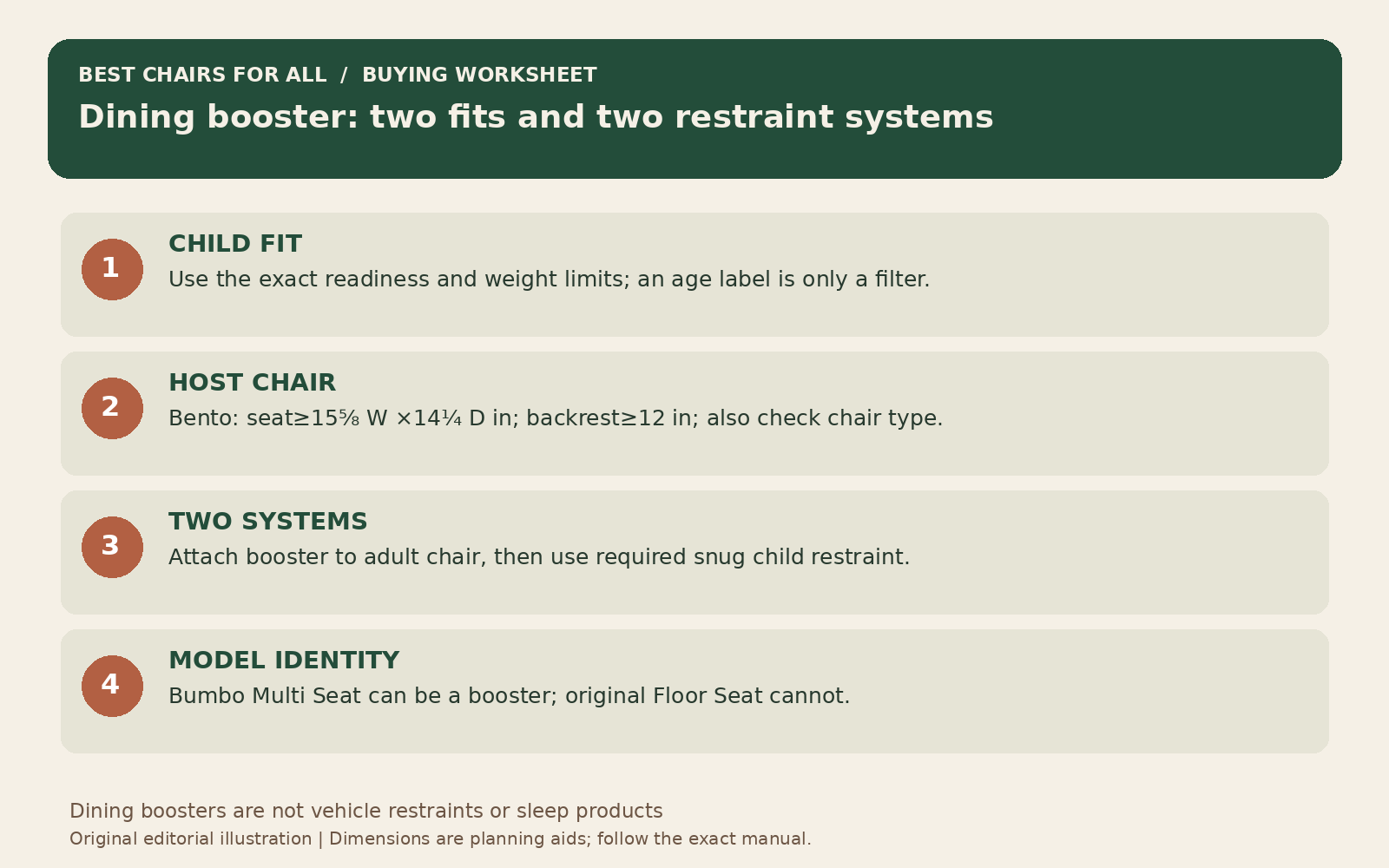
These are eating-seat boosters, not vehicle booster seats. We reviewed current US manufacturer pages, the Bento manual, and CPSC booster guidance on November 6, 2026. We have not performed attachment, stability, or cleaning tests. Our host-chair worksheet helps eliminate an incompatible purchase before a small portable seat is mistaken for a universal fit.
Compare the complete attached setup
| Model | Published dimensions | Product limit information | Main buying question |
|---|---|---|---|
| OXO Tot Nest | 12.8 ×14.8 ×12.5 in;5.32 lb | From 9 months; up to 50 lb; follow exact readiness instructions | Does the adult chair meet the supplied manual? |
| Chicco Bento | 17 ×14 ×17.5 in; folded 19.5 ×14 ×4.5 in | 6 months–50 lb advertised; booster requires unassisted sitting | Host seat at least 15⅝ W ×14¼ D in;12-in backrest |
| Bumbo Multi Seat | 14.57 W ×13.39 D ×10.24 H in with foam | 6 months–3 years;33 lb; sit unaided | Correct straps, foam configuration, and current stock |
OXO Tot Nest: a supported shell with separate attachment straps
The Nest manufacturer page lists a high back and sides, removable cushion, three-point child harness, and back and bottom adult-chair straps. Its published size is 12.8 by 14.8 by 12.5 inches and weight 5.32 pounds, with a 50-pound maximum. The current Drizzle listing showed $55.99 and a purchase control. Treat the age description beginning at nine months as an initial filter rather than proof that every child of that age meets the instructions.
Nest’s appeal is a contained dining position without buying a separate full-height chair. The removable cushion can make some cleanup tasks easier, and the attachment straps store under the seat when not in use. Those conveniences still require correct reattachment at the next use. A non-slip foot or snug child harness cannot replace the straps securing the product to the adult chair.
Choose it for further investigation when the actual host chair is stable, compatible, and easy to inspect. It is less useful if the chair’s shape, upholstery, or backrest prevents the instructed attachment. The current page does not supply every host-chair dimension needed for a tight compatibility decision, so obtain the exact manual before ordering for an unusual seat. Do not interpret the marketing reference to most adult chairs as approval for a stool, pedestal chair, folding chair, or an unsupported bench.
Chicco Bento: a folding option with explicit host-chair measurements
The Bento 3-in-1 page gives an assembled size of 17 by 14 by 17.5 inches, a folded size of 19.5 by 14 by 4.5 inches, and a 5.5-pound weight. It has two height positions and an included tray. The listed price was $34.99, but style selection is required for final availability, so confirm the exact offered color and complete contents before planning a trip around it.
The official US manual makes the booster requirements concrete. The adult chair needs a seat at least 15⅝ inches wide and 14¼ inches deep and a backrest at least 12 inches high. The manual excludes damaged or unstable chairs, folding chairs, pedestal chairs, and bar stools, and requires both adult-chair attachment straps. Booster use is for a child capable of sitting upright unassisted, within the 50-pound maximum.
Bento is worth investigating when its fold and supplied tray are useful and your measured host chair passes the entire manual. It is less useful if the adult seat is narrow, the back prevents correct straps, or you need a product whose current style stock is already certain. Its floor feeding and later toddler-chair modes have different instructions. A photograph showing a harness stored in a later mode does not permit removing it early in the attached booster configuration.
Bumbo Multi Seat: compact, with strict distinction from the Floor Seat
The Multi Seat product page describes a floor, feeding, and booster system for children who can already sit unaided. The US FAQ gives a six-month-to-three-year range,33-pound maximum, and standard size of 14.57 inches wide,13.39 deep, and 10.24 high with the foam insert fitted. The tray stows at the back, and the foam insert and adult-chair straps have storage provisions.
This is a different product from Bumbo’s original Floor Seat, which must never be used as a dining booster. Multi Seat includes adult-chair attachment straps and a child harness; use them according to the exact manual and approved configuration. Do not borrow a belt, tray, or assembly step from another Bumbo model. Removing the foam changes the internal seat space, not the need to follow the applicable restraint instructions.
The checked manufacturer finish showed $69.99 and sold-out status. That makes this a conditional comparison until a complete current unit and its support terms are confirmed. It can be useful where the compact system fits the child and host chair, but it is not a substitute for a larger booster once the child exceeds its 33-pound limit. It also fails the shortlist if the only available used example lacks an identifiable label, correct straps, or approved tray.
The adult-chair compatibility worksheet
Record the host chair’s usable seat width and depth, backrest height, construction, condition, and strap path. Measure the actual flat support area rather than the outside of a curved upholstered seat. Then add the booster’s minimum dimensions and prohibited chair types from its own manual. Mark the result pass, fail, or unknown. An unknown should not become pass simply because the product seems to rest on top without a child.
For a worked Bento example, a hypothetical adult chair has a flat seat 16 inches wide and 15 inches deep, with a 14-inch backrest. It exceeds the manual’s minimum dimensions by⅜ inch of width,¾ inch of depth, and two inches of back height. That arithmetic only clears the dimensional filter. The construction, stability, no-overhang rule, and secure routing of both straps must still pass. A chair with the same dimensions but a prohibited folding frame remains unsuitable.
Now consider a 14-inch-square adult seat. It may match minimum dimensions published for some other booster model, but it fails Bento’s stated width and depth requirements. Never copy a compatibility number from Pocket Snack, Nest, or another brand. A few fractions of an inch can matter precisely because the feet or support frame need to sit in the position the maker designed.
Attachment and child restraint are separate systems
Before each use, check the product’s attachment to the adult chair. Then secure the child with the required harness adjusted snugly. Do not treat these as alternate safety systems: the attachment straps prevent the booster from moving relative to the chair, while the child restraint addresses the child’s position in the booster. The tray does not replace either system.
Bento’s manual provides its own transition language for restraint use when a child can independently get in and out. Follow the exact rule for the configuration and child rather than adopting a universal age cutoff from an article. Another model may have different requirements. Even where a later child-harness transition is permitted, that does not automatically remove the requirement to attach the booster to the adult chair.
Do not carry an occupied booster, lift the adult chair with a child aboard, or allow the child to push away from the table. Keep the supporting chair on a firm, level surface and stay near throughout use. If a strap becomes loose, the child can move the system, or a buckle is damaged, remove the child and stop use until the correct problem is resolved. Do not tie on extra straps as an improvised repair.
Table fit comes after the host chair passes
Once the empty attached setup is correct, assess its relationship to the dining table. The shell height is not necessarily the sitting-height increase. Nest’s 12.5-inch overall height, Bento’s 17.5-inch assembled height, and Multi Seat’s 10.24-inch standard height cannot simply be added to an adult seat measurement to calculate the child’s eating position. The backrest and other parts contribute to those overall figures.
Measure the tabletop and underside apron, then ask the maker for any missing functional seat height. A tall shell may collide with the apron before the child is comfortably positioned. Do not force the chair under the table or stack a cushion underneath the booster to create a different height. If the approved arrangement fails, choose a different suitable seat or a dedicated high chair.
Folding, washing, and travel tradeoffs
A folding booster is useful only when the full folded size fits the intended bag or cupboard. Bento’s 19.5-inch folded length can be awkward for a small bag even though its 4.5-inch thickness looks compact. A fixed-shell booster may be perfectly adequate for a relative’s home where it stays attached to one approved chair. Decide how often portability is actually needed before paying for a feature you will not use.
Follow the model’s cleaning directions by component. Bento permits its tray in the top dishwasher rack, but the harness is spot-cleaned and air dried rather than machine washed. Bumbo’s FAQ says not to submerge the foam or Multi Seat tray, and its plastic trays are not dishwasher safe. A tray that looks similar can therefore require a different routine. Keep straps dry and correctly routed when replacing removable parts.
Recall and purchase checks
The CPSC booster guidance emphasizes an active means of attachment and minimum host-chair dimensions. Search the current recall database using the exact model and date code, register the purchase, and keep instructions available to all caregivers. Do not infer unit-specific safety from a retailer’s current listing or from a generic certification claim.
Reject an incomplete secondhand unit unless the maker can provide the exact approved replacement parts. Verify stock for the selected finish, delivery costs, and return conditions before ordering. Keep these eating boosters separate from vehicle child-restraint decisions: they are not designed to protect a child in a crash, and they should never be used in a car.
Investigate Nest for a high-backed cushion design, Bento for the documented folding system and host-chair measurements, or Multi Seat only with confirmed current stock and its lower weight limit respected. The most useful booster is the one that passes both the child-fit and adult-chair checks with the complete original attachment system. The small footprint alone should never decide the purchase.
Something unclear or out of date? Send a correction with this article’s title and the detail to check.
Sources, research & corrections policy ↗