As an Amazon Associate, we earn from qualifying purchases. Read our affiliate disclosure.
The best nursery recliner is the one you can open, use, close, and leave predictably while remaining an awake caregiver. Start with the manual DaVinci Piper when you prefer a nonpowered mechanism, the Babyletto Kiwi when a narrower exterior and electronic adjustment matter, or the Namesake Crewe when its higher seat and taller back fit you better. Treat these as three different control-and-fit systems, not a ranked promise that the most expensive mechanism is most useful.
Manufacturer pages were checked November 6, 2026. This is specification-based research, with no claimed hands-on operation or measured closing effort. We have not established that any candidate requires less force for a particular person. Matching Amazon-search links are shopping aids; confirm the model, condition, seller, and included components before ordering.
These chairs are for awake adult caregiving, not infant sleep. If there is any chance you may fall asleep while feeding, avoid an armchair or couch and follow NICHD safe-sleep guidance. Move a sleeping baby to an appropriate separate infant sleep space; a reclined nursery chair is not that space.
Compare the whole operating cycle
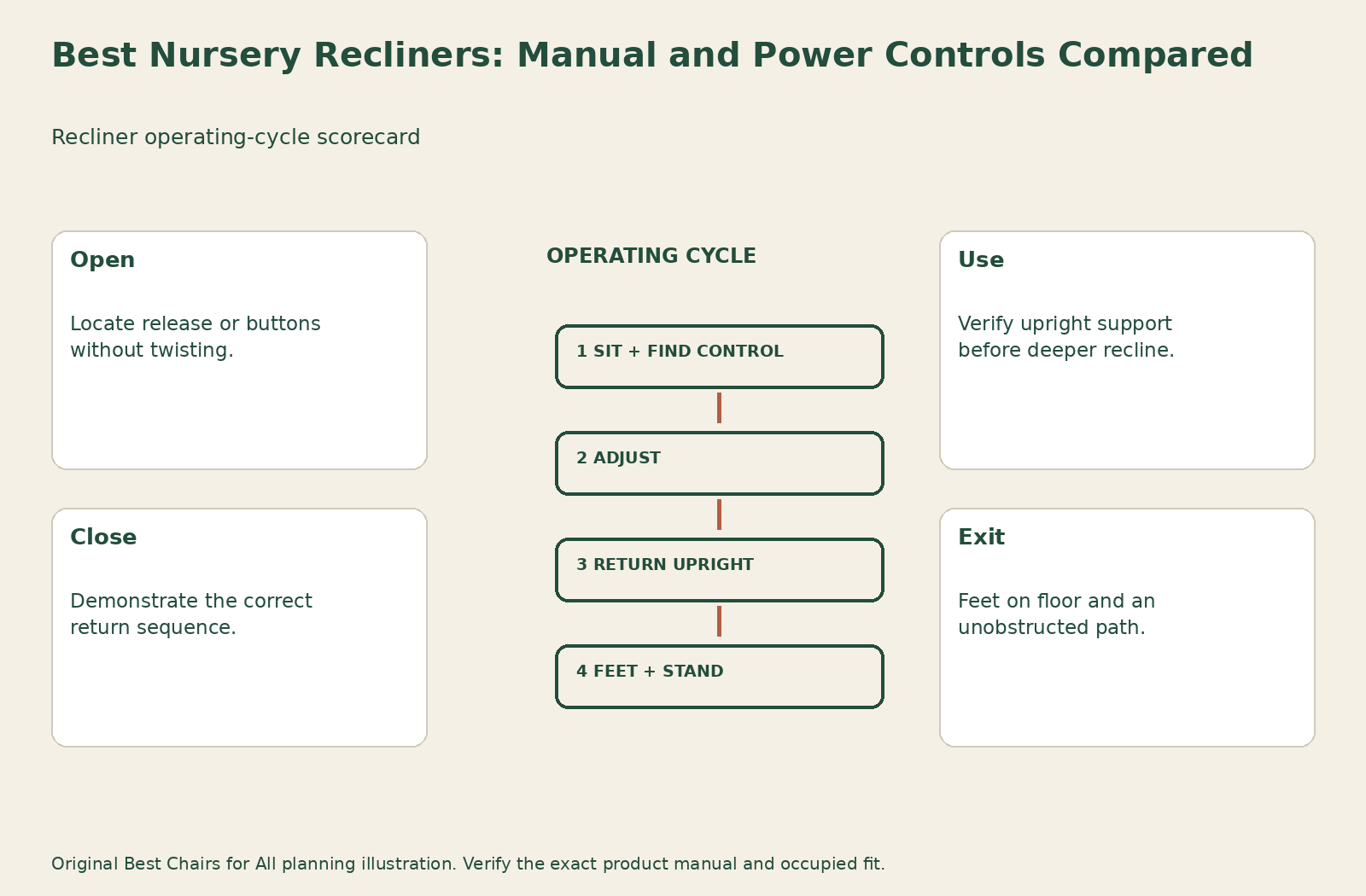
Write down the cycle you need: sit, find the control, adjust, return upright, place feet, and stand. A nursery photo typically shows only the adjusted position. Your decision needs the movements before and after it. First demonstrate the entire cycle with no baby in your arms and with enough clear room to follow the manual. A convenient button or lever is useful only if the rest of the sequence works too.
Manual and powered mechanisms fail a purchase for different reasons. Manual operation may be uncomfortable or hard to close for a specific user. Powered operation may be inconvenient if there is no suitable electrical location or if a control is difficult to reach. A powered recline does not make a chair a lift chair, and neither a lift-like appearance nor a high seat establishes transfer suitability.
Source-backed configurations in this shortlist
The DaVinci Piper Recliner and Swivel Glider page identifies manual recline with a pop-up leg rest. The Babyletto Kiwi Electronic Recliner and Swivel Glider page describes electronic recline and upright gliding. The Namesake Crewe Electronic Recliner and Swivel Glider page identifies the electronic model, its dimensions, and its own charging restrictions. Check the specific manual linked by the manufacturer for the delivered model; a related manual or retailer photograph is not an adequate operating guide.
The published fully reclined lengths are 61.75 inches for Piper, 64 inches for Kiwi, and 64.5 inches for Crewe. These are useful comparison dimensions, not complete clearance instructions. They do not independently tell you required wall spacing, foot sweep, swivel envelope, or the standing path. Ask the manufacturer about any unresolved clearance and mark the full arrangement on the floor before buying.
The three control-and-fit candidates
1. DaVinci Piper Recliner and Swivel Glider
Best for: a manual recliner without a powered seating circuit.
Piper is the starting candidate if you want a nursery recliner but do not want the reclining function tied to a wall outlet. The published 61.75-inch fully reclined length is the shortest of these three candidates, while the 22-inch seat width gives a useful specific comparison. Its role here is a manual-control alternative, not a universally easier chair.
A manual release and a closing movement need a personal trial. Do not assume that a lever within reach means the whole return sequence is manageable. Compare operation after sitting back naturally, then check the feet and arms. Its 20-inch seat height and deep cushion may work differently for two caregivers, especially if one needs a shallower seat.
Product Details
| Brand | DaVinci |
|---|---|
| Dimensions | 34 in deep × 30.5 in wide × 39.25 in high |
| Seat | 22 in deep × 22 in wide; 20 in high |
| Back above seat | 26 in |
| Fully reclined length | 61.75 in |
| Motion | Manual recline, swivel and gliding |
Pros
- No powered recline connection is part of the stated operation.
- Published extended length is shorter than Kiwi or Crewe.
Cons
- Closing effort remains unverified until you try the exact chair.
- Manual control does not provide assistance with standing.
Keep Piper on the shortlist when opening and closing feel controlled in the normal instructions and the seat fits. If the closure is awkward, another manual recliner with a similar silhouette is not automatically the solution.
2. Babyletto Kiwi Electronic Recliner and Swivel Glider
Best for: a powered option with a relatively narrow exterior.
Kiwi combines electronic adjustment with a 29-inch overall width. It is the candidate to examine when you prefer holding a button to operating a manual release, while still needing a comparatively narrow furniture body. The manufacturer distinguishes gliding in the upright position, which matters when planning how you will actually use the recliner.
Its fully reclined length is 64 inches, so narrow exterior width does not mean a short operating envelope. Establish an accessible outlet and a cord route that stays clear of the moving base. Try the controls from your relaxed position and confirm the exact model, because the original Kiwi, Plus, Pro, and other variants should be treated as different specifications.
Product Details
| Brand | Babyletto |
|---|---|
| Dimensions | 38 in deep × 29 in wide × 41 in high |
| Seat | 22 in deep × 21.75 in wide; 20.25 in high |
| Back above seat | 25.5 in |
| Fully reclined length | 64 in |
| Motion | Power recline; 270-degree swivel; glides upright |
Pros
- Powered position adjustment provides a different control method from Piper.
- Narrower overall width than the other two listed candidates.
Cons
- Requires electrical placement and cord management.
- The 22-inch seat depth can still be too long for some users.
Select Kiwi only after the control method, body fit, and room envelope all pass. Its integrated footrest is a reclining feature, not an infant sleep surface or a powered standing aid.
3. Namesake Crewe Electronic Recliner and Swivel Glider
Best for: a higher seat and taller published back among these options.
Crewe deserves a separate trial if you want powered recline and the lower seat position of the other candidates does not feel suitable. Its listed seat height is 21.5 inches and back height above the seat is 28.5 inches. These dimensions offer a concrete reason to compare it with Kiwi rather than relying on the brand or styling.
The higher seat can also be a disadvantage when feet do not reach useful support. Its seat is listed at 20.5 inches deep, so the fit relationship differs from the two 22-inch-deep options. A 40-inch upright depth and 64.5-inch extended length require a meaningful room check. Confirm the electronic model; Crewe also appears in other product variations.
Product Details
| Brand | Namesake |
|---|---|
| Dimensions | 40 in deep × 30.5 in wide × 42 in high |
| Seat | 20.5 in deep × 22 in wide; 21.5 in high |
| Back above seat | 28.5 in |
| Fully reclined length | 64.5 in |
| Motion | Electronic recline, 270-degree swivel and gliding |
Pros
- Different height-and-depth combination from Piper and Kiwi.
- Electronic adjustment is documented for this exact Crewe version.
Cons
- Largest listed upright depth and extended length in this comparison.
- Higher seat is not automatically better for a shorter caregiver.
Investigate Crewe when its specific geometry addresses a real fitting need and you can place it with clear operating room. Reject it if gaining higher support means losing stable foot contact or easy access to the control.
Make an operating-cycle scorecard
Use a row for each stage and separate columns for every adult who will use the chair. Under sitting, record whether the seat is accessible and the feet can find useful support. Under finding the control, record whether it is visible or easy to locate without twisting. Under adjustment, record whether the motion is controlled and matches the manual. Under closing, record the actual sequence and any difficult step.
The final row is exit. Confirm that the leg rest is in the position required before standing and that the route beside the chair is clear. Do not use the footrest as a platform or let another person push the chair mechanism through a movement it is not designed to perform. If a physical limitation affects entry or exit, obtain appropriate individual advice and product-specific guidance instead of interpreting this scorecard as a transfer assessment.
Mark an item verified only when it has been demonstrated on the correct configuration. “Salesperson says easy” is unresolved for your purposes. “Right-side button cannot be reached comfortably in normal position” is a specific failure that can guide another trial. Avoid adding together scores if one essential stage fails; a beautiful fabric does not cancel an unusable closing sequence.
Plan the electrical arrangement separately
For Kiwi and electronic Crewe, identify an appropriate outlet and where the cable will run as the chair moves. A swivel feature does not mean a cord can wrap indefinitely around the base. Follow the exact manual’s limits, keep children away from moving and electrical parts, and do not route a cable through an extending footrest or across the walking path.
Ask what happens if power is unavailable while the chair is adjusted and what the manufacturer recommends. Do not assume a battery backup or manual release exists unless it is documented for that exact model. If uninterrupted operation is important for your circumstances, resolve that question before paying. The chair should not depend on a guessed emergency procedure or an improvised electrical modification.
Charging convenience is a separate function. Crewe’s product page restricts its charging panel to small devices such as a phone and cautions against larger devices such as a tablet. Read the delivered instructions for the applicable model rather than assuming every USB port supports every device. A charging feature should not drive the purchase if the seat and operating cycle remain unsuitable.
Separate recline comfort from the adult work position
Try the ordinary upright caregiving position before judging the fully reclined one. An adult may need useful elbow support and access to supplies while upright even if a deeper recline feels pleasant during a showroom pause. Check whether a contour pushes at the shoulders, whether the head support meets you naturally, and whether the seat depth lets you sit back.
A greater recline range is not automatically more useful for feeding. The chair is furniture, not a prescription for nursing technique or a therapeutic position. If your feeding method, recovery, or symptoms require a particular arrangement, discuss that need with the appropriate professional and then verify the furniture can provide it. Do not substitute a marketing description of supportive cushioning for individual guidance.
Work through one realistic room decision
Imagine a room where the measured available depth seems enough for Piper’s 61.75-inch extended length. The decision remains incomplete until you account for the manufacturer’s rear clearance, the nearby crib, the chair’s turning movement, and a clear way to stand and walk. If the footrest consumes the only route, the recliner fails that layout even when its upright footprint looks compact.
A larger room does not automatically favor Crewe. Its seat and back geometry must still fit. A shorter user may prefer Piper or Kiwi if Crewe’s higher seat leaves the feet poorly supported, while a long-torsoed user may want to trial its taller back. Use geometry to identify candidates, then let the operating-cycle sheet establish the useful configuration.
Confirm the order against the tested cycle
Record the exact model, base, upholstery, seat measurements, control type, and source manual. Ask whether delivery includes the assembled configuration you tested and what you must do on arrival. Save the return deadline and costs before unboxing, since an intact recliner can still be a poor fit. Photograph any transport damage and stop use if movement is unexpected or a component appears damaged.
The final recommendation is conditional: Piper for a demonstrated suitable manual cycle, Kiwi for a fitting powered cycle in a narrower body, and Crewe when its higher geometry earns its larger room commitment. Keep the scorecard with your order. It makes the choice reviewable and keeps attention on the full sequence you will repeat, rather than only the reclined position shown in the photograph.
Something unclear or out of date? Send a correction with this article’s title and the detail to check.
Sources, research & corrections policy ↗