Wheelchair seat width begins with a seating assessment, not a universal “hip width plus two inches” formula. Bring clear observations, current equipment details and relevant environmental measurements so the clinical team and supplier can connect body dimensions, seating supports and the manufacturer’s order definitions.
There are several widths, and they are not interchangeable
Permobil’s K0005 configuration article distinguishes body width, rear seat-width measurement, front seat width and overall chair width. Its described rear frame measurement uses the outside of the seat tubes at the back posts, while its front measurement uses the inside of the front frame tubes. That is an example of why reference points matter. Do not apply those definitions automatically to another manufacturer’s order form.
Label every measurement with what was measured and where. “Eighteen inches” could describe a cushion, seat upholstery, frame or overall width, each of which answers a different question. A photograph with the measuring points visible can help a supplier resolve ambiguity, provided it is taken safely and shared with the user’s consent. A number without a definition is not ready to copy into a new order.
Let the assessment establish the body measurement
Permobil’s measurement education discusses measuring across the widest relevant body area as part of fitting wheelchair components. A qualified professional considers the person’s position, tissue, supports and function while obtaining those measurements. This article does not ask a user to perform an unsupported transfer or hold an unfamiliar position so someone can use a tape.
Ask the clinic in advance what information it wants you to collect and what will be measured during the appointment. Bring usual clothing, relevant prescribed supports and current equipment as requested. Explain changes in body size, discomfort or difficulty reaching the handrims. Do not reduce the body measurement to clothing size or assume that a current chair’s nominal width must still be correct because it was previously prescribed.
Cushions and back supports belong in the discussion
The NSW Agency for Clinical Innovation guide notes that cushion choice and a rigid backrest can influence seat width, and that frame dimensions may have limited scope for later change. That makes it useful to evaluate the proposed seating components with the frame rather than ordering a width in isolation and adding supports afterward.
Bring the exact cushion make, size and configuration, plus information about a rigid back, side supports and guards where present. Record an issue such as contact against a side guard or unused space beside the cushion without diagnosing the cause. A narrower cushion, thicker insert or removed support should not be used as a home experiment to force a fit. The team needs to assess the complete arrangement and explain any approved changes.
Describe function instead of choosing a wider or narrower answer
A seat that appears tight and a chair that feels difficult to propel need careful evaluation rather than opposite automatic solutions. Explain where contact occurs, what activity reveals the difficulty and whether the problem began after a change. Reaching handrims, using a work surface, approaching a transfer surface and accommodating supports are distinct tasks. The right configuration depends on their relationship.
Avoid selecting extra width merely as “room to grow” without assessment, or narrowing a seat solely because a bathroom doorway is tight. Those choices can affect support and access to propulsion. Growth, changes in function and future adjustability are appropriate questions for the team, but they do not authorize a general allowance to add to every body measurement. Ask which dimensions are adjustable and which are fixed after manufacture.
Bring the current chair’s identity and actual arrangement
Photograph the model and serial information, and obtain the original order or configuration sheet when available. Record the current cushion, back, wheels, handrims, side guards and any power-assist attachment. Note whether these match the original configuration. A nominal width from an old invoice can become misleading if the physical seating arrangement has changed.
If measuring the empty chair as requested, keep it in its normal safe configuration and use the manufacturer’s measuring points. Do not remove supports or loosen structural parts just to reach a tape across the frame. Mark uncertain measurements as uncertain. It is better to bring an honest observation and ask the supplier to demonstrate the definition than to provide an apparently precise value measured between the wrong surfaces.
Keep the doorway survey separate from seat selection
Measure important home openings and routes and bring those observations to the same appointment, but keep them in an environmental column. Overall chair width includes components beyond the seat. Handrim spacing, wheel geometry and accessories can change the external envelope. A catalog seat-width label cannot establish a doorway fit by itself.
Do not solve an access problem by removing handrims, changing camber or squeezing the person into a narrower seat without professional assessment. The team can consider the appropriately fitted chair and the environment together. A doorway issue may require a different equipment configuration, an environmental change or another access arrangement. The body-fit question should remain visible rather than being silently replaced by the narrowest door in the home.
Ask the supplier to translate the assessment into the order
At the ordering stage, ask the supplier to show the diagram corresponding to each width entry and confirm units. Clarify whether the selected value is nominal, usable space, inside frame or outside frame. Check whether taper changes the front without changing the rear measurement. Have the clinical team and supplier resolve any disagreement between the written assessment and order form.
Save the completed configuration and the revision of the form used. Do not compare two manufacturers by copying a number from one sheet into another and assuming equivalent geometry. Request a trial where indicated and ask how the actual seating supports were included. A well-documented translation prevents a measurement convention from being mistaken for a change in the user’s needs.
Review the delivered system against the intended result
At delivery, have the provider review the ordered configuration, the installed cushion and supports, and the user’s actual fit and function. Raise differences immediately rather than assuming discomfort is simply part of getting used to a new chair. Ask whom to contact for follow-up and which observations should prompt earlier review.
Keep notes about the specific task: whether a side component contacts the body, whether the intended support is used and whether the chair negotiates the documented environment. Avoid modifying the frame, axle or seating parts at home to reconcile an unexplained difference. The purpose of the measurement packet is to make the final result traceable from assessment through order to the completed chair, with uncertainties resolved by the responsible team.
Measurements and observations for the seating appointment
| Check | Evidence and decision |
|---|---|
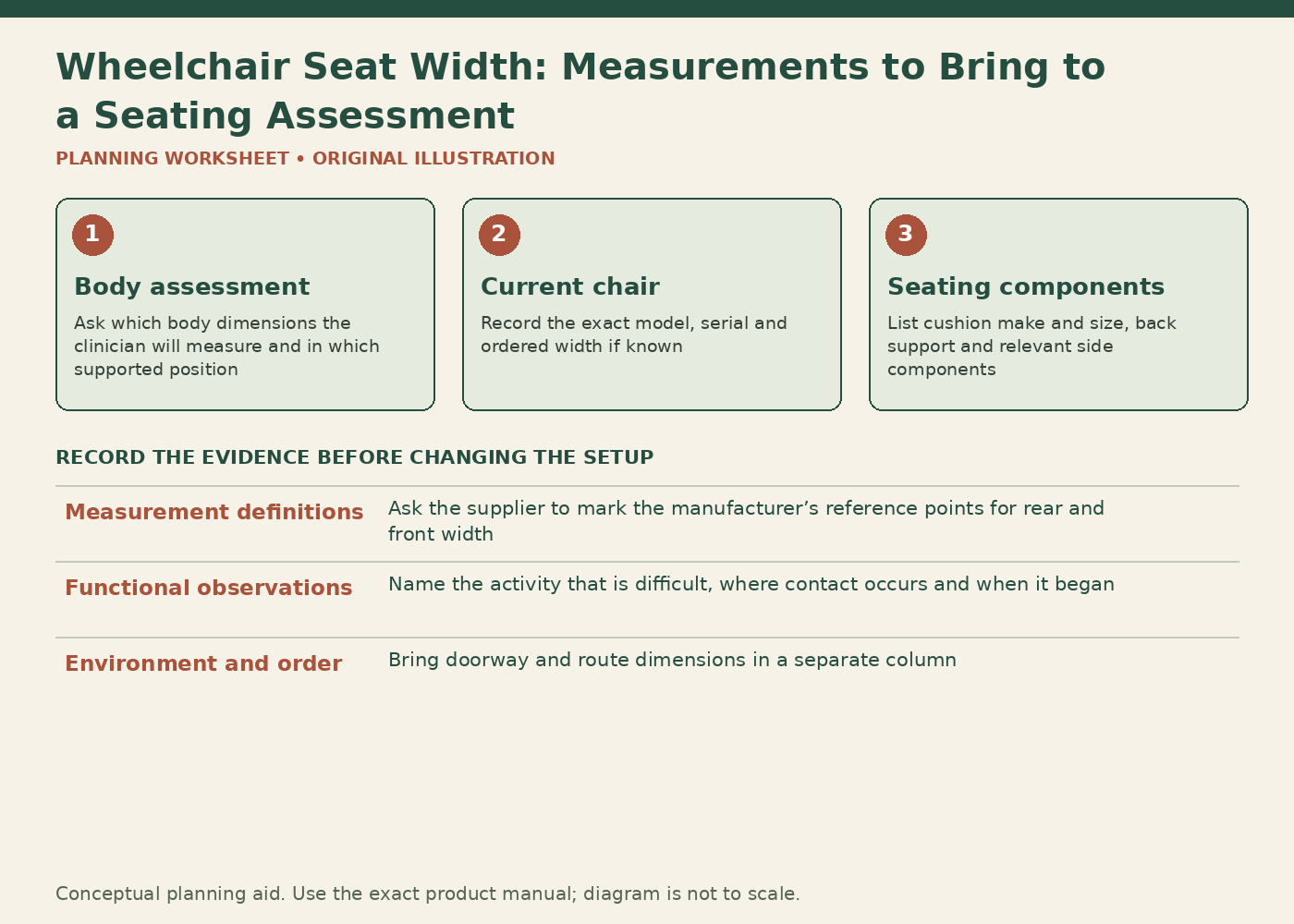
| Body assessment | Ask which body dimensions the clinician will measure and in which supported position. Bring requested clothing and equipment information. Do not use clothing size or a generic added allowance as a substitute. |
| Current chair | Record the exact model, serial and ordered width if known. Distinguish the written nominal number from any empty-chair measurement. Identify changes made since the original fitting. |
| Seating components | List cushion make and size, back support and relevant side components. Describe contact or space concerns in ordinary words. Do not trim a cushion or remove support to create an apparent fit. |
| Measurement definitions | Ask the supplier to mark the manufacturer’s reference points for rear and front width. Preserve inside-versus-outside wording and units. A similar numerical value can describe a different geometry. |
| Functional observations | Name the activity that is difficult, where contact occurs and when it began. Include access to handrims and usual work surfaces. The observation gives the assessor a task to evaluate instead of a preselected width to defend. |
| Environment and order | Bring doorway and route dimensions in a separate column. Ask for the completed chair’s overall width in the selected configuration. Confirm that any access solution preserves the assessed seating requirements. |
Worked example
A hypothetical current chair is described on an invoice as 18 inches wide, while an owner measures 17 inches between two interior surfaces. That discrepancy does not immediately prove the order was wrong. The invoice may use an outside-frame convention while the tape spans a different usable space. The owner labels both values and asks the supplier to demonstrate the manufacturer’s definition on the actual chair.
Suppose the planned replacement uses a tapered front and a different back support. Copying “18 inches” into its order form would still leave unanswered questions about front width and usable support space. The assessment team relates the person’s needs to the new design, then the supplier records the matching order dimensions. These invented numbers illustrate a documentation problem, not a recommended seat width. The useful outcome is a shared definition and a fitted complete system, not agreement on a number stripped of its measuring points.
If records come from more than one appointment, preserve their dates and conditions. A measurement taken before a cushion change or significant body-size change may not describe the current arrangement. Keep original units beside converted values, and ask the team how ordering increments affect the available choices. Rounding a body measurement to the nearest catalog size is a selection decision for the assessment process, not a clerical step to perform without discussing its effect on the completed seating system.
Sources checked November 6, 2026
Use the current document for the exact model, market and production revision. These sources establish the cited instructions and distinctions; they do not certify an individual chair or replace a personal assessment where one is needed.
- Permobil: K0005 seat width and front seat width definitions
- Permobil: Wheeled Mobility 101 measurement and assessment guide
- NSW Agency for Clinical Innovation: Wheelchair configuration and individual fit
- Permobil: The Wheelchair Handbook
Something unclear or out of date? Send a correction with this article’s title and the detail to check.
Sources, research & corrections policy ↗