Choose between upholstered and wooden dining chairs by comparing the exact seat shape, care instructions, and household routine. Upholstery can offer a softer contact surface, while an exposed wooden seat can make some everyday messes easier to see and remove. Neither material guarantees comfort or effortless cleaning. A well-shaped wood chair may suit you better than a poorly fitted padded one, and a washable upholstery system may fit your routine better than a delicate wood finish.
Compare complete chairs rather than material stereotypes
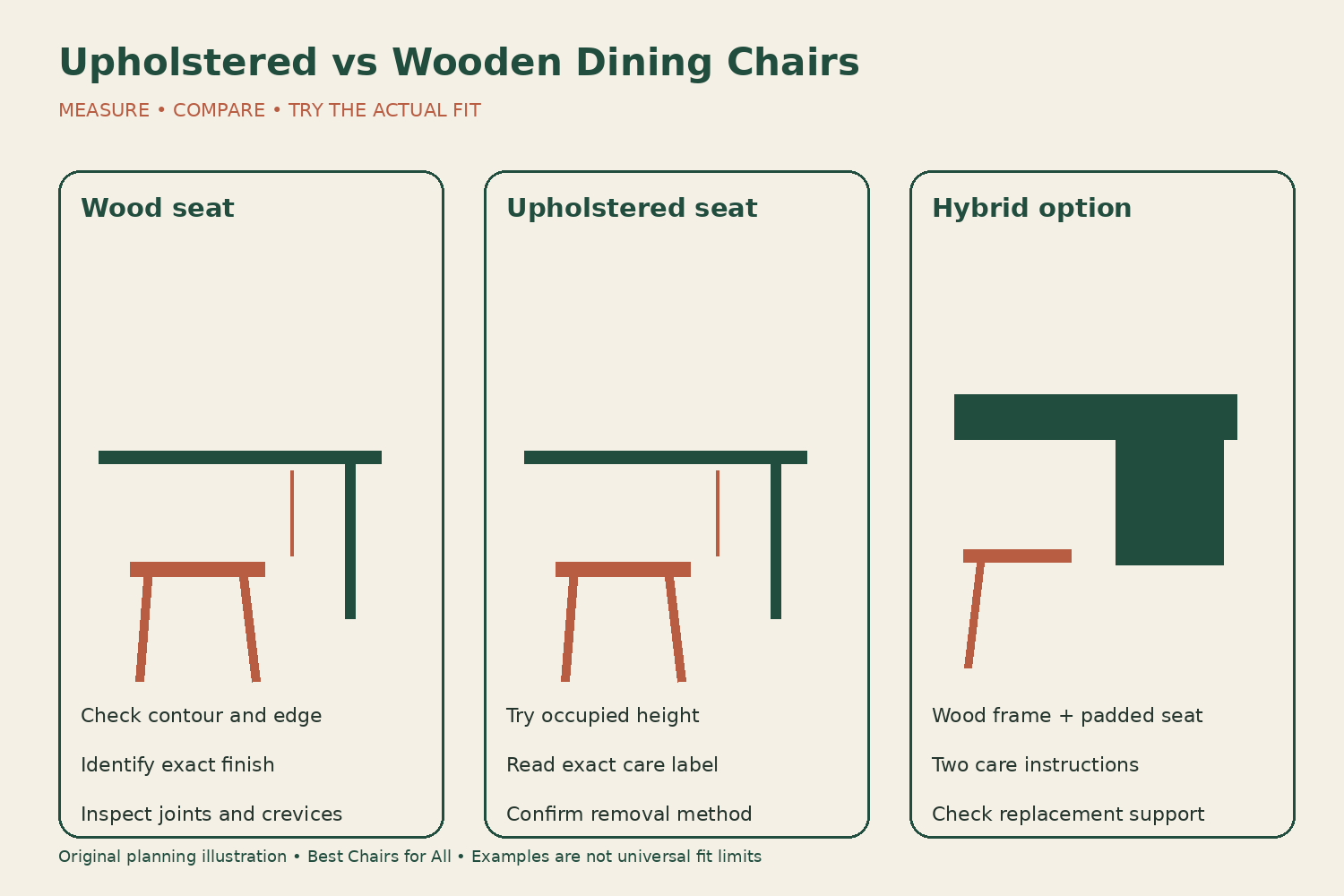
“Wooden chair” can mean a solid timber frame with an upholstered seat, a molded veneer shell, a flat plank seat, or a contoured seat and back. “Upholstered” can mean a thin attached pad, a deep padded shell, or a removable fitted cover. These constructions have different dimensions and maintenance needs. Begin by describing what you are actually comparing.
Room & Board’s dining-chair guide presents upholstered seating, contoured wood seating, and wood chairs with upholstered seats as distinct options. That middle category matters. You do not have to choose between an entirely hard chair and a fully upholstered chair if a padded seat on an exposed frame meets your needs.
Herman Miller’s Eames Molded Wood Chair, for example, uses a shaped veneer shell and offers an attached seat pad. This illustrates why the material label alone tells you little about the sitting surface. Shape, pad construction, and dimensions deserve separate lines in a comparison.
Start with fit before softness
Sit with your feet supported and your body in a normal dining position. Check whether the seat depth lets you use the back without pressure behind the knees. Notice whether the front edge is rounded, sharply defined, or hidden under padding. A soft cushion can feel inviting immediately yet leave you sliding or sitting too low once it compresses.
Compare the chair at the table height where it will be used. Padding changes occupied seat height, which changes both reach to the tabletop and room below the apron. If a wooden chair fits well and the upholstered alternative raises you several inches, their difference is not just softness. Record the changed position so you can identify the cause of discomfort.
Try the chair for an activity resembling your longest regular meal. Notice whether the back supports the place where you naturally rest or forces you forward. Do not assume that all wood seats cause discomfort or that upholstery provides a medical benefit. The useful evidence is the intended user’s experience in a realistic dining position.
Map the messes you actually have
Write down the common cleaning events in your household: dry crumbs, water splashes, greasy fingers, sauces, pet hair, or craft materials. Add who usually cleans the chairs and how quickly a spill is likely to be noticed. This simple list is more useful than buying a material marketed broadly as “family friendly” without checking its care instructions.
An exposed seat can make crumbs easy to spot, but seams, carved details, spindles, and joints still collect debris. Upholstery may catch hair and dry particles, but the result depends on the weave and construction. Inspect the whole chair, including the junction between seat and back, rather than making the comparison from a close-up swatch alone.
Consider where the chairs sit. Sunlight, nearby heat, and repeated moisture can affect materials and finishes in different ways. Ask for the manufacturer’s guidance for the exact finish or textile. A general statement about wood, velvet, polyester, or leather cannot replace instructions for a particular product with its own coatings, backing, adhesives, and dyes.
Read upholstery instructions before buying
Look for the cleaning method and any restrictions. A removable cover is not automatically washable, and washable does not mean it tolerates every wash temperature or drying method. Zippers may exist to aid manufacture rather than invite home laundering. Ask whether the cover is intended to be removed by the owner and how it should be refitted after cleaning.
A specific example shows the level of detail needed. The IKEA BERGMUND Djuparp green-blue cover has its own published care instructions, including machine washing warm and restrictions on bleach and tumble drying. Those instructions apply to that cover. They should not be copied to another BERGMUND fabric, another brand’s chair, or an upholstered seat with a fixed cover.
For a fixed upholstered chair, keep the care label and manufacturer’s cleaning guidance accessible. Check whether routine cleaning means vacuuming, specified spot treatment, or professional care. Ask what to do after an unknown spill instead of assuming a household spray, steam cleaner, or extractor is suitable. “Performance fabric” is not a complete cleaning instruction.
Identify the wood finish
The wood species and the surface finish answer different questions. A chair may have lacquer, paint, oil, varnish, or another treatment. Cleaning that is suitable for one can damage another. Ask for the finish name and the manufacturer’s recommended method. If a secondhand chair’s finish is unknown, start with identification rather than a strong cleaner or an oil marketed for all wood.
Use the least aggressive approved method and avoid leaving moisture in joints or beneath the seat. A wipeable surface is still furniture with edges, fasteners, and contact points. Do not equate cleaning with stripping, sanding, or applying polish. Those are different tasks and may change the appearance or future maintenance requirements.
Keep a sample or finish reference if the manufacturer provides one. If one chair is damaged later, a repairer can work from better information than a vague description such as “brown wood.” For chairs with upholstered seats on wood frames, preserve both care instructions. A cleaner suitable for the fabric may be unsuitable for the adjacent finish.
Think about maintenance time across a full set
Multiply the care task by the number of chairs. Vacuuming one upholstered seat may be easy; doing twelve after frequent meals may feel different. Removing, washing, drying, and refitting covers requires space and spare seating. Wiping wood frames may be quick until the design includes many spindles or detailed carving. Count the actual tasks rather than assigning each material an imaginary effort score.
A practical trial is to inspect a display chair’s underside and joints, then describe how you would clean the areas you can see. Ask whether a narrow vacuum attachment reaches the seat-back gap and whether covers need tools to remove. Do not use a showroom product as a cleaning-test surface; request a swatch or follow the seller’s approved demonstration process.
Plan for drying time if laundering is allowed. A cover that cannot be tumble dried may need an appropriate air-drying area, and a chair should not be returned to use with damp components. Keep spare covers only if they are available for the exact model and you would actually use them. Availability can change, so verify it rather than treating replacement covers as a permanent promise.
Compare repair paths
For wood chairs, ask whether glides, hardware, and finish repair support are available. For upholstered chairs, add questions about replacement covers, seat pads, and access to the upholstery. A removable seat can make some later work more manageable, but do not assume every padded chair has a seat that the owner can safely detach or re-cover.
Separate surface wear from structural trouble. A stained cover, a scratched finish, a loose seat attachment, and a cracked frame require different responses. Do not keep using an unstable chair merely because you plan to reupholster it. Cosmetic improvement does not establish that a damaged structure can carry a person safely.
Avoid predicting a service life from appearance or material alone. Two chairs with wood frames can use very different joints, and two upholstered chairs can have very different support systems. Ask for the warranty and intended-use information, but read the exclusions as carefully as the headline duration. Keep repairability as a question to investigate rather than a benefit you invent.
A household decision worksheet
Make columns for the exact wood chair, the exact upholstered chair, and any hybrid option. Record dimensions, occupied fit observations, finish or textile identity, approved routine care, approved spill response, removable components, and replacement-part information. Write “unknown” where information is missing. An unanswered cleaning question is a reason to investigate before purchasing.
Then add a weekly routine and one realistic spill scenario. For example, note how crumbs will be removed after dinner and what happens if sauce reaches both the seat and the frame. List the required supplies and drying or professional-cleaning steps only as described by the relevant manufacturer. This turns a vague materials preference into a workable ownership plan.
Finally, rank the three things that matter most to you: a comfortable meal, manageable cleanup, repair support, low visual bulk, or another concrete priority. Use those priorities to compare the worksheet. You may reasonably choose upholstered end chairs and wooden side chairs, but check fit and care for both. A mixed set creates two maintenance routines, which should be a deliberate choice.
Decide from evidence you can repeat
Order the exact finish and upholstery you evaluated. Keep the product information, care instructions, and a photograph of the underside labels. If you change cushions or covers later, repeat the fit and care checks because the finished chair has changed. A new pad can alter seat height, and a new textile can require a different cleaning routine.
The better choice is the construction that fits the sitter and the household’s actual willingness to maintain it. Softness, exposed wood, or a stain-resistance claim can help narrow the search, but none replaces a seated trial and a material-specific care plan.
For a shared household, write the approved cleaning routine where everyone can find it. Agree on who handles spills and when to seek help. Consistent, material-specific care is more useful than keeping several incompatible cleaning products beside the table.
Something unclear or out of date? Send a correction with this article’s title and the detail to check.
Sources, research & corrections policy ↗