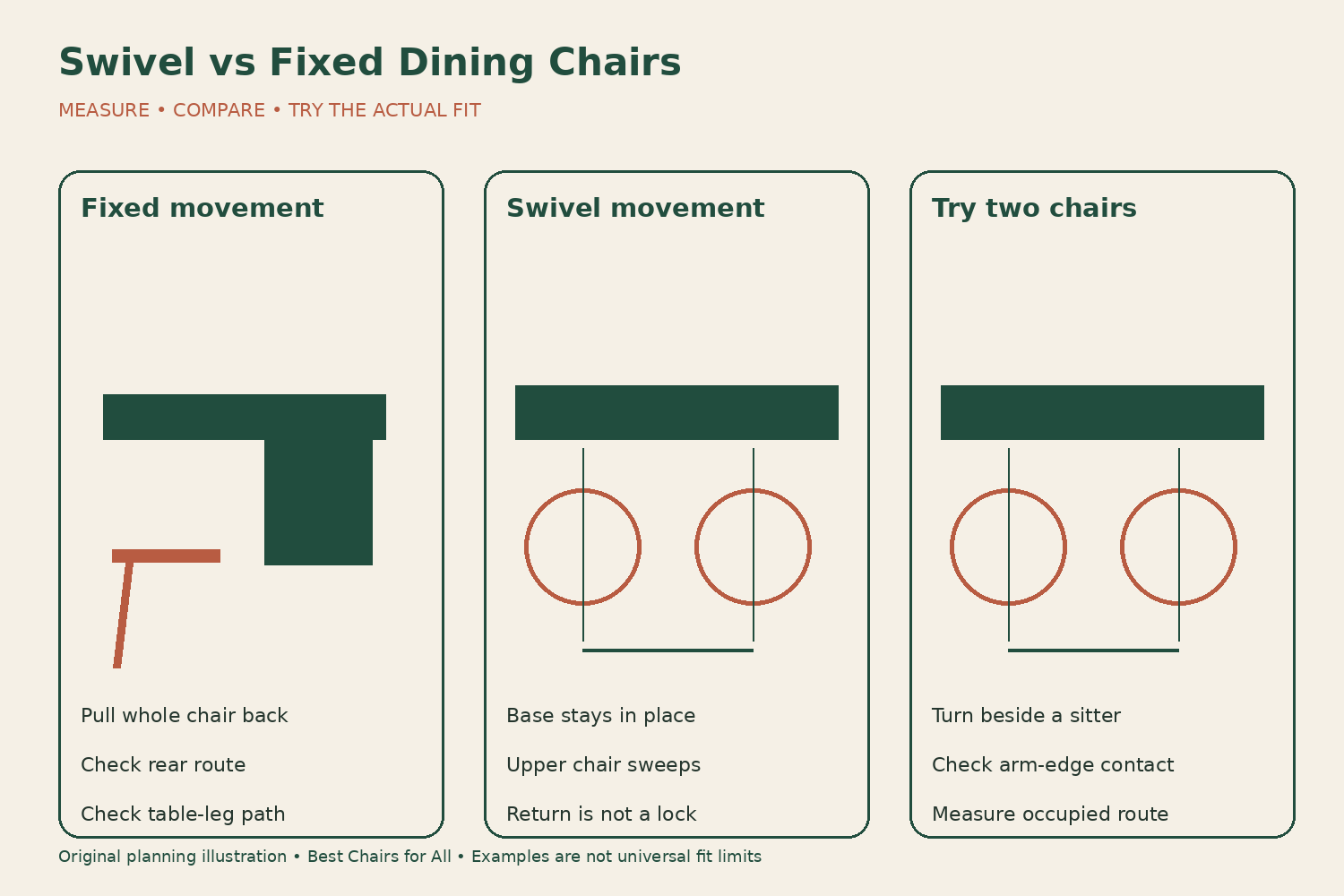
A swivel dining chair can let you turn toward the room or enter from the side while the base stays in place. A fixed chair requires the whole chair to change direction. Which works better depends on the moving seat’s clearance, the user’s preference, and the room behind the table. Compare the exact motion and footprint rather than assuming a swivel automatically saves space.
Find out what “swivel” means on that chair
A swivel may rotate through a full circle, turn through a limited range, or return toward a starting position when released. These are different functions. Ask for the model’s specified rotation and return behavior, and confirm that the ordered variant has them. Closely related versions in one product family can use different bases and mechanisms.
The Calligaris Virginia listing for Basil CS1856 180 describes an aluminum spoke base with a 180-degree swivel and return mechanism. The Anime CS2254 180 listing describes a swivel-return seat on wooden legs. These examples show that swivel is a function, not one particular base silhouette.
A return mechanism helps orient an empty chair, but it does not pull the chair toward the table, guarantee arm clearance, or hold the seat stationary for every user. Try the return action before buying. Do not assume that “memory return” means a lock, an adjustable resistance setting, or an accessibility feature unless the manufacturer specifically says so.
Draw two footprints for a swivel
The base has a stationary footprint on the floor. The upper chair has a moving envelope as the seat turns. Measure both. A compact star base can sit beneath a broad upholstered shell, and a narrow seat can have a deep back that swings toward its neighbor. Looking only at the feet misses the part most likely to contact the table edge.
Use the overall width and depth of the moving upper section, including arms and back. If a seller only supplies the entire chair’s width, ask whether that figure includes the base or the upper shell. A plan-view drawing showing the pivot is particularly useful. An offset pivot changes the space swept by the back and front corners.
For a rough geometric screen, a rectangle rotating around its center fits inside a circle whose diameter equals that rectangle’s diagonal. A 24-by-24-inch envelope has a diagonal of about 33.9 inches. This is an explanatory calculation, not a product clearance requirement. Real chair shapes, pivot positions, and rotation limits need their own assessment.
Check contact with the table
Start with the chair facing the table in its normal occupied position. Look at the arm height, the underside of the tabletop, the apron, and the edge profile. Then turn slowly through the intended entry and exit range while maintaining clearance. Stop before contact. Do not use repeated bumps to discover whether upholstery or a stone edge can withstand a collision.
An arm may clear the underside in the forward-facing position but approach the outer edge during rotation. A high back can also meet the table when turned unusually far. The important question is whether the user’s normal movement clears the actual furniture, not whether the chair can technically achieve its advertised rotation in an empty showroom.
A fixed chair needs a different check. Pull it back enough to stand, then move it toward the table as normally used. Its front legs, rear legs, or arms may contact the table structure on that path. A fixed design does not eliminate collisions; it changes the movement that creates them.
Compare entry and exit as a sequence
For a swivel, try approaching the chair, turning the seat to the preferred entry angle, sitting, and turning toward the place setting. Reverse the sequence to leave. Notice whether the seat returns unexpectedly while you are positioning yourself and whether you can control it comfortably. Follow the manufacturer’s use instructions rather than improvising a way to immobilize the mechanism.
For a fixed chair, try pulling it out and repositioning it without dragging it in a way the flooring or chair instructions discourage. A lightweight frame may be easy for one person to handle and difficult for another. Ask the intended user to try the chair. The relevant comparison is the whole sequence, not a showroom claim that one style is “easy access.”
If someone needs particular support while sitting or standing, obtain advice suited to that person’s needs. Movement that one user welcomes can feel unsettling to another. Do not promise that a swivel improves transfers, prevents falls, or replaces an assessed seating solution. Keep ordinary furniture preferences separate from clinical or accessibility requirements.
Account for neighboring people
Place two chairs in their proposed positions and seat two people. Turn one chair only through the normal movement used to leave. Check for contact between arms, backs, knees, and elbows. A pair can have a generous-looking static gap yet interfere during rotation. Testing one chair in isolation will not reveal this interaction.
At a round table, the chairs face inward from different angles. The backs may be farther apart than the front corners, or the base may create another conflict. At a rectangular table, an end chair and the nearest side chair can compete near the corner. Test these pairs specifically instead of copying the spacing of chairs along a straight side.
Room & Board’s dining-chair guidance asks shoppers to consider table-leg spacing and the room between chairs and table legs. With swivels, extend that assessment to the moving upper section. A table opening wide enough for the base does not establish clearance for the turning chair.
Test the occupied walking route
Arrange the chairs where they will actually be used, then assess the route behind them. Check a passage to the kitchen, a doorway, and nearby storage. The space behind an empty chair tucked neatly under the table differs from the space behind someone eating or leaving. Measure the configuration that matters to daily movement.
A swivel can reduce how far some users need to pull a chair back, but that is an observation to verify, not a guaranteed space saving. The upper chair still turns into the room, and the person’s legs need somewhere to go. A fixed chair with a smaller overall footprint may sometimes suit a narrow route better than a broad swiveling shell.
Keep cabinetry doors and drawers in the trial. If a sideboard can open only while diners stand, decide whether that tradeoff is acceptable for the household. Do not judge circulation by one numerical rule without checking the activity. Your route must remain usable under the real combination of people, furniture, and doors.
Consider floors and moving parts
A swivel does not remove the need for appropriate glides or floor protectors. The base can still move during use and must be repositioned for cleaning. Inspect the contact points and ask whether replacement parts are available for the exact base. Keep the floor and protectors free of grit according to the relevant care instructions.
Read the assembly and maintenance instructions for the swivel mechanism. Ask which visible fasteners, if any, the owner should check and how often. Do not lubricate, dismantle, or tighten an enclosed mechanism based on generic advice. An unexpected scrape, looseness, or return-action change should be reported to the manufacturer rather than concealed with an improvised adjustment.
A fixed chair has fewer motion functions to evaluate, but it still has joints, seat attachments, and floor contacts. Compare the actual maintenance requirements rather than assuming “fixed” means maintenance-free. A well-documented replacement glide or hardware path is more useful than a vague promise that either type will last indefinitely.
A swivel-versus-fixed trial sheet
Write down the exact candidates and their seat dimensions first so you do not attribute a deeper seat’s effect to the swivel. Record the base footprint, moving upper width and depth, arm height, rotation limit, return action, and any stated lock. For a fixed chair, mark the motion-related fields as not applicable rather than inventing equivalent scores.
Record four observable results for each: independent entry, table contact risk during normal movement, interference with a neighbor, and route behind the occupied chair. Use short descriptions. “Arm passes the edge when leaving to the left” is useful; “space saving: yes” is too broad to explain what happened or whether another person can repeat it.
Add a maintenance row listing the approved care source, accessible parts, and service contact. Save the dimensional drawing for the selected base. If the seller changes the base or offers a similar substitute, repeat the clearance assessment. A familiar seat shell does not ensure the pivot, height, and footprint remain identical.
Choose for the movement you use
A swivel is a strong candidate when turning is a useful part of everyday dining and the full motion fits the table and room. A fixed chair is a strong candidate when its simpler movement suits the user and the pullout route is clear. Neither decision should depend solely on how the chairs look when everyone has left the room.
Before ordering a full set, confirm the precise base and motion variant on the invoice and retain the return conditions. Trial the delivered chair in the intended position, with a neighboring seat if possible. The best evidence is a repeatable, comfortable sequence of arriving, eating, turning or pulling back, and leaving without interference.
Pay attention to conversations away from the table as well. If a chair faces a living area or window, check whether turning for that view moves its back into the next diner. A swivel chosen for an open-plan room should be assessed in that ordinary conversational position, while people and furniture occupy their usual places.
Something unclear or out of date? Send a correction with this article’s title and the detail to check.
Sources, research & corrections policy ↗