A swivel recliner turns the seat toward different parts of a room. A stationary recliner keeps its base orientation while the back and footrest move. The swivel can make a television-and-conversation layout more convenient, but it also expands the area you must keep clear. Decide by drawing the chair’s movement and access routes, not by comparing the diameter of its base with the width of a stationary chair.
Stationary does not always mean motionless. A non-swivel chair may still rock, glide, or move forward while reclining. Confirm exactly which movements each candidate offers. The practical question is whether the permitted movement helps the way you use the room while preserving a workable route to and from the seat.
Identify the actual base configuration
A collection may be sold with several bases, including swivel glider, rocker, and wall-saving versions. Ask for the complete product code and the mechanism configuration. Save that information with the dimension sheet. Otherwise, a measurement taken from a stationary showroom chair can accidentally be applied to a swivel version ordered in a different upholstery.
Best Home Furnishings’ Comfort Sync page describes distinct base choices and different space implications. This is a useful reminder that the upholstery silhouette does not define the operating footprint. Ask whether the swivel remains available when reclining and whether the model has travel limits, a return feature, or other operating restrictions.
Draw the views you want to reach
Sketch the room from above and mark the television, main conversation area, window, and reading light. Draw a line from the proposed chair position toward each. If all useful activities face roughly the same direction, a swivel may add little. If a chair needs to face a screen in one direction and a sofa in another, the turning function may serve a clear purpose.
Do not add a swivel simply because the room contains several focal points. Consider whether the controls, table, and light remain usable after turning. A chair that faces the conversation but leaves its reading lamp behind the back can create another reach problem. Record the intended daily orientations rather than designing for every theoretical angle.
Map the swept area of the upholstered chair
The turning envelope includes the projecting arms and back, not just the circular base. An upholstered rectangle rotating around a center reaches farther at its corners than at the middle of its sides. Ask the retailer for the model’s operating-space drawing or help identifying the turning center. A simple floor outline can then show which walls and tables need to remain clear.
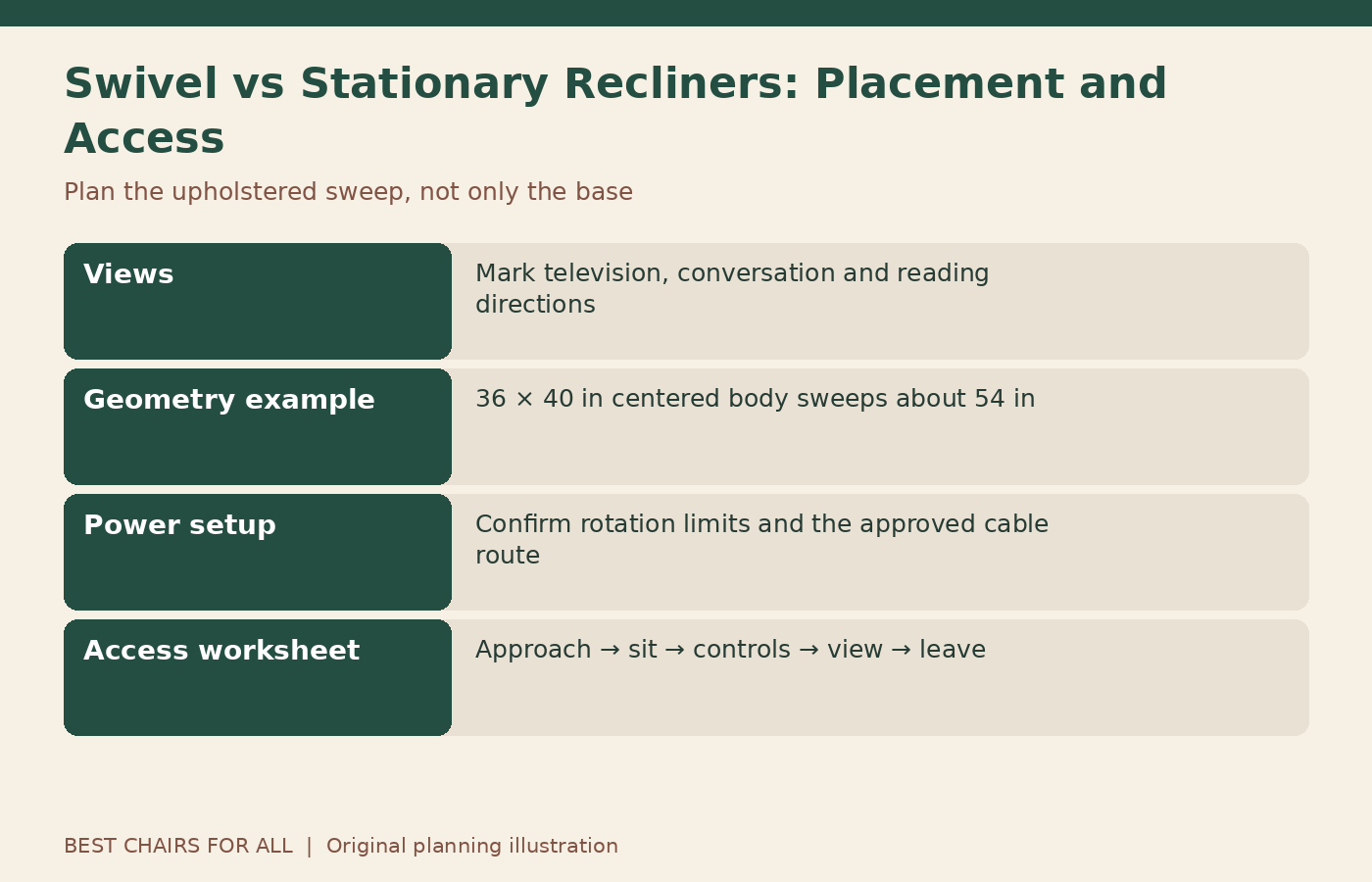
For an illustrative upright rectangle 36 inches wide and 40 inches deep, centered evenly on its turning point, the corner radius is about 27 inches: half the diagonal. A full rotation would therefore sweep a circle about 54 inches across. Real chairs may have offset pivots and irregular shapes, so use this calculation to understand the issue, not to specify an actual installation.
Add reclining movement to the rotation plan
A swivel recliner’s footrest can create a much larger projection than its upright arms. The permitted turning range while reclined must come from the manufacturer. Do not rotate a chair into a table to discover whether its footrest fits. Have the seller demonstrate the approved sequence in a clear area, then translate that movement to your room drawing.
La-Z-Boy’s recliner guide describes gliding recliners with swivel movement separately from non-rocking recliners. That product grouping is not a universal clearance rule. When the chair both glides and turns, include the combined permitted motion. An upright full-turn specification does not establish that every orientation is usable with the footrest extended.
Compare a stationary placement fairly
Place a stationary candidate on the same room sketch at its best useful angle. It may be possible to aim it between the screen and sofa so that neither activity requires much turning. Alternatively, the compromise angle may make television viewing uncomfortable or force someone to twist toward conversation. Test the proposed orientation with an ordinary chair before judging it from the drawing alone.
Include the stationary chair’s full recline and any rocking or wall-away movement. A stationary base is often simpler to plan, but it does not automatically occupy less front-to-back space. Compare complete operating envelopes. Use the manufacturer’s stated rear gap and the correct reference points when adding wall clearance to published reclined depth.
Use an access-first placement worksheet
Make five rows: approach the chair, sit down, reach controls, use the intended view, and leave the chair. For each row, describe the room condition when the action happens. Is the chair facing forward or toward the sofa? Is the footrest closed? Is a table nearby? Does another person need to stand beside it? Write the actual household arrangement instead of only labeling the layout spacious.
Next to each action, mark Works, Needs adjustment, or Unresolved. A swivel layout can pass the view test yet fail the approach test if the seat regularly faces a narrow gap. The worksheet shows which furniture to move or which specification to obtain. It also prevents a convenient turning feature from outweighing an unresolved access problem.
Give tables a specific job and position
A small table should be reachable without entering the chair’s moving envelope. Check both its top and its base. A pedestal foot can sit where the footrest travels even if the tabletop appears well clear. If the chair changes direction, decide whether the table will serve one main orientation or whether a different arrangement is needed.
Avoid planning to drag the table around while seated. That can pull cords, spill drinks, or place an object in the chair’s path. Instead, test a fixed table position and the permitted chair movements around it. If a stable, useful position cannot be found, the room may be better suited to a stationary chair or a smaller swivel design.
Treat cord routing as part of swivel selection
A power recliner adds a cable route between the chair, transformer, and outlet. Ask how the selected model accommodates rotation and what limits apply with its supplied power system. Do not assume that a 360-degree swivel description authorizes repeated turns that wind a cord around the base. The manufacturer’s installation and operating instructions control the answer.
Keep the cord away from footpaths, moving metal parts, and furniture legs that could trap it. A rechargeable pack may be offered for certain models, but compatibility and charging instructions need verification. It does not turn a chair into a universally cordless product. Include the pack’s placement and service access in the plan if it is part of the approved setup.
Check the floor and installation conditions
Confirm that the proposed floor meets the model’s requirements. A rug edge, uneven tile, or a flexible mat can affect how the base rests. Ask about approved floor protection rather than adding an improvised board or riser. If the chair feels unstable, stop using it and have the installation checked rather than trying to cure the feeling by tightening unknown hardware.
Best’s care and maintenance library separates customer information and model-specific service resources. Use the matching instructions for your chair and involve the retailer where needed. A general furniture article cannot establish which fasteners, bearings, or stops should be adjusted on an unidentified swivel mechanism.
Consider who will use the turning feature
Try normal sitting and standing with the provider’s guidance. Some people enjoy a seat that changes direction easily; others prefer a base that stays oriented during access. If a user has balance concerns, needs transfer assistance, or follows a care plan, seek individual advice rather than treating either base category as inherently suitable. A swivel feature is a furniture function, not an assessment of personal safety.
For shared use, have each main user try the chair. Differences in body size and control reach can change the experience. A taller person’s comfortable table position may be difficult for a shorter user to reach after turning. Record these differences on the worksheet and decide whether the room can accommodate them without repeated furniture rearrangement.
A two-layout comparison exercise
In Layout A, a swivel chair faces the television, then turns toward a sofa across the room. The taped turning envelope overlaps a floor lamp, but moving that lamp leaves a clear approach and keeps the outlet route accessible. In Layout B, a stationary chair is angled between the two views, leaving more predictable space beside a small table but requiring the user to turn their head toward the sofa.
Neither layout is automatically better. Try the activities in each arrangement and write the tradeoff in one sentence. For example: swivel improves conversation and requires a relocated lamp; stationary preserves the table arrangement but compromises the second view. This small documented comparison is more useful than saying one chair feels more versatile.
Verify the finished layout after delivery
Before ordering, confirm the exact swivel range, operating restrictions, full reclined dimensions, wall clearance, power arrangement, and delivery-piece sizes. Keep the manual and model code with your plan. Ask about return terms if fit or access remains uncertain, especially for a custom upholstery order. Do not treat an approximate online dimension as a guaranteed installation drawing.
After installation, check the approved movements with surrounding furniture in its final position and everyone clear of moving parts. Recheck access when the chair is facing each intended direction. Photograph the layout and retain the measurements for future cleaning or rearrangement. The best placement makes the swivel useful while keeping everyday approaches, controls, and room routes easy to understand. If you change the room later, repeat the checks rather than assuming the original approval covers a new table, rug, power location, or chair orientation.
Something unclear or out of date? Send a correction with this article’s title and the detail to check.
Sources, research & corrections policy ↗