A swivel accent chair changes direction while its base stays in place. A stationary chair keeps its seat aligned with its feet or fixed base. The swivel can help connect a conversation area with a window or television, but it needs a clear turning envelope. The stationary version offers a predictable orientation and can be easier to place close to other furniture.
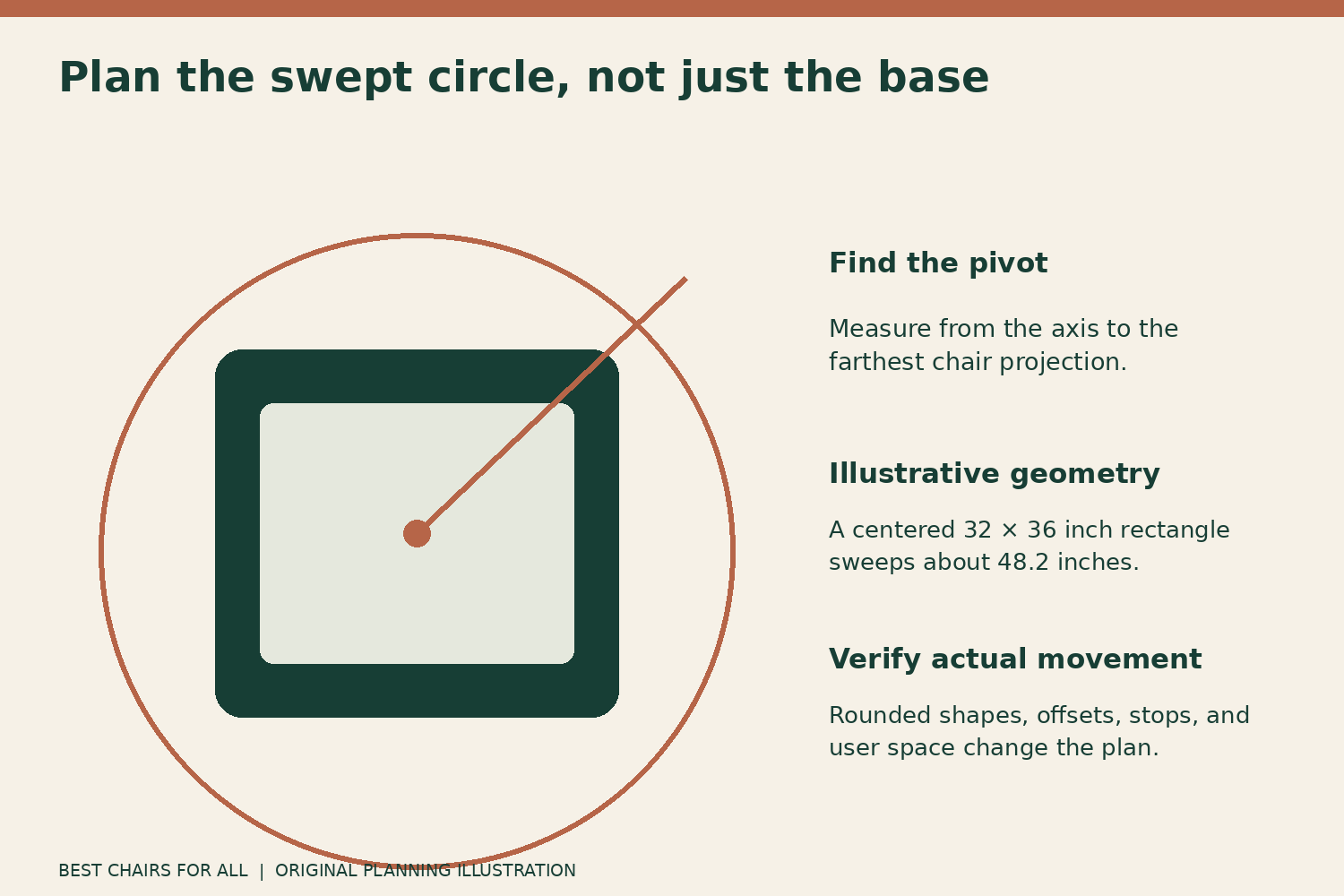
Compare the whole moving chair rather than the base diameter. An arm, back corner, or projecting cushion can sweep much farther than the support beneath it. Start with the directions you want to face, then measure the path the chair takes between them. That reveals whether the swivel solves a real room problem or adds motion you will rarely use.
Decide which directions actually matter
Sketch the chair’s proposed location and mark the activities around it: talking to the sofa, watching a screen, looking out a window, or reading beside a lamp. Draw a line from the chair toward each activity. If the directions are nearly the same, a stationary chair may already serve them well without requiring a rotating base.
If the directions differ substantially, a swivel can let the user reorient the whole seat rather than repeatedly turning the torso. That is a practical observation, not a medical benefit claim. Test the motion with the intended user, because some people prefer a seat that remains still while sitting down, standing, or reaching for a table.
Do not assume swivel means full rotation. Check the model’s stated range and whether it has a return mechanism, stops, or other controls. A chair that returns toward a starting position behaves differently from one that remains where you leave it. Ask the seller if those details are not explicit in the instructions.
Separate motion from seat size
Swivel chairs span a wide range of sizes. IKEA’s DYVLINGE in Kelinge orange is listed at 24¾ inches wide and 29½ inches deep. Those outside dimensions are much smaller than some lounge-style swivel seats, so it would be misleading to call swivels universally bulky or compact.
At the other end of the scale, Room & Board’s listed Eos swivel chair configuration measures 51 inches wide and 51 inches deep and specifies 360-degree swivel. Its dimensions illustrate why motion and size must be checked independently. This is a comparison of documented examples, not a recommendation that either suits every room.
Also compare usable seat width, seat depth, and seat height. A chair that turns conveniently can still leave your feet unsupported or its back too far away. If a collection offers both swivel and stationary versions, request the dimensions for each exact version. A different base can change seat height or outside proportions even when the upholstery looks similar.
Measure the turning radius from the pivot
The turning radius is the greatest horizontal distance from the swivel axis to any part of the chair. That point might be a back corner, an arm, or a front cushion edge. If the chair can rotate fully, the outermost point traces a circle around the axis. The diameter of that circle is twice the maximum radius.
A centered rectangular envelope gives a useful conservative calculation. For a hypothetical chair 32 inches wide and 36 inches deep, with the pivot exactly at the rectangle’s center, the corner radius is the square root of 16 squared plus 18 squared, or about 24.1 inches. The enclosing circle is therefore about 48.2 inches in diameter.
This is an original geometry example, not a manufacturer clearance. It assumes a centered pivot and a rectangular outer envelope. A rounded chair may occupy less of that circle; an off-center pivot may require more room on one side. Verify the actual pivot location and manufacturer’s requirements before using the calculation in a room plan.
If the axis is offset, measure directly from it to the farthest points or ask the manufacturer for a planning drawing. Do not simply divide overall width by two. A chair that extends farther behind its axis can sweep into a wall even when its front clears a table comfortably.
Use a swept-path worksheet
Record the following information for each candidate. For a stationary chair, the parked outside dimensions and approach route may be enough. For a swivel, complete the motion entries as well. Leave uncertain values marked unknown; an unverified pivot position should not become a precise-looking room clearance.
| Worksheet field | What to write | Why it matters |
|---|---|---|
| Parked envelope | Overall width and depth | Initial position in the room |
| Pivot location | Confirmed center or measured offset | Reference for the turning radius |
| Rotation range | Actual permitted degrees or stops | Which path the chair can sweep |
| Farthest projection | Arm, back, cushion, or other point | Potential collision point |
| Nearby objects | Table, wall, lamp, curtain, footstool | Clearance through the whole movement |
| User movement | Feet placement and standing route | Occupied use beyond furniture geometry |
Transfer the largest verified swept outline to the floor with painter’s tape. Then add the side table and lamp base. Use boxes at arm height to reveal collisions that a floor outline misses. A lamp may clear the base but meet the chair’s upper back, while a low table may sit beneath one projection and collide with another.
Test the occupied motion
With the chair correctly assembled, sit normally and turn through the directions you plan to use. Keep the area clear and avoid rapid spinning. Notice whether you can start and stop the movement comfortably, whether your feet have room, and whether the seat drifts when you expect it to remain oriented toward the book or conversation.
Now put down the book and stand. A swivel chair can turn as weight shifts, depending on its design. If that feels inconvenient or uncertain for the intended user, compare a stationary alternative. Do not attempt to lock a swivel with a wedge, tighten an unspecified component to create resistance, or alter the base to imitate a fixed chair.
Manufacturer assembly guidance remains model-specific. IKEA’s DYVLINGE assembly instructions show the intended components and assembly sequence for that design. Use the exact manual supplied with your chair; a visually similar rotating seat may have a different attachment system and service requirements.
Include footstools and tables in the comparison
A separate ottoman does not automatically rotate with the chair. If your feet remain on it while the seat turns, the leg position changes. Try the complete setup and decide whether the ottoman needs to be moved when changing direction. A swivel chair may offer less useful flexibility once a large footstool occupies the area in front.
Side-table placement needs the same thought. A table conveniently beside a stationary arm can end up behind the reader after rotation. A small table positioned outside the swept envelope may work for more than one direction, but reach it during a realistic trial. Do not place a drink where an arm or back could knock it while turning.
For a shared conversation area, consider what the chair looks like when facing away. A swivel used toward a window may leave its back facing the sofa until someone reorients it. That may be perfectly acceptable, but it differs from a stationary chair whose appearance and relationship to the group remain predictable.
Check the floor and base relationship
The rotating mechanism and the floor-contact surface are different parts of the chair. Inspect the specified feet, glides, or base ring and confirm that they suit the floor according to the manufacturer. Do not assume that a swivel will scratch less because the base stays still; grit, shifting, or damaged contact surfaces can still cause trouble.
Keep the entire support on a suitable level surface. A rug edge beneath only part of a base can change how the chair sits, and a thick rug may interact differently with a low upholstered skirt. Follow the model’s instructions rather than adding stacked pads or modifying feet to compensate for an uneven placement.
If motion becomes rough, noisy, or unstable, stop and consult the manufacturer or an appropriate service professional. Clear visible loose objects only where safe and accessible. Do not disassemble a swivel mechanism, powered function, or pressurized component based on generic online advice. A stationary chair also needs sound joints and feet, but it avoids the additional rotating assembly.
Choose the motion that earns its space
A swivel is worthwhile when the change of direction is useful, the complete swept path fits, and the intended user likes the way it moves during ordinary activity. A stationary chair is a strong choice when the room has one main focal direction or when a consistently still seat and compact placement are more valuable.
Keep the worksheet with the floor plan and exact model information. Resolve missing pivot or motion details before buying a close-fitting chair. The right comparison is not between a moving chair and a static rectangle; it is between two complete seating arrangements, each with its own usable seat, surrounding objects, and everyday movement.
For two swivels, test both chairs at once
Two individually clear turning circles can still produce an awkward arrangement when the users face different directions. Draw both swept envelopes on the same plan and identify any overlap. If the furniture bodies can enter that overlap, the chairs may collide when turned simultaneously. Move their centers farther apart or choose a different shape rather than relying on everyone remembering an invisible stopping point.
Also place the shared table on that combined plan. A table centered between the parked chairs can fall inside one or both turning paths. Check the table at its actual height and include projecting tops, handles, or lamp shades. Finally, have both users rehearse standing at the same time. Their exit routes may compete for space even when the chair bodies remain clear.
Something unclear or out of date? Send a correction with this article’s title and the detail to check.
Sources, research & corrections policy ↗