A bleacher cushion changes the surface under you; a folding backrest adds a structure behind you. Many products combine both, but the distinction matters when deciding what to carry and what a venue will admit. If your main complaint is a hard bench, a simple pad may answer it with little setup. If you want a place to rest your back, compare the backrest’s shape, adjustment, footprint, and attachment rather than assuming extra foam provides the same function.
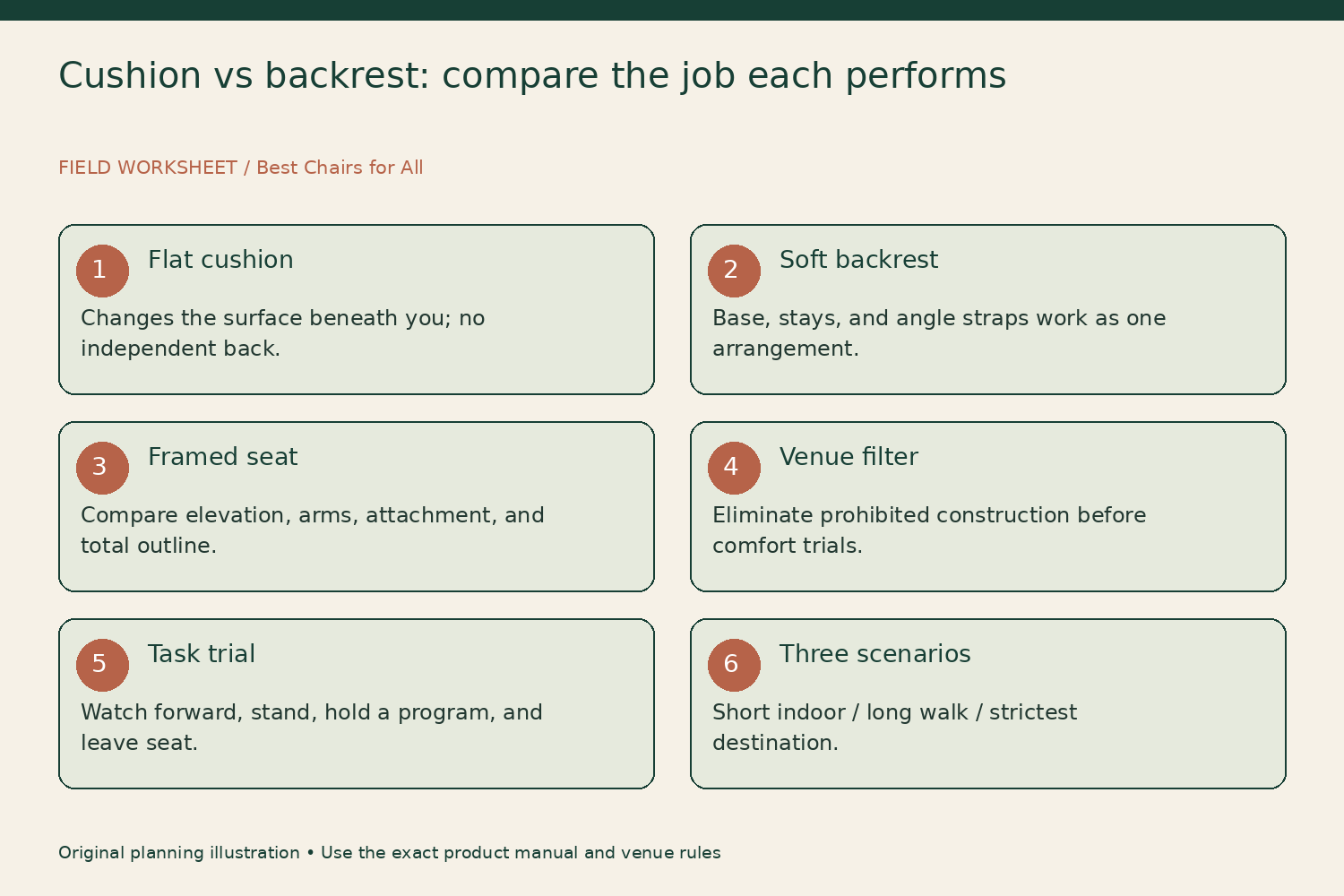
Neither category guarantees comfort for every person or treats a medical condition. The practical choice depends on the bench, event rules, walking distance, clothing, and how you prefer to sit. The comparison below uses a task worksheet rather than a universal winner. It also separates a soft folding ground seat, a framed stadium chair, and a flat cushion, because their similar shopping names can conceal quite different arrangements.
Decide which problem you are solving
Write a one-sentence description of the problem before looking at products. Examples include ‘I want a barrier between me and the bench,’ ‘I want a backrest while watching a long event,’ or ‘I need the smallest permitted item for a distant parking lot.’ These are different goals. Listing them in priority order prevents a large feature list from drawing you toward a chair that does not address your main constraint.
Add the conditions in which the problem occurs: indoor bleacher, outdoor bench, winter clothing, summer heat, frequent standing, or a crowded row. A thick pad that feels comfortable at a kitchen table may alter your position differently on a shallow bench. A reclining backrest that works on open ground may occupy too much rearward space in stadium seating. The location is part of the comparison, not an afterthought.
Understand the flat cushion
A flat cushion provides a layer between your body and the bench without creating an independent back support. Compare its usable width and depth, compressed feel, surface texture, carry arrangement, and care instructions. A handle or storage pocket may matter to both transport and venue admission. Do not infer a thermal rating from the words ‘insulated’ or ‘foam’ when the maker does not provide one.
A thin pad may be easy to hold while navigating stairs and easy to place within a narrow allocation. A thicker cushion can change the effective seated height, particularly when it does not compress much. Check that your feet and balance feel appropriate on the intended seating arrangement. Do not stack loose pads into a tall pile to imitate a raised seat; that creates a different, undocumented setup.
Understand the soft folding backrest
A soft folding seat commonly joins a padded base to a back panel and uses side straps or stays to hold a selected angle. Its support comes from the entire arrangement, not a freestanding legged frame. Identify whether straps adjust the back angle, hold the chair folded, or attach it to a bench. Their presence alone does not prove that the seat is secured to the bleacher.
The Crazy Creek Original Chair is a useful named example: the manufacturer describes closed-cell foam, support stays, and adjustable side straps. These features explain how the design differs from a simple pad. Its maker’s instructions and the venue’s rules still govern where and how it can be used. A ground-chair description is not automatic permission to install it on every stadium bench.
Understand the framed stadium chair
A framed chair can elevate the seating surface above the bench and provide a more defined back structure. Some add arms, an attachment hook, or a recline mechanism. Compare the total open footprint and weight, not just the seat’s softness. The space below the fabric, the position of the backrest, and the attachment arrangement all affect how the chair sits on a bleacher.
For example, the GCI Big Comfort Stadium Chair with Armrests describes an elevated frame, molded arms, and an L-hook for open-front bleachers. Those are functional differences from a flat pad. They also create additional fit and policy checks. The same features can be useful at a permissive local venue and disqualifying at a venue that limits width or forbids arms.
Make venue permission the first filter
Do not compare padding thickness among chairs that your destination excludes. The 2026 Michigan Stadium safety policy permits specified simple pads and cushions while prohibiting seat backs, arms, metal, and other listed features. At that venue, the distinction between a cushion and a folding backrest has an immediate practical consequence. Check the current official policy for your own event rather than generalizing from this example.
Write the permitted construction and features on your worksheet. If the venue uses vague language, send photographs and dimensions to guest services before buying. Ask specifically about a backrest, frame, attachments, pockets, and carrying bag. A product name or photograph on a retailer’s ‘stadium seating’ page cannot resolve those questions. Keep the reply associated with the event date because policies can change.
Compare your sitting position
Try the permitted candidate on an appropriate surface using its instructions. With a cushion, note the feel at the front edge, whether it slides, and whether its depth matches the bench. With a backrest, note where the panel meets your back, whether its width feels restrictive, and whether the selected angle encourages the position you actually want to use while watching the event.
Check upright tasks as well as relaxed sitting: looking forward, holding a program, standing, and letting someone pass. A deep lounge angle may feel pleasant during a brief trial yet be impractical while watching play or sharing a crowded row. Record your observations in ordinary language rather than assigning a medical-sounding posture score. Personal fit is evidence about your preference, not a universal ranking.
Measure what the backrest occupies
For a cushion, record its outline on the bench. For a folding backrest, add the highest and farthest rearward points in the permitted use position. For a framed chair, include arms, hinges, and attachment projections. Draw each footprint on the same scale so the comparison shows what your neighbors and the next row will experience, not just how much sitting surface you receive.
In a hypothetical comparison, Pad A occupies sixteen by twelve inches, while Backrest B occupies seventeen by fifteen inches before any recline projection. The extra outline is not necessarily a problem, but it must fit the actual allocation and bench. These illustrative measurements do not represent any named model. Replace them with manufacturer data and your venue’s dimensions before making a purchase decision.
Compare the complete carrying package
Weigh and measure the item as you will carry it, including its bag and any permitted accessories. A flat pad can be light but broad; a framed seat can fold compactly in one direction yet remain awkward in another. Carrying handles, a shoulder strap, or backpack straps change how your hands are available on the walk and stairs. Compare actual carried shape instead of relying on the word ‘portable.’
Picnic Time’s Ventura seat page describes fold-flat transport and adjustable backpack straps. That is a different transport arrangement from holding a cushion by a small handle. It also illustrates why packed dimensions deserve their own line: a product can be thin when flat but still wide and long. Recheck the bag policy separately if you plan to enclose it in a carrying case.
Examine the care burden
A simple pad may have an exposed washable surface, while a folding backrest can include foam, stays, seams, buckles, and pockets. Read the exact cleaning instructions before deciding that one is easier to maintain. Do not assume water resistance means immersion is allowed or that a removable-looking fabric panel can be machine washed. Care methods belong to the identified product and materials.
After a wet event, inspect the bottom and folds rather than packing the seat away immediately. Follow the drying and storage guidance for that model. If your routine involves frequent rain, consider how easily you can carry the wet object home and dry it between events. That ownership task can matter more than a small difference in packed size, particularly when several family members use seats every weekend.
Use a task-based comparison table
Create rows for bench barrier, desired back support, venue admission, seat allocation, row clearance, carrying method, wet-weather handling, and setup effort. Give each candidate a short evidence-based note in every row. For a pad, ‘no backrest’ is a feature description, not a fault. For a framed chair, ‘requires documented attachment fit’ is a real task rather than a vague disadvantage.
Then test three scenarios on paper: a short indoor match, a long outdoor event with a distant walk, and your strictest destination. A single product may serve all three, or two simple items may work better across your schedule. Do not average away a failed admission or attachment requirement because another scenario looks attractive. Essential compatibility conditions are gates, while softness and carrying preferences help decide among the options that remain.
Choose the function you will actually use
Select a cushion when the primary goal is a permitted layer on the bench and you do not need an independent backrest. Select a folding backrest only after its structure, angle, footprint, and attachment match the intended location. A combined product can offer both functions, but it brings its combined dimensions and care requirements with it. More features do not automatically improve the fit for a specific event.
Keep your comparison notes after buying and revise them after an ordinary permitted use. Note whether you used the backrest, how the carry method worked, and whether setup consumed space you had overlooked. These observations help you decide what to bring next time without pretending to have conducted a universal comfort test. The right bleacher setup solves the stated problem within the real limits of the event.
Something unclear or out of date? Send a correction with this article’s title and the detail to check.
Sources, research & corrections policy ↗