A stadium chair with arms fits a bleacher only when its outside width, usable seat space, attachment, and front-to-back position all work together. The seat cushion’s width alone cannot answer the question. Arms can project into a neighbor’s allocation, hinges can extend beyond the frame, and a chair that fits a bench physically may still be prohibited by the venue. Make a scaled footprint before buying so you can separate these different constraints.
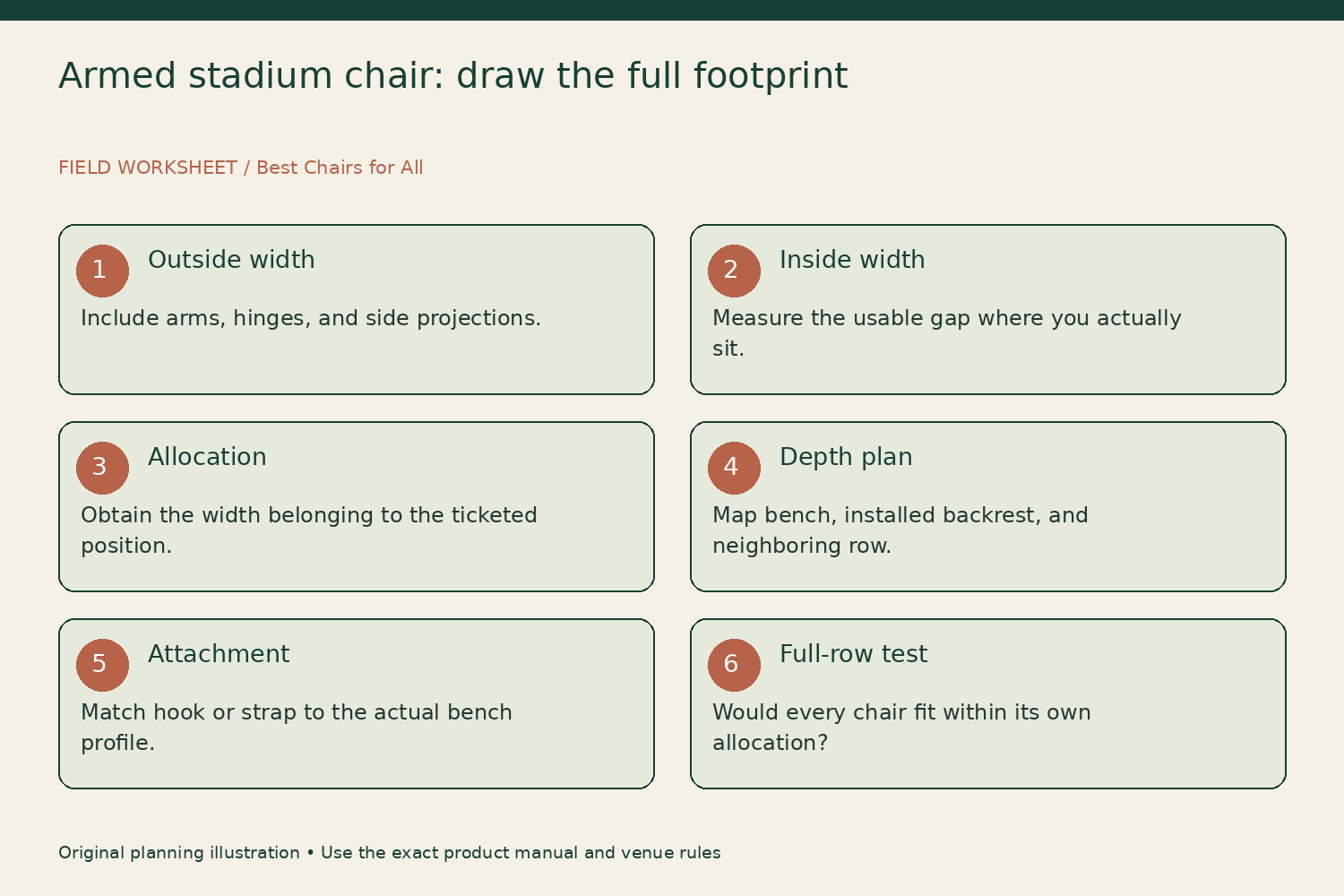
The most useful measurements are the chair’s overall open width, the clear width between its arms, its installed depth, and the dimensions of the bleacher location. This guide explains how to collect them and builds a worked paper comparison. The example dimensions are deliberately hypothetical unless linked to a named product. They show a method, not a claim that a particular stadium gives every spectator the same amount of space.
Check whether arms are permitted at all
Read the official event policy first. At Lambeau Field, for example, the Packers carry-in policy excludes stadium seats with armrests and describes other seat restrictions. At Michigan Stadium, the current safety information also prohibits armrests as part of its more restrictive cushion rules. Neither example becomes a rule for your local school, racetrack, or other event.
If arms are prohibited, a model that folds them away may still contain a prohibited feature. Do not assume that arriving with the arms inverted changes the venue’s classification. Send the actual configuration and model information to guest services if the policy is unclear. A favorable product label such as ‘stadium seat’ or a team logo does not establish that a chair is admitted to the team’s own venue.
Distinguish three different widths
Overall width is the distance between the outermost points of the open chair. Clear seat width is the usable gap between arms or side supports. Allocated width is the space associated with your bleacher position. Record all three with units and labels. Calling each of them ‘seat width’ hides the exact mismatch you are trying to discover.
For your own chair, measure the outside of the arms and any projecting hinge separately, then keep the largest number as overall width. Measure the gap where your hips and clothing actually sit, not just the widest part near the armrest tops. A chair can be generous outside and restrictive inside. If buying online, request both dimensions from the manufacturer when the listing supplies only one.
Use the current model's specifications
The GCI Big Comfort Stadium Chair with Armrests page lists 22.8 inches of open width and a rotating L-hook for open-front bleachers. That makes the outside dimension and bench type explicit. It does not establish the allocated width of your seat, nor does it approve use at a venue that forbids arms. Treat the manufacturer specification as one input in the fit assessment.
Other models change configuration. Picnic Time’s Ventura product page describes invertible arms and six backrest positions. Such features add questions: which configuration are the dimensions describing, does the venue permit it, and how much space does the selected back position occupy? Ask for the installed open footprint when a listed measurement describes the seat lying flat for transport.
Obtain the bench allocation
Ask the venue whether your ticket is for a continuous bench, an individual chair, or a bench with a rental backrest already installed. Request the relevant seat width and bench dimensions if published. If you can measure beforehand with permission, measure between the actual allocation marks rather than estimating from the distance between neighboring spectators. An uncrowded photograph can be misleading about space on a sold-out day.
Do not assume that purchasing two adjacent tickets permits every possible chair arrangement between them; ask the venue about positioning and obstructions. A projecting arm or back can still affect the next row or aisle. Likewise, an aisle seat does not give permission to extend an armrest into circulation space. The footprint has to remain within the seating arrangement the venue allows.
Draw a scaled width comparison
Use graph paper or a simple drawing app. Choose a scale, such as one square per inch, and draw the allocated bench width. Overlay the chair’s maximum outside width. In a hypothetical example, a twenty-inch allocation and a 22.8-inch chair differ by 2.8 inches. Centering the chair would put 1.4 inches beyond each side of the allocation. Those numbers describe the geometry only; they do not authorize borrowing neighboring space.
Next draw the clear seat gap inside the outline. Suppose two candidates have the same twenty-two-inch outside width, but their usable gaps are sixteen and eighteen inches because the arms differ. That comparison helps explain why overall size and personal fit deserve separate entries. A larger exterior does not necessarily provide a larger sitting area. Keep photographs of the arm shape beside the drawing to show tapered or curved sections.
Add front-to-back space
Measure bench depth, chair seat depth, and the installed position of the backrest. Ask how far a reclining back can move behind the bench. Draw the neighboring row’s boundary on the same plan if the venue supplies the information. A chair that clears side boundaries may still intrude behind you or place its front edge where people pass.
Do not slide the chair forward until its attachment barely reaches simply to improve rear clearance. The manufacturer determines the supported position and attachment engagement. If the required position does not work in your section, that is a fit failure. Choosing an upright backrest or a simpler cushion may address the constraint more directly than trying to use a reclining chair in a space designed around a narrow bench.
Check the underside and attachment access
An L-hook needs the bench geometry specified by the chair maker; a wraparound strap needs an accessible permitted route. Measure the bench edge or profile only to compare it with documented requirements, not to design your own attachment. A closed riser, support bracket, permanent seat pad, or unusual front lip can prevent a seemingly compatible chair from engaging correctly.
Ask for an attachment drawing before purchase if the listing shows only the padded top. Include a side photograph of the actual bleacher in a manufacturer inquiry when permitted. Do not use a carrying strap as a substitute for a bench strap, attach to a neighbor’s chair, or tie the backrest to a railing. Those changes create a different arrangement from the chair’s instructions and may interfere with venue equipment.
Account for clothing and arm movement
Try the chair with the clothing you expect to wear, on a suitable permitted surface and following its instructions. A narrow arm gap can feel different with a winter coat than with summer clothing. Check whether your elbows rest naturally or have to tuck inward. These are personal-fit observations; they do not establish a medical benefit or make a chair with inadequate venue clearance acceptable.
Consider the normal actions of the event: standing to let someone pass, turning to talk, holding a program, and retrieving a phone. Arms may create a defined personal space but can also make side access more awkward. Choose a chair you can enter and leave without needing to push it into another allocation or pull on a neighboring person. If you need access assistance, discuss the seating arrangement with the venue in advance.
Compare two configurations honestly
Create columns for Candidate A with arms in use, Candidate A with arms inverted if permitted by its instructions, and Candidate B without arms. Record outside width, usable width, depth, attachment type, carrying shape, and event permission. Do not count arm inversion as a benefit until the manufacturer explains the configuration and the venue accepts the resulting design.
Use a pass, fail, or unresolved status for each requirement. A chair that fits your body but exceeds the bench allocation fails that location. A chair that fits the allocation but lacks attachment confirmation remains unresolved. This approach avoids choosing a winner by adding up soft preferences while a basic use condition is still unknown. Comfort comparisons are useful only among candidates whose essential fit questions have been answered.
Think about neighboring seats before arrival
Imagine every spectator bringing the same chair. Would all of the outside outlines fit inside their allocations at once? This is a useful paper test because one chair can appear to fit by using unoccupied space around it. The question becomes clearer when the row is drawn full. Do not rely on arriving early to establish a wider personal footprint than other ticket holders can use.
Also consider whether your group includes different seat types or a venue-installed rental. Measure from the fixed boundaries that actually exist. A portable chair placed next to a rental frame may encounter a different side obstruction from an open bench. Ask staff how the section is arranged instead of removing or loosening a rental to make your own chair fit.
Make the decision from the completed footprint
Your final page should contain the dated event policy, seating type, allocated width, bench profile, chair’s outside and inside widths, installed depth, and attachment confirmation. Keep a separate note for personal fit and carrying preferences. This gives you an explanation for the choice: the chair works within the documented space and permits the sitting position you prefer, or it has a specific unresolved limitation.
When the chair arrives, verify its model and measurements before removing labels or discarding packaging. Open it according to its instructions and compare it with your drawing. If the actual outside width differs from the listing, resolve that discrepancy while return options remain available. A stadium chair with arms is a practical choice only for the events and bleachers where its complete installed shape belongs.
Something unclear or out of date? Send a correction with this article’s title and the detail to check.
Sources, research & corrections policy ↗