Your heels do not necessarily need to sit fully on top of a recliner’s footrest. Some manufacturers deliberately design the calves to be supported while the heels extend slightly beyond the main footrest. Other designs include a shaped extension or a separate ottoman. The correct starting point is the manual for the specific chair, followed by a comfortable fit trial—not a universal rule that every foot must be entirely supported or entirely overhanging.
A small amount of intended heel overhang is different from a chair that leaves much of the lower leg unsupported or creates an uncomfortable edge. This guide helps you describe what the footrest is doing and compare alternatives. If pain, altered sensation, swelling, or a medical care plan affects positioning, seek individual advice rather than trying to solve it through a furniture sizing rule.
Read the manufacturer’s intended support pattern
The Pride Sitting Pretty owner manual explains that the chairs it covers are intended to support the backs of the calves with the heels beyond the end. It also describes the extension as following the foot’s natural curve and notes that the extension may not be level with the main footrest. That is model-family guidance, not a rule for all recliners.
Find the corresponding explanation for your own model. If the sales sheet only states footrest extension without describing its shape or support role, ask the provider for a demonstration. A photograph from above may hide a step or curve that becomes obvious from the side. Do not assume that an extension is a flat platform designed to hold the entire weight of both feet.
Separate the calf support from the extension
A continuous chaise pad can cover the area from the seat to the leg support, while a smaller extension appears near the far end. The upholstered surfaces may look like one long cushion, but their intended roles can differ. Ask which section is meant to support the lower legs and what position the heels should occupy when the chair is correctly sized.
Pride’s footrest-extension explanation discusses heel placement and extensions for its products. Use that discussion to frame questions for a retailer, rather than assuming every brand’s extension works identically. The exact mechanism, size variation, and upholstery layout determine what you should compare in a showroom.
Begin with a normal upright sitting position
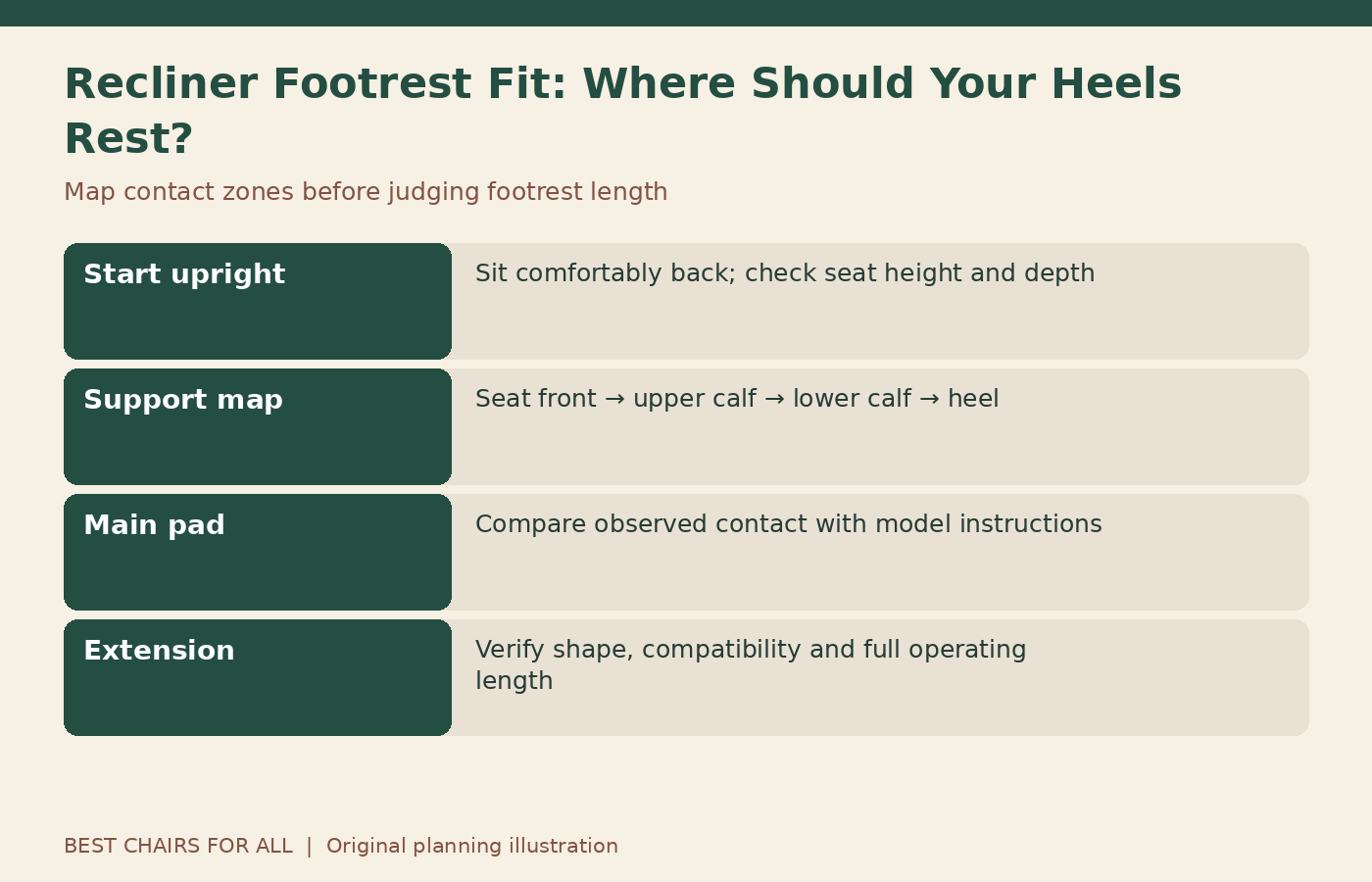
Before opening the footrest, sit comfortably back against the chair and check seat height and depth. If you begin by perching forward, the legs will project farther than they do in the intended sitting position. If you deliberately slide backward to force the heels onto the pad, you may change back support and head position. Either adjustment can disguise the real fit issue.
La-Z-Boy Australia’s fit guide treats upright seat fit and reclined leg support as connected checks. Record both. A chair should not be selected solely because the footrest looks long with no one sitting in it. The place your body actually occupies on the loaded cushion is the relevant starting point.
Make a side-view support map
Use a simple drawing of a seated person with the footrest extended. Mark four zones: seat front, upper calf contact, lower calf contact, and heel position. Beside each zone, write what you observe. A helper may take a side photograph with your permission, avoiding any need to reach near the mechanism. The purpose is to capture contact locations, not to measure an ideal medical angle.
A useful note might read: broad calf contact, heels just past the main pad, no obvious edge discomfort. Another might read: edge concentrated under lower calf, much of leg unsupported. Those observations tell a salesperson more than the statement feet hang off. Keep the chair’s position, headrest setting, and exact model code with the map so the comparison can be repeated.
Distinguish intended overhang from insufficient length
A heel just beyond the pad can be consistent with a manufacturer’s design. A lower leg that seems to bridge a short support with a narrow contact point deserves a closer fit check. Do not decide by counting visible inches of shoe alone: shoe size, ankle position, seat depth, and posture change the view. Focus on the contact pattern and whether the chair feels comfortable in ordinary use.
If the footrest feels too short, compare the correct tall version, a verified factory extension, or another model with different leg-support geometry. A deeper seat is not automatically the answer. It may move the user farther back but create an upright depth problem. Ask the provider to evaluate the whole seating arrangement rather than lengthening one dimension in isolation.
Check several permitted reclining positions
The footrest’s relationship to the legs can change as the seat and back move. Check your normal reading position, a more reclined rest position, and the upright return. Use only positions and sequences allowed by the manual. Notice whether the contact spreads along the calf or concentrates at an edge, and whether you must shift your body each time to stay comfortable.
For a linked mechanism, moving the footrest may also change the back angle. For independent controls, you may be able to alter leg and back position separately. Neither arrangement guarantees a particular fit. Test the functions on the selected chair rather than inferring their behavior from the number of buttons. Record the position that produced each observation on the support map.
A three-candidate comparison example
Imagine Candidate A supports most of the calves and leaves the heels just beyond the main pad, matching its manual’s description. Candidate B places a firm edge under a small area of the lower calves and feels uncomfortable. Candidate C includes a shaped extension that the provider confirms is intended to support the heel area, and it feels comfortable without sliding in the seat.
The useful comparison is therefore intended pattern and comfort, concentrated contact and discomfort, or approved extension and comfortable fit. It is not simply shortest versus longest footrest. These are invented observations, not product test results. They show how a support map can guide the next showroom question without claiming that a particular heel location is right for every body.
Ask about factory extensions before accessories
An extension offered by the chair’s manufacturer may be standard on some models and optional on others. Verify the exact size and item code, whether the extension is fitted at the factory, and whether it changes the overall operating length. Ask the retailer to confirm compatibility in writing. A listing that says universal does not establish compatibility with a moving recliner footrest.
Avoid building a platform, attaching a board, or strapping an improvised support across moving parts. Such changes can interfere with operation and alter how loads reach the mechanism. If an existing chair’s leg support is unsuitable, discuss approved options with the manufacturer or authorized provider. Do not use a footrest as a seat, step, or lifting surface unless the model instructions explicitly permit that use.
Avoid using a pillow to hide the whole problem
A pillow may change the feel of a surface, but it can also move, interfere with closing, or change the leg’s contact pattern. If you intend to use any support accessory, ask whether it is suitable for that model and repeat the full movement and fit check. Keep loose material away from moving parts and remove it as the manual requires before operation.
Where positioning is connected to a health condition or reduced sensation, get individual guidance on supports and inspection. A furniture article cannot prescribe how long to hold a position or which area should bear weight. The practical shopping task is to identify the chair’s design, document the fit, and obtain appropriate advice when ordinary comfort observations are not enough.
Remember the return to sitting
A comfortable footrest position is only one part of the chair’s use. Check whether you can return to an upright seated position and close the footrest using the permitted controls or manual action. Keep the area clear and follow the provider’s demonstration. Do not push down on the extended support with a person standing on it or try to force a mechanism that resists.
For a lift chair, the sequence from recline to sitting and then lifting deserves its own guided assessment. The fact that the calves feel supported while reclining does not establish that the seat’s height, depth, and lift action suit the user. Include any helper or assistive equipment in the provider’s demonstration when relevant to the intended household routine.
Include the longer support in the room plan
A factory footrest extension can increase how far the chair projects into the room. Obtain the exact fully reclined length with the extension installed and confirm the required rear clearance. Tape the complete operating footprint on the floor, including the end of the extension. A leg-support improvement is only useful if the chair can use it without striking a table or blocking an essential route.
Check nearby blankets, power cords, and small objects before operating the footrest. Keep children and pets clear according to the manufacturer’s warnings. The extra upholstered section may fold away beneath the main support and create a movement that is not apparent from an upright photograph. Ask the retailer to show the complete approved cycle in a clear space.
Keep a fit record you can use later
Save the manual section, product code, extension option, and side-view support map with the receipt. If the delivered chair feels different from the showroom model, compare configurations before assuming that the footrest is defective. A different cushion package, size, or sitting position may help explain the discrepancy and give the retailer a useful starting point.
If the chair changes suddenly, the footrest becomes uneven, or normal movement produces new discomfort, stop and contact the provider for an assessment. Do not adjust hidden springs or linkages to change support length. Your decision record should make it clear what the chair was intended to do and what changed, which is more useful than trying to enforce a universal rule about whether feet may hang over the end.
Something unclear or out of date? Send a correction with this article’s title and the detail to check.
Sources, research & corrections policy ↗