For sewing, the main question is whether the chair stays where you intend while you operate the pedal and guide fabric. Wheels make repositioning easier; glides remove wheel rotation but can still slide on a floor. A locking or load-sensitive caster can behave differently again. Choose the complete base configuration for the task and floor, not just the part that seems to offer more grip.
Begin by separating two needs: staying in position during a seam and moving between tasks. A chair that rolls conveniently toward a cutting table may drift away from a sewing pedal. A chair that remains planted for stitching may be awkward to reposition if the workspace requires repeated sideways movement. The room layout may need adjustment along with the chair.
What sewing guidance emphasizes
OSHA's OSHA sewing chair and station recommendations recommends a sewing chair with no wheels or wheels that lock, alongside appropriate adjustment and support. That guidance is relevant because pedal operation and close hand work create a different demand from rolling around a general office. It does not mean any glide fitted to any chair becomes an appropriate sewing configuration.
Apply the guidance through the actual manufacturer's options. Ask whether the chair is available with approved glides, manual locking casters, or another defined wheel system. Confirm how it behaves both occupied and unoccupied. If the product description merely says “safety casters,” ask what that term means for the specific part.
For home sewing, the same movement questions remain practical even though a workplace guidance document does not describe every domestic room. For commercial work, confirm the equipment's intended-use and warranty terms as well. A chair sold for residential crafting may not be offered for a production workplace.
Understand four kinds of floor contact
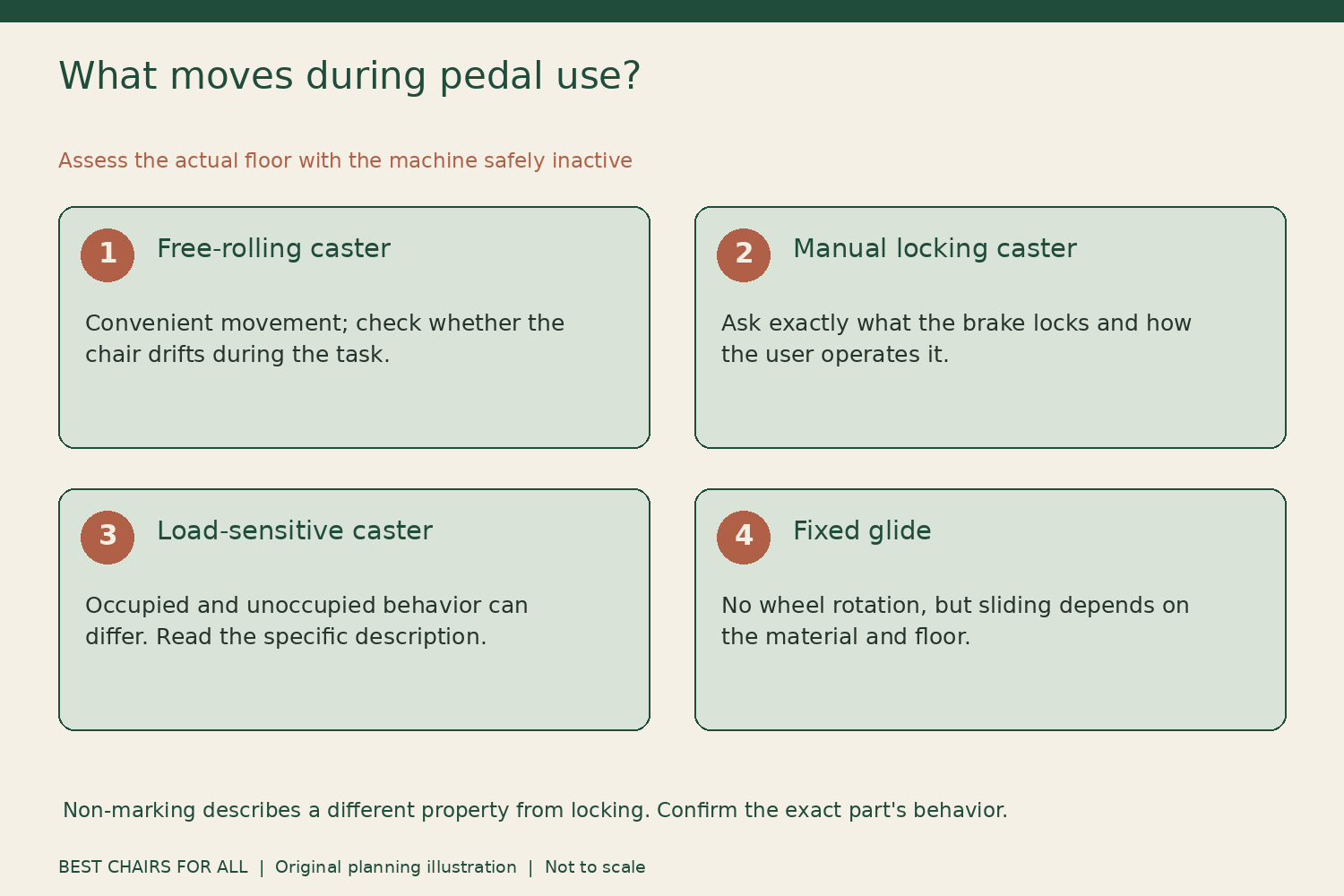
A free-rolling caster allows the wheel to turn and the assembly usually to swivel. A manual locking caster has a user-operated brake with a defined function; some designs lock wheel rotation, some address swivel, and some have other behavior. Read the manufacturer's description rather than assuming all brakes immobilize every movement.
A load-sensitive caster changes resistance according to whether the seat is occupied. The direction of that behavior matters. Treston's Treston caster and glide function descriptions describes caster options that resist movement when a chair is unoccupied. Such behavior is different from a manual brake intended to hold a chair during seated pedal work. Do not infer occupied holding performance from an unoccupied braking claim.
A glide is a fixed floor-contact component, often with a shaped pad or stem. It does not roll, but its material and the floor can permit sliding. The word “glide” itself suggests that movement may be intentional in some applications. Ask about the approved glide, floor type, and complete-chair height rather than treating it as a universal non-slip foot.
Non-marking does not mean locking
Arrow's Arrow sewing-chair wheel parts and use instructions identifies five non-marking wheels for the listed sewing-chair models. That description concerns a different property from braking. The manual's parts list does not by itself establish that those wheels lock. If a stationary sewing setup requires a brake or glide option, ask the manufacturer what it supports rather than assuming the existing wheels meet that need.
“Quiet,” “smooth,” “rubber,” and “hard-floor” also do not establish braking. A wheel can be designed to protect a floor and still move easily. A large inline-style replacement may change height and rolling behavior without solving pedal stability. Product adjectives should be translated into specific questions about function.
Do not jam wheels with loose objects, bind them with tape, or place the chair on a towel to stop it moving. Those workarounds can create unpredictable movement or interfere with the base. If the chair's approved configuration cannot meet the task, consider another suitable chair or a better workstation arrangement.
The floor is part of the system
Record the floor finish, its condition, and whether the working area includes a mat, rug, threshold, or slope. A chair that behaves one way on carpet can move differently on smooth vinyl or tile. Debris caught in wheels can also change movement and mark a surface. Inspect through the manufacturer's permitted care method.
Ask both the chair supplier and, where relevant, the flooring manufacturer about compatible contact materials. Do not assume that a caster sold for “hard floors” is suitable for every finish or that a felt glide remains appropriate under the intended use. Floor protection and task stability are separate requirements to satisfy together.
A chair mat introduces edges and another rolling surface. Check whether the pedal remains on the same stable plane and whether a caster can approach the edge during ordinary movement. Avoid a mat arrangement that creates a trip point or lets the chair transition unexpectedly between surfaces while the user is concentrating on the needle.
Keep the pedal and chair relationship visible
With the sewing machine safely inactive, sit in the normal position and locate the pedal where the foot can reach it without stretching. Notice whether pressing the pedal's normal travel causes the chair or pedal to shift. Do not operate the machine to discover an unstable relationship; resolve the setup first.
Record movement separately. If the pedal slides while the chair stays put, changing chair wheels may not address the problem. If the chair rolls backward while the pedal remains fixed, focus on the chair's approved floor-contact options and the user's supported position. If both move, the entire arrangement needs assessment.
Check cable routing as well. A cable pulled taut can change pedal position or lie in a wheel path. Follow the machine instructions and keep cables clear of moving furniture. Do not modify the pedal's wiring or electrical controls to make a furniture arrangement more convenient.
A floor-and-pedal comparison worksheet
Use one sheet for the actual station. Record chair model, caster or glide part, braking behavior, floor finish, mat arrangement, pedal model, and the normal chair location. Add whether the chair remains in place during a safe inactive rehearsal and whether deliberate repositioning remains manageable. Keep these as observations, not a certification test.
Then record transitions: approaching the machine, starting a seam position, reaching nearby supplies, standing up, and moving to another station. Note which movements happen frequently and which could be reduced by relocating supplies. Sometimes an easy-to-reach shelf removes the apparent need to roll sideways while seated.
Compare an alternative only when it is an approved complete-chair configuration or a supplier-authorized demonstration. Keep the same floor, shoes, pedal position, and work arrangement so the difference is interpretable. If a different floor-contact option changes seat height, record that and refit the chair before judging the pedal relationship.
Worked example: two different movement problems
Imagine a home sewer whose chair rolls back on smooth flooring during pedal use. They initially plan to buy larger wheels because those are advertised as smooth. The worksheet shows that smooth travel is not the missing function. They need a supported sitting position and a manufacturer-approved way to control movement during stitching.
A second sewer has a chair on fixed glides that stays in position, but the pedal slides forward on the same floor. Replacing the glides would target the wrong object. That person needs to review the pedal's permitted placement and an appropriate stable support arrangement, keeping both feet comfortable and the cable clear.
Neither example proves that all wheels are bad or all glides are better. It shows the value of naming what moves, when it moves, and what the task requires. The solution can then be matched to the relevant equipment instead of buying a generic accessory based on a broad promise of grip.
Replacement parts need approval
Before changing wheels to glides, ask the chair manufacturer to confirm the correct part and whether the conversion is permitted. Stem dimensions alone do not establish compatibility. Overall height, base clearance, load conditions, and intended use can also matter. Use the complete set and installation method the supplier specifies.
Do not mix wheel sizes or combine improvised feet on one base. A chair should stand in its approved configuration, with all contact points functioning as designed. If a socket is damaged, a caster repeatedly falls out, or a glide does not seat correctly, remove the chair from use and obtain service advice rather than forcing the component.
Do not dismantle a pressurized lift cylinder while working on floor-contact components. If the approved procedure requires handling beyond your ability or tools, have the supplier or technician perform it. Keep a record of the new parts so future height or maintenance questions refer to the current configuration.
Repositioning without unnecessary reach
A stationary chair should not force the user to twist or stretch for supplies that could be placed closer. Arrange frequently used tools within a practical reach and stand to move between tasks when appropriate. Do not use a chair as a rolling transport device or push off toward another work area with tools in hand.
If the work genuinely needs frequent seated movement, discuss that requirement with the supplier or workplace assessor. A defined locking system may be useful, but it needs to be accessible and usable in the actual sequence. A brake that is consistently forgotten or impossible to reach from the station is a workflow problem to resolve.
Shared workspaces should include a quick reset: correct chair position, appropriate documented brake state, pedal location, and clear cable route. Marking a pedal's permitted position on a floor plan can help, provided it does not replace individual fit. Different users may need different settings within the same safe arrangement.
Wheels versus glides is therefore a decision about controlled movement, floor compatibility, and pedal access. Identify the moving object, check the exact caster or glide function, and choose an approved configuration that supports both steady sewing and deliberate repositioning. A part advertised as non-marking or smooth does not answer those questions by itself.
Sources and specifications checked November 6, 2026. Examples are planning exercises, not product testing.
Something unclear or out of date? Send a correction with this article’s title and the detail to check.
Sources, research & corrections policy ↗