A salon chair's weight capacity is the manufacturer's permitted client load under the stated conditions. Product weight is the mass of the chair itself. Shipping weight may include packaging or multiple cartons. These numbers can all appear on the same page, but only a clearly identified capacity tells you what load the chair is rated to accommodate.
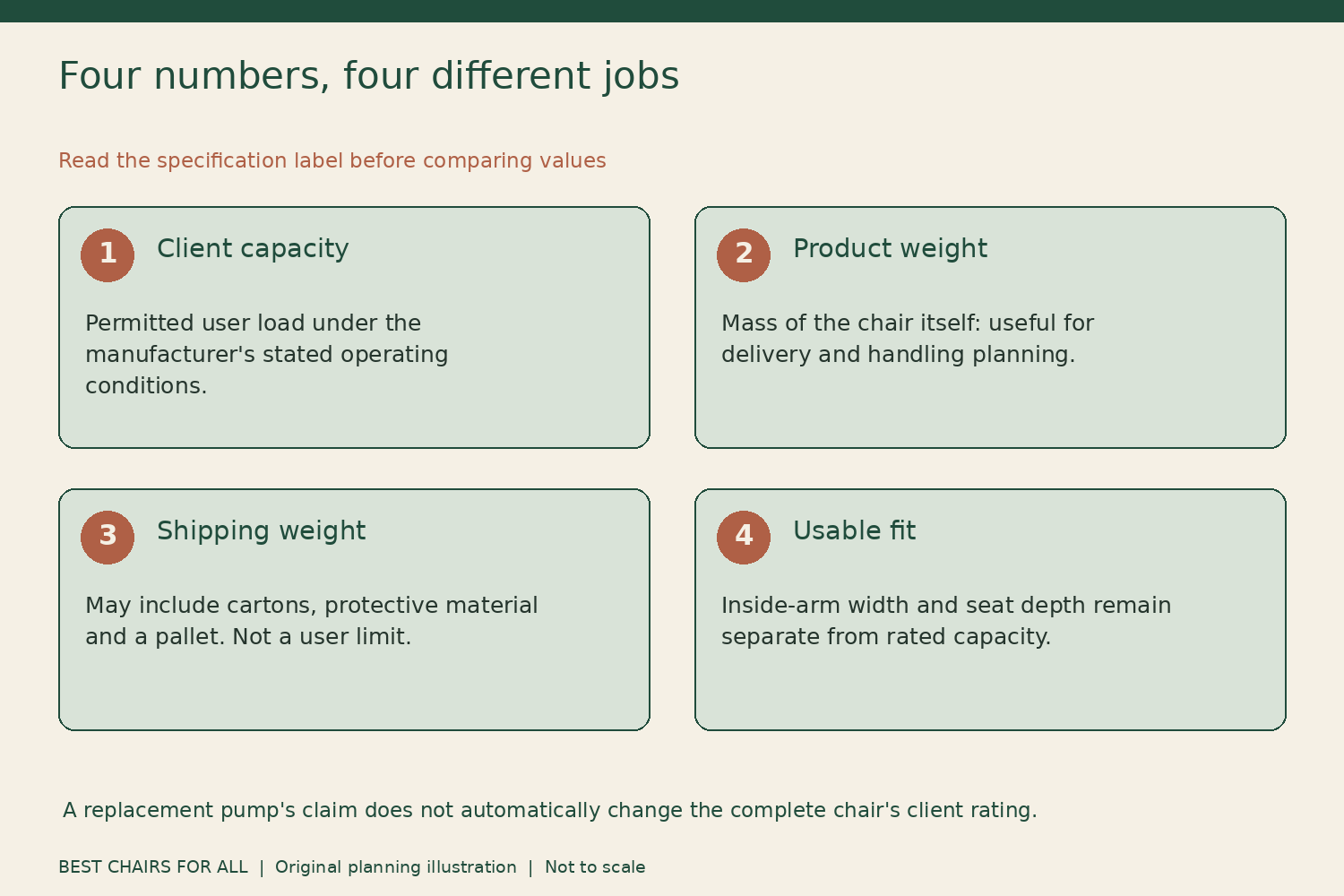
When the wording is ambiguous, ask the manufacturer to confirm the complete assembled chair's rating in writing. Name the chair top, base, hydraulic unit, and accessories. Do not infer capacity from a heavy base, a broad cushion, the word “commercial,” or the rating of a replacement pump sold separately.
Read the label attached to the number
A specification that says “Weight: 145 pounds” may describe the object being delivered. “Weight capacity: 350 pounds” describes a different property. “Maximum recommended user weight,” “lifting capacity,” and “static load” can introduce additional conditions. Do not silently treat all these phrases as equivalent when comparing products.
A listing may also have an unlabeled “weight” field generated by a retailer's catalog software. It could be product mass, shipping mass, or erroneous data. The presence of a number does not make its meaning clear. Ask what the field represents and request the source document if it affects your purchase.
The Minerva Vantage model capacity and dimensions illustrates useful labeling: it lists weight capacity separately from inside-arm width, seat depth, and other dimensions. The cited Vantage configuration states 350 pounds. That is a model-specific published claim, not a capacity recommendation for every salon and not an independent test conducted by this website.
Product mass does not establish strength
A heavy chair may include substantial decorative castings, a large base plate, or a complex reclining assembly. A lighter chair may use a different structural design. Without the manufacturer's rating and conditions, neither mass allows a reliable calculation of allowable client load. There is no valid “chair weight times a factor” shortcut for buyers.
For example, the Takara Belmont Clipper product-mass specification lists product weight with a specified base and gives separate overall dimensions. It does not turn that product mass into a client rating. If the capacity is needed for that configuration, obtain the correct current rating from the manufacturer or authorized supplier instead of deriving one from the brochure's kilograms.
Shipping mass is even less useful for that purpose. Packaging, pallets, detachable parts, and the way a dealer groups cartons can change the reported figure. Keep shipping data for delivery planning. Keep client-load information in the equipment specification and booking guidance. Mixing those records can produce a serious misunderstanding even when every individual number was copied accurately.
Ask what the rating covers
A capacity statement should identify the complete assembly and intended use. Ask whether the rating applies throughout normal height travel, during approved recline, and with the accessories being purchased. If a manufacturer distinguishes lifting from stationary support, preserve both terms and follow the stated restrictions rather than choosing the larger number.
Do not assume a chair may carry more simply because no adjustment will be made. An unsupported static-load claim from a marketplace seller is not permission to exceed a manufacturer's user limit. Similarly, do not subtract the chair's product weight from a stated user capacity unless the manufacturer explicitly defines the rating that way.
For an existing chair, identify whether the original base, top, and mechanism are still present. A replacement component can change what needs confirmation. Takara Belmont's Takara Belmont complete-base compatibility precautions notes that certain chair tops cannot be combined with certain bases and directs compatibility questions to an authorized dealer. Matching appearance or an apparent mechanical fit is not complete approval.
Capacity and body fit are separate checks
A chair can have an adequate published capacity while being too narrow between the arms for a particular client. It can also be comfortably wide without a sufficient load rating. Check inside-arm width, usable seat width, seat depth, arm shape, footrest position, and entry and exit requirements independently.
Do not use a client's visible size as a substitute for either measurement. Body proportions differ, and clients may prefer different amounts of room around their hips and arms. Offer clear equipment information privately and let the client describe the space or assistance they need. Avoid public questions, assumptions, or comments that turn a practical booking issue into embarrassment.
A removable arm, if offered, needs its own documentation. Confirm whether removal is an intended user adjustment, whether it changes any stated conditions, and how it is performed. Do not remove structural components to make the chair wider. If the chair does not fit, identify appropriate alternative equipment or a different service arrangement.
Use a capacity evidence sheet
Create a short sheet for each station. Include the chair and base model, serial or order identifier, year of purchase, approved accessories, capacity wording exactly as published, units, conditions, and the document date. Add a link or stored copy of the source. This is an equipment record, not a file about individual clients.
Add separate boxes for “product weight,” “shipping weight,” and “inside-arm width.” Keeping those nearby but clearly labeled helps staff avoid confusing them with capacity. Write “not confirmed” where evidence is missing. Do not replace a missing rating with the value from a similar chair elsewhere in the salon.
Include a “changes requiring review” line: base replacement, hydraulic replacement, chair-top replacement, structural repair, upholstery changes that affect fit, or new accessories. Not every change necessarily alters capacity, but it can make the original configuration record incomplete. Ask the supplier which documentation should remain with the updated assembly.
Worked example: three different weight numbers
Imagine a hypothetical quote that lists “chair weight 120 pounds,” “shipping weight 145 pounds,” and “maximum client weight 350 pounds.” The 120-pound figure helps the installer plan handling. The 145-pound figure helps the carrier plan delivery. The 350-pound figure is the client limit, subject to the manufacturer's stated operating conditions.
Now imagine a replacement pump page listing a 400-pound lifting claim. Installing that pump would not automatically convert the hypothetical 350-pound chair into a 400-pound chair. The chair top, mounting connection, base, footrest, and approved combination still need manufacturer confirmation. A stronger claim for one component does not rewrite the complete product's documentation.
Finally, suppose one source uses kilograms and another uses pounds. Convert only after you identify what each number describes. Using approximately 2.205 pounds per kilogram, 150 kilograms is about 331 pounds. Keep the original value alongside the conversion and avoid rounding upward as if it grants extra capacity. Unit conversion clarifies a claim; it does not change it.
Do not conduct your own proof test
A buyer should not ask a person to bounce, lean, stand on the footrest, or sit beyond the stated limit to see whether the chair holds. Such an experiment cannot establish a professional rating and may damage equipment or injure someone. A chair surviving one unusual event does not document its suitability for repeated service.
Likewise, a pump that raises a person once does not prove that every part of the chair is appropriate for them. Normal operation should stay within documented conditions. If the chair struggles, drops, wobbles, or behaves unexpectedly, remove it from service and contact the supplier. Do not frame the event as the client's fault or ask them to help diagnose it.
For a used chair without traceable documentation, ask the original manufacturer what can be identified from accessible labels and photographs. If the complete configuration or condition cannot be verified, treat that uncertainty as part of the purchase decision. A low price does not compensate for missing information about the load the equipment may accommodate.
Buying for a broader client range
Begin with the services and people the business intends to welcome. Ask manufacturers for chairs whose documented capacities and usable dimensions meet that plan, and compare access and operating space as well. Avoid treating a single high capacity number as a complete inclusivity strategy. Seat width, arm design, support placement, and the client's experience all matter.
Ask for a demonstration of normal controls and access with the chosen configuration, without using a client as a test load. Confirm whether an alternative station needs a larger floor footprint or different clearance. A higher-rated chair that cannot be positioned for the service may solve only one part of the problem.
Staff should know where to find equipment specifications and how to discuss alternatives discreetly. A practical script can explain the available chair's documented dimensions and limit, offer another suitable arrangement when available, and invite the client to discuss access preferences. Do not promise equipment suitability that the documentation does not support.
Keep ratings current after repairs
Retain the service report when a base or hydraulic unit is changed. Ask the technician or supplier to identify installed parts and confirm the complete assembly's intended use. Keep the original rating only when its applicability is clear. Do not advertise an upgraded capacity based solely on the replacement part's sales page.
Inspect equipment according to its manual and act on damage promptly. A published rating assumes the product is used and maintained as specified; it is not a guarantee that a damaged, modified, or incorrectly assembled chair remains suitable. Remove questionable equipment from booking until the authorized assessment is complete.
A clear salon-chair weight record has three qualities: the number is correctly labeled, it applies to the actual complete configuration, and its conditions are available to the people who need them. Combined with separate fit and access information, that provides a useful basis for selection and respectful service planning.
Sources and specifications checked November 6, 2026. Examples are planning exercises, not product testing.
Something unclear or out of date? Send a correction with this article’s title and the detail to check.
Sources, research & corrections policy ↗