The useful minimum height of a salon chair is the lowest position of the complete seat cushion above the finished floor. It is not the overall back height, bare pump height, or hydraulic stroke. For a stylist who cannot comfortably reach the crown of a taller client, that low endpoint can matter more than how high the chair rises.
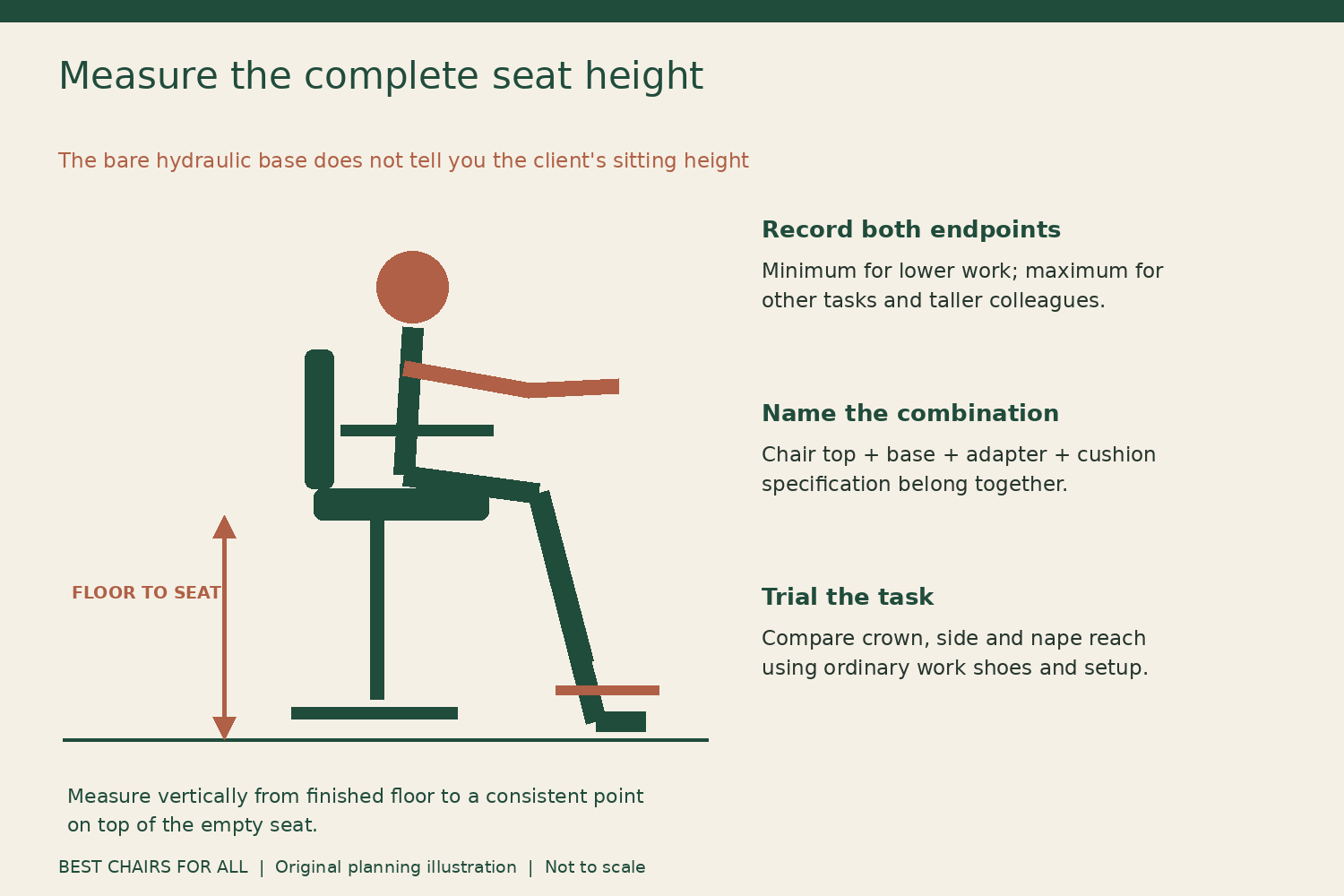
There is no single minimum seat height that fits every stylist. Your footwear, working technique, client proportions, and the chair's cushion all influence the result. Find a usable range by measuring a known station and trying the complete chair. Then compare the same floor-to-seat measurement across the exact chair-top and base configurations being quoted.
Separate the numbers on a specification page
Overall height normally reaches the highest part of the chair, often the backrest or headrest. Seat height reaches the sitting surface. Base height describes a component below that surface. Stroke describes how far a lifting mechanism travels. These numbers answer different questions and cannot be substituted for one another.
Also check whether the listed seat height is measured with the chair empty and whether it is approximate. Cushions compress differently under different clients. That does not make the published measurement useless, but it means you should use it to shortlist a chair and then confirm fit through an ordinary demonstration. Do not subtract an invented compression allowance to make an unsuitable specification appear to fit.
Takara Belmont's Takara Belmont Harp seat-height specifications, for example, lists seat height separately from overall height and names the SP-AD base used for the dimensions. The manufacturer warns that another base can alter dimensions and total weight. This is exactly the kind of configuration note that should stay attached to a comparison spreadsheet.
Why the chair top changes minimum height
A seat consists of more than upholstery thickness. Its frame, underside bracket, mounting relationship, and cushion shape all contribute to the finished position. Two chair tops on the same base can therefore have different low endpoints. Similarly, two chairs that appear equally padded may have different mounting geometry beneath them.
Minerva's Minerva chair-top and base travel guide discusses this relationship and provides examples of chair models paired with its low-profile configuration. Treat the examples as combinations within that manufacturer's system. Ask the supplier to confirm the actual seat-height range for your selected model, base, and accessories rather than assuming that the shortest base always produces the same seat height.
Do not improvise a lower chair by cutting components, substituting an unidentified pump, removing structural parts, or modifying the floor contact. If the manufacturer offers a shorter approved configuration, have the supplier specify and assemble it correctly. If no approved combination reaches the needed height, choose another complete chair rather than turning the problem into a workshop experiment.
Measure the station you already know
Use a working chair that is in sound condition and follow its normal operating instructions. With the seat unoccupied and at its lowest intended position, measure vertically from the finished floor to a consistent point on top of the seat cushion. Record the location, because a contoured cushion may be higher at the back than at the front.
Next, document ordinary work with several willing adults who represent the range of client proportions you serve. Use normal service positions and do not make anyone part of a load or stability test. Record whether you can work around the crown, sides, and nape without repeatedly lifting the shoulders or losing your preferred stance. Keep client identities out of the worksheet.
The resulting note might read: “Current empty seat minimum 21 inches; crown work feels too high with taller seated clients; side work is manageable.” That is more useful to a showroom representative than “I am short.” It describes the task that needs improvement and provides a reference height against which another chair can be demonstrated.
Use the client target, not only stylist stature
Standing height alone cannot predict an ideal salon chair. Two clients with similar overall height can have different seated torso lengths. The same stylist may want one working height for crown sections and another for detail at the nape. A chair needs enough range to support those changes without forcing the stylist to compensate around the station.
List your actual task targets: crown, temple, nape, front fringe, and any service that uses recline. For each, note whether you normally stand, sit on a stool, or change position. A low minimum may solve crown reach while a sufficient maximum remains necessary for other tasks or a taller colleague. Consider both endpoints before ordering.
Bring ordinary work shoes to a demonstration. If an anti-fatigue mat is normally used, account for its thickness and confirm that it can sit in the intended relationship to the chair base and pedal. A measurement taken barefoot on a showroom floor may not reproduce the studio's actual working relationship.
A measurement worksheet for the shortlist
Give each chair one sheet. At the top, record manufacturer, chair-top model, base model, upholstery, and any adapter or tray. Below, record published minimum and maximum seat height, the source document, the measurement reference point, and whether the supplier confirmed the range for that combination. Keep millimeters and inches in clearly labeled columns.
Add your current chair's measured height as a baseline. Then create rows for crown, sides, nape, and entry and exit. Record observations in plain language: “shoulders rise during crown work,” “adequate arm access,” or “client feet do not reach the intended foot support comfortably.” Avoid turning subjective comfort observations into medical conclusions.
Finish with a decision field: suitable as demonstrated, unsuitable, or further confirmation needed. An unresolved number should remain unresolved. If the advertised range comes from a different chair top or a photograph of an older base, ask for the correct drawing rather than assuming the difference will be small enough to ignore.
Worked example: calculating the change
Consider a hypothetical stylist whose current chair has an empty-seat minimum of 21 inches. A candidate complete chair is documented at 18.5 inches minimum. The nominal reduction is 2.5 inches. If both use the same measurement reference and comparable conditions, the client's seated position starts roughly that much lower. This arithmetic helps frame a trial; it does not guarantee the crown lands at the perfect height.
Suppose a second candidate lists its base at 15.5 inches. That is not automatically lower than the first chair's 18.5-inch seat. The missing chair-top contribution prevents the comparison. Write “finished seat height needed” in the worksheet and ask the supplier for that measurement. Do not add a guessed cushion thickness, because the bracket and frame relationship may contribute as well.
Finally, consider an accessory. Takara Belmont's Takara Belmont accessory compatibility and height notes says its Asista Tray II uses a swivel adapter that adds approximately two inches and identifies compatible bases. This model-specific example shows why accessories belong in the height calculation. It does not mean every tray adds two inches or that another manufacturer's adapter behaves the same way.
Check the upper endpoint at the same time
A low minimum can be attractive enough to distract from a limited maximum. Ask each person who will use the station to demonstrate their routine tasks. A shared chair should be assessed for the shortest and tallest practitioners, the seated and standing techniques used, and the client proportions actually encountered.
If two stylists need very different ranges, a different approved base or separate stations may be more practical. Do not expect one worker to solve an unsuitable chair by standing on an improvised platform. A workstation change should have appropriate support and room planning, and it should not introduce access or movement problems around the client.
Also distinguish travel from convenience. A chair may technically reach a height but require a control position that is awkward at your station. Check pedal access with the actual base orientation, mat, trolley, and mirror cabinet. The complete experience matters more than the endpoint alone.
Entry, exit, and foot support
Minimum working height is only one part of client access. Ask the supplier to show the manufacturer's intended position for entering and leaving, the rotation lock, and the footrest relationship. A lower seat can change how the client approaches the chair, but it does not establish that the chair meets every individual's access needs.
Do not treat a salon footrest as a step or improvise a climbing routine to compensate for chair height. Discuss any access limitations respectfully and privately before the appointment, with the client guiding the assistance they want. Where more specialized access is required, obtain advice about appropriate equipment rather than assuming a styling-chair height adjustment solves the whole issue.
During the demonstration, check whether the footrest remains in a useful position across the seat's range. A client who sits comfortably at the low endpoint should not have to adopt an awkward leg position merely because the practitioner can now reach the crown. Client fit and practitioner fit need to be considered together.
Confirm the order and check delivery
Put the required complete-seat range and exact base on the purchase record. Keep the manufacturer's drawing, supplier confirmation, and accessory list together. If a substitute base is proposed, recheck the range before accepting it. Similar finishes and matching bolt patterns do not establish an equivalent working height.
After authorized assembly, compare the delivered configuration with the order and measure the empty seat again using the same reference point. If the result differs materially from what was promised, photograph the measurement and contact the supplier before routine use. Do not modify the assembly to recover an expected number.
A minimum-height decision is strongest when it combines a correctly understood specification, a useful baseline, and an ordinary task demonstration. That process can identify a lower chair that actually improves the working relationship, while keeping maximum height, client fit, and approved component compatibility visible.
Sources and specifications checked November 6, 2026. Examples are planning exercises, not product testing.
Something unclear or out of date? Send a correction with this article’s title and the detail to check.
Sources, research & corrections policy ↗