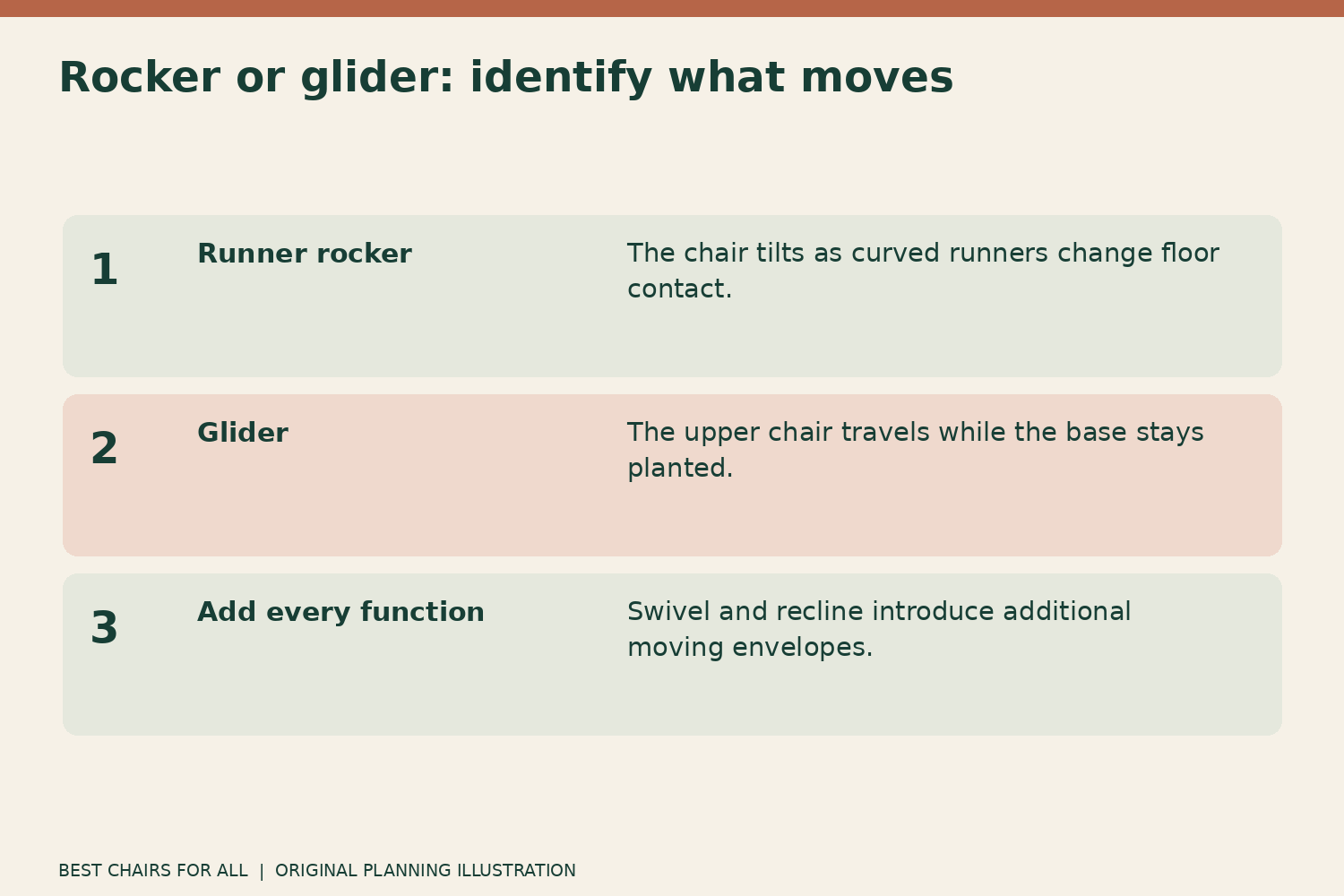
A traditional rocking chair tilts on curved runners that contact the floor. A glider moves its seat relative to a base that remains planted. The rocker changes the chair’s angle as it rolls along the runners; the glider uses a mechanism to create a different back-and-forth path. Some chairs add swivel or recline functions, so the product’s complete motion specification matters more than the word rocker or glider alone.
Choose by testing the motion you prefer, the seat that fits you, the floor beneath it, and the space through which the chair moves. A fixed glider base does not mean the moving seat stays inside the base footprint, and a traditional rocker is not automatically larger. Compare the exact models in their full operating range.
Understand what moves and what stays planted
A runner rocker carries the chair on two curved contact surfaces. As weight shifts, the contact point along each runner changes and the chair tilts forward or backward. The curve, chair geometry, user position, and floor all influence the feel. Similar-looking runners can produce noticeably different motion, so a photograph cannot establish the experience.
POLYWOOD’s comparison of rockers and gliders distinguishes the rocker’s arc from a glider’s straighter back-and-forth motion and explains a glider linkage using suspended arms. Its discussion concerns its outdoor seating context; use the mechanical distinction without assuming that every indoor glider uses identical hardware or travel.
In a glider, the lower support can remain stationary while the upper chair moves forward and backward. Linkages or other mechanisms determine the path. Some designs also permit rotation, and some combine gliding with a reclining back or extending footrest. List each function separately so its clearance and controls can be checked.
Do not confuse flexible frames with runner rocking
Some chairs flex under the user without moving on curved runners. That resilience can feel slightly springy, but it is not the same mechanical arrangement as a traditional rocker. A collection may include a cantilever armchair and a separately designed rocking version. Confirm the exact base shown in the selected product.
IKEA’s POÄNG rocking chair with the Hillared anthracite cushion is a specific runner-based version in that collection. Its listed overall depth is 37 inches, with seat depth separately listed at 19⅝ inches. Use the rocking version’s own measurements rather than borrowing those of the related armchair.
The same caution applies to product names containing glider rocker. That phrase may describe a platform or linkage motion rather than runners rolling on the floor. Inspect the base drawing and operating instructions. If the mechanism is hidden by upholstery, ask the seller to identify the actual functions and required operating space.
Compare the motion with a repeatable trial
Use a level, appropriate surface and a correctly assembled chair. Sit back, place your feet normally, and initiate a small amount of motion. Notice how much effort is needed to start, maintain, and stop it. A motion that feels pleasant for a brief showroom demonstration may be less suitable when you want to read steadily.
Bring a real book or e-reader and try turning a page while moving. Then stop the motion and place the book on a nearby table. Check whether the chair’s movement makes that reach awkward or whether the table would enter the moving path. Record the practical observation instead of describing one motion as universally smoother or more relaxing.
Have every regular user repeat the trial. Different leg lengths and sitting positions can alter how a person initiates motion and where the feet rest. Do not infer that a rocker suitable for one household member will feel equally manageable to another. The useful choice is the one whose motion each intended user can control comfortably.
Fit the seat before choosing the mechanism
Check usable seat width, depth, height, back shape, and arm contact. A glider with desirable motion can still be too deep for the user to reach the back with feet supported. A rocker with attractive runners can still have arms that meet the elbows awkwardly. Mechanism preference should not hide a basic seat-fit problem.
For a second documented example, Room & Board’s Ward swivel glider lists a 32-inch width, 33-inch depth, 20-inch seat height, and 19-inch seat depth for the displayed configuration. It also specifies 360-degree swivel. These are model facts, not typical dimensions for all gliders.
Compared with the cited POÄNG rocker, the Ward has a shorter listed overall depth but a higher nominal seat. That does not establish a comfort winner. It shows why the comparisons need several dimensions and an occupied trial. Cushion compression, back angle, and the user’s ordinary posture remain part of the fit.
Plan the moving envelope around the chair
For a rocker, the upper back can move behind the parked runner footprint, while the front and the user’s feet require space ahead. For a glider, the seat can travel beyond the stationary base. Obtain the exact manual’s clearance requirements and identify which chair point the measurement uses.
A swivel glider requires another layer of planning. The chair may glide while oriented in several directions, so a clearance that works facing forward may fail after rotation. Ask the manufacturer how to plan the combined motions. Do not assume that checking one straight line behind the back covers every permitted orientation.
Place the chair, table, lamp, ottoman, and nearby doors on the same sketch. Include projecting arms and cushion edges at their actual heights. A table can clear the base while meeting the moving arm, and a curtain can enter a path that looks empty on a floor-only drawing.
A motion-and-room comparison worksheet
Use this original worksheet to separate the mechanism from seat fit and placement. Fill it out for the exact products under consideration. A missing clearance or unclear control should remain an open question until the manufacturer or seller supplies the relevant information.
| Question | Runner rocker | Glider |
|---|---|---|
| Floor contact | Curved runners change contact point | Base remains planted during glide |
| Upper-chair path | Tilting motion to observe | Forward/backward travel to observe |
| Additional function | Confirm any unusual base feature | Confirm swivel, recline, or lock |
| Seat-fit result | Feet, knees, back, and arms | Feet, knees, back, and arms |
| Room requirement | Manual clearance plus occupied access | Manual clearance plus combined motion |
| Service route | Runner and joint inspection | Mechanism guidance and replacement support |
For a worked decision, suppose the room has a table close to the chair’s right side and a wall behind it. A stationary-base glider might initially seem easier to fit. If it also swivels, however, the moving arm can sweep toward that table. A simpler rocker may be easier to place, or the table may need to move. The mechanism name alone does not resolve the layout.
Check the relationship with the floor
A runner rocker needs both runners to move consistently on an appropriate surface. A rug edge beneath one runner can create uneven resistance, while grit beneath the contact area can damage a finish. Do not sand, shorten, or reshape runners to compensate for a placement problem. Start by checking the surface and chair condition.
A glider’s base also needs stable, level support. A fixed footprint does not make it suitable for every rug, slope, or floor. Check the intended glides or feet and follow the floor and furniture manufacturers’ instructions. Avoid stacked pads or improvised blocks that alter how the base bears weight.
If either chair shifts unexpectedly, wobbles, binds, or makes a new noise, stop the trial and investigate through the manufacturer’s guidance. A symptom may come from assembly, wear, damage, or the surface. Adding lubricant indiscriminately can stain upholstery or be unsuitable for the mechanism, so do not use a generic remedy without identification.
Rehearse sitting down and standing
Motion affects the transition into and out of the seat as well as the time spent sitting. Test the ordinary movement with the intended user and the chair’s instructions. If a model has a motion lock, confirm its purpose and operating sequence; a recline lock and a glide lock may be different controls.
Do not assume every glider locks, or that a rocker can be safely immobilized with a wedge. Choose a model whose normal entry and exit feel manageable. An armrest should be used only as intended, and decorative or moving components should not be treated as guaranteed standing supports.
Keep the surrounding moving area clear of loose belongings and route cords outside it. Avoid reaching beneath the seat or into a linkage while the chair can move. If service is needed, use the exact manual or a qualified professional rather than dismantling an unfamiliar powered, hydraulic, or pressurized assembly.
Compare maintenance as a design requirement
A traditional runner rocker may expose much of its frame for inspection, while an upholstered glider can conceal its mechanism. Accessibility does not establish reliability, but it changes what the owner can readily observe. Ask what routine checks the manufacturer requires and which parts can be serviced or replaced.
Inspect upholstery care separately from mechanism care. The cited POÄNG cushion and frame have their own cleaning directions, while the Ward’s selected fabric requires its own care information. A removable cushion can help access without implying that its cover is machine washable. Keep the material code and mechanical instructions together.
Choose from the complete use pattern
Favor the runner rocker when you like its controlled tilting motion, its seat fits, and the surface and operating space suit it. Favor the glider when its particular travel and any additional functions work comfortably within the room. Neither category guarantees easier entry, a smaller footprint, or better long-term comfort.
Make the final comparison during a realistic activity, with the table and foot support you intend to use. Save the worksheet and manufacturer clearance information. A successful moving chair is one whose motion, seat, floor contact, and surrounding arrangement continue to work together during ordinary use.
Something unclear or out of date? Send a correction with this article’s title and the detail to check.
Sources, research & corrections policy ↗