A woven appearance does not tell you whether a chair can stay outside. Resin wicker, natural rattan and coated natural-fiber wicker can look similar in a photograph while having different intended uses and care requirements. Read the actual material specification and the manufacturer’s outdoor-use instructions before choosing a location or a cleaning method.
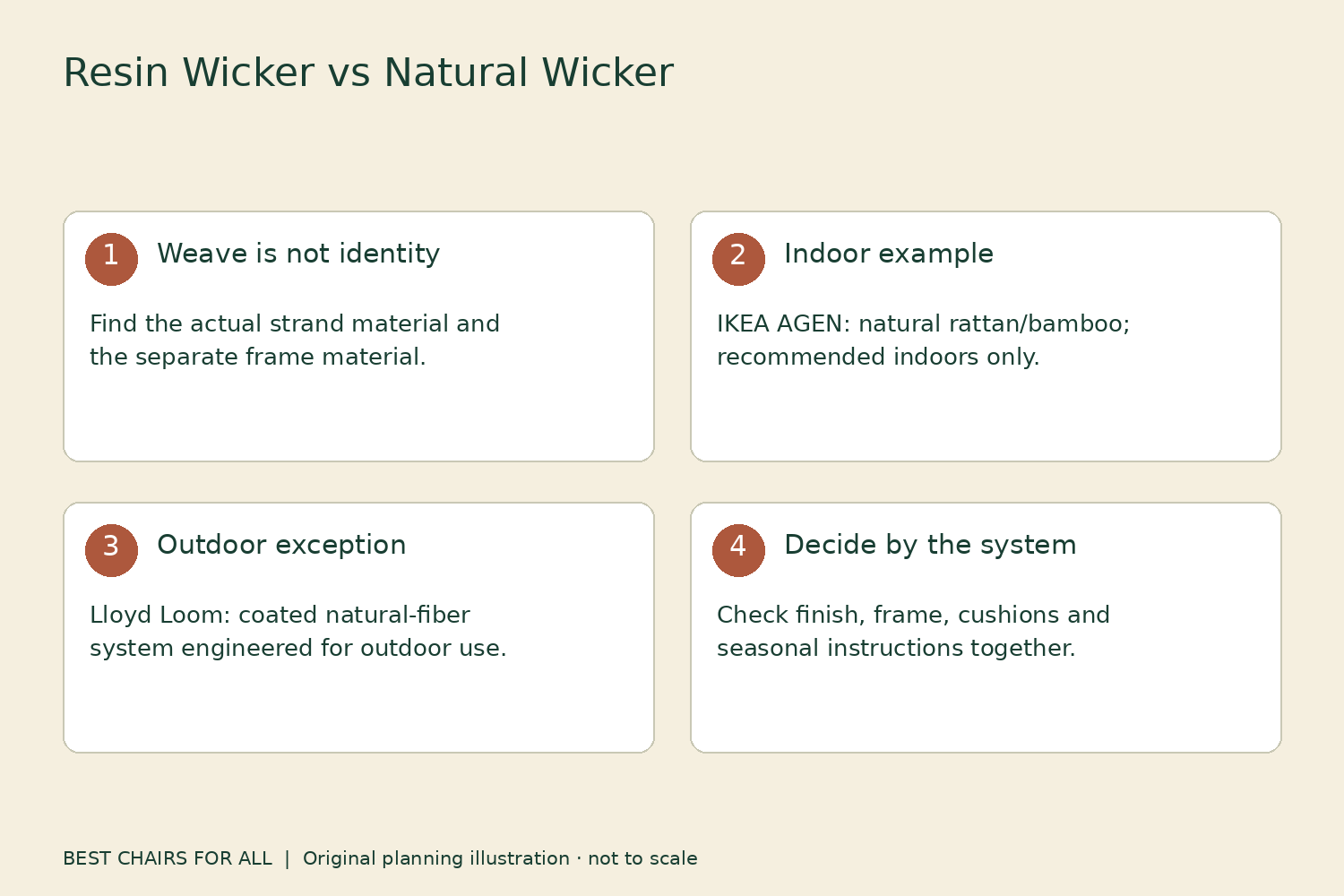
The simple rule “synthetic outside, natural inside” catches many ordinary shopping mistakes, but it has important exceptions. Some manufacturers engineer coated natural-fiber systems specifically for outdoor use. Other natural rattan chairs remain indoor products despite a protective lacquer. This guide uses documented examples to help you identify the complete construction rather than relying on the word wicker.
Separate the weave from the material
Wicker describes a woven construction in common furniture terminology; it does not identify a single substance. A seller may use “rattan look” for a synthetic strand, “resin wicker” for a polymer weave or a natural-material name for plant-based components. Read the materials section carefully enough to identify the strands and the frame separately.
Ask what “resin” means for the actual product. Do not assume every synthetic weave has the same polymer, UV treatment or cold-weather limits. A manufacturer’s specification may name polyethylene, vinyl or another material system. Copy that description into your notes rather than converting it into a broader claim such as “all plastic wicker is weatherproof.”
Look for a label beneath the chair and a matching model page. Product descriptions copied between sellers can lose details about coatings or indoor use. If the chair is secondhand, a similar weave pattern is insufficient identification. The underside, attachment method, frame label and original purchase information can help the manufacturer establish what it is.
Natural rattan can be explicitly indoor only
The IKEA AGEN armchair uses rattan and bamboo with clear acrylic lacquer and is recommended for indoor use only. That is a concrete example of a natural woven chair whose finish does not make it an outdoor product. Its plastic feet do not change that intended-use statement.
A covered porch does not automatically count as an indoor environment. Wind-driven rain, humidity, sun and temperature changes can still reach a chair beneath a roof. If the maker says indoor use only, do not reinterpret that as permission for a sheltered patio. Choose an outdoor-rated product for that location or keep the indoor chair in its specified setting.
Likewise, a spray-on coating cannot be assumed to convert an indoor chair into an outdoor one. The frame, bindings, adhesives and attachment points may all differ from an outdoor design. Applying a surface product treats only part of the construction. It also changes the finish history, which can complicate later cleaning or repair advice.
Coated natural-fiber systems are an exception
Lloyd Flanders describes Lloyd Loom as natural-fiber wicker with a high-performance Durium polyester coating for outdoor durability and flexibility. This shows why natural-fiber content alone does not settle the placement question. The engineered material and finishing system are part of the product’s intended use.
The manufacturer’s materials description explains cellulose strands, aluminum stakes within the loom fiber, sealing and a coated assembly. Do not equate that construction with an uncoated rattan chair found at a market. A similar visual texture can hide substantially different materials and finishing processes.
The exception also has a care consequence: coating condition matters. A system designed around a protective finish needs that finish maintained according to its maker. Do not assume the underlying natural material can be treated like a generic synthetic strand if the coating is scratched. Obtain the correct touch-up product and procedure for the actual collection.
Resin wicker still depends on the frame
Synthetic strands may tolerate outdoor exposure under the maker’s guidance, but the chair is more than its visible weave. Find out whether the concealed frame is aluminum, steel, wood or a mixture. Check the finish and the condition of joints, fasteners and lower legs. A sound-looking outer weave can conceal a corroded or damaged support.
Look beneath the seat without pulling strands aside or removing structural attachments. If you see rust staining, cracked welds, loose hardware or a deformed frame, stop using the chair and seek an assessment. Cleaning or replacing a few strands does not fix the support underneath. A blanket statement that “resin cannot rust” misses the metal parts entirely.
Cushions add another material system. Their fabric may resist water while the filling still needs complete drying and indoor storage. A chair advertised for outdoor use does not establish that every removable cushion can remain outside through prolonged rain. Keep the cushion’s care label with the chair’s model information and plan storage separately.
Use a material-identification worksheet
| What to identify | Useful evidence | What it does not prove |
|---|---|---|
| Woven strand | Manufacturer’s named material | The frame has the same properties |
| Surface treatment | Coating, paint or finish instructions | Any extra coating will be compatible |
| Frame | Model specification and visible condition | Concealed joints are automatically sound |
| Intended location | Explicit indoor or outdoor statement | A porch is equivalent to indoors |
| Cushion system | Fabric, filling and storage guidance | Water-resistant fabric means a waterproof cushion |
| Winter limits | Model-specific storage instructions | “All-weather” removes every seasonal restriction |
Keep unknowns visible. If a retailer only says “wicker chair,” ask for the manufacturer’s model information before buying for an exposed patio. If you already own an unidentified chair, use a conservative protected location while you investigate. Do not use wetting, burning, scraping or chemical tests to identify the strands at home.
Cleaning methods must match the construction
Begin with loose debris and the maker’s recommended gentle tools. Weave openings collect crumbs and dust, so cleaning only the broad surfaces can leave material trapped at intersections. Avoid sharp picks that can nick strands or coatings. A vacuum attachment or soft brush may be appropriate where the instructions allow it.
Lloyd Flanders support describes gentle cleaning with a soft brush or sponge and distinguishes care for its material systems. Follow the instructions for the actual collection. Do not transfer a hose-rinsing routine from an outdoor synthetic product to an indoor natural rattan chair. The amount of water and the drying process matter as much as the detergent.
The AGEN example calls for wiping with a damp cloth and mild cleaner, then drying with a clean cloth. That is a different operation from saturating a weave with a hose. A finish that looks dirty may also be damaged rather than merely soiled. If gentle cleaning does not clarify the surface, ask for advice before escalating to bleach, solvents or abrasive scrubbing.
Do not generalize paint and repair advice
A coating intended for one woven system may not adhere to another or may alter flexibility. Lloyd Flanders makes specific distinctions about repainting its Lloyd Loom and woven vinyl furniture. That is a reason to identify the collection before opening a spray can. “Wicker paint” is not a complete compatibility specification.
A broken strand also needs context. On some designs it affects the visible covering; on others the woven assembly is part of the occupied support. Do not assume a decorative-looking strip is nonstructural. Photograph the break and ask the manufacturer or a qualified furniture repair service whether the chair should remain out of use and what repair is appropriate.
Avoid pulling a loose strand hard enough to tighten the surrounding weave. That can shift tension or expose an edge. Do not melt synthetic material with a hot tool as a general repair technique. Heat can damage the polymer, finish, frame attachments or adjacent upholstery. An online trick for a different resin formulation does not establish suitability for your chair.
Plan exposure honestly
Map where rain, sun, irrigation and debris reach the chair. A roof may protect from overhead rain while water still blows in from the sides. A cover may reduce direct exposure while trapping existing moisture if used incorrectly. The product’s intended-use statement and cover instructions should guide the plan together.
For a chair that is permitted outside, keep drainage and ventilation paths clear as the maker directs. Do not store it upside down or block openings unless the instructions permit that position. A frame can collect water in unexpected places. If winters are severe, obtain the actual seasonal guidance rather than assuming the strand material alone answers the question.
For an indoor-only chair, an outdoor party does not erase the limitation. If you move it temporarily, you still accept exposure outside its intended setting. A more practical plan is to use seating designed for the event and keep the natural indoor piece in its documented environment. That avoids an ongoing effort to make weather protection compensate for an unsuitable product choice.
Buy the documented system
When comparing two woven chairs, put their material and care sheets side by side. One may be synthetic wicker over coated steel; another may be a coated natural-fiber system over aluminum. Their ownership requirements can differ even if both are sold for outdoor living. Evaluate fit, construction, replacement support and seasonal care with the same attention as appearance.
If appearance is the main reason you prefer natural rattan, ask to see an actual sample of each outdoor alternative. Strand width, color variation and the depth of the weave change its visual character. A sample can help settle that preference, while the care sheet separately establishes whether the material is suitable for the location. Keep those two decisions independent.
Retain the model label, finish name and approved care products after purchase. Those details make later cleaning and repair questions much easier. The reliable answer to what can stay outside comes from the complete chair’s documented use, with its frame, weave, finish and cushions considered together.
Something unclear or out of date? Send a correction with this article’s title and the detail to check.
Sources, research & corrections policy ↗