A power recliner can operate without household electricity only if its particular system includes an appropriate, working battery arrangement. An emergency battery backup is often intended to return the chair toward an exit position during an outage. A rechargeable daily-use pack is designed for a different role on compatible furniture. Do not treat those systems as interchangeable or assume that every power recliner includes either one.
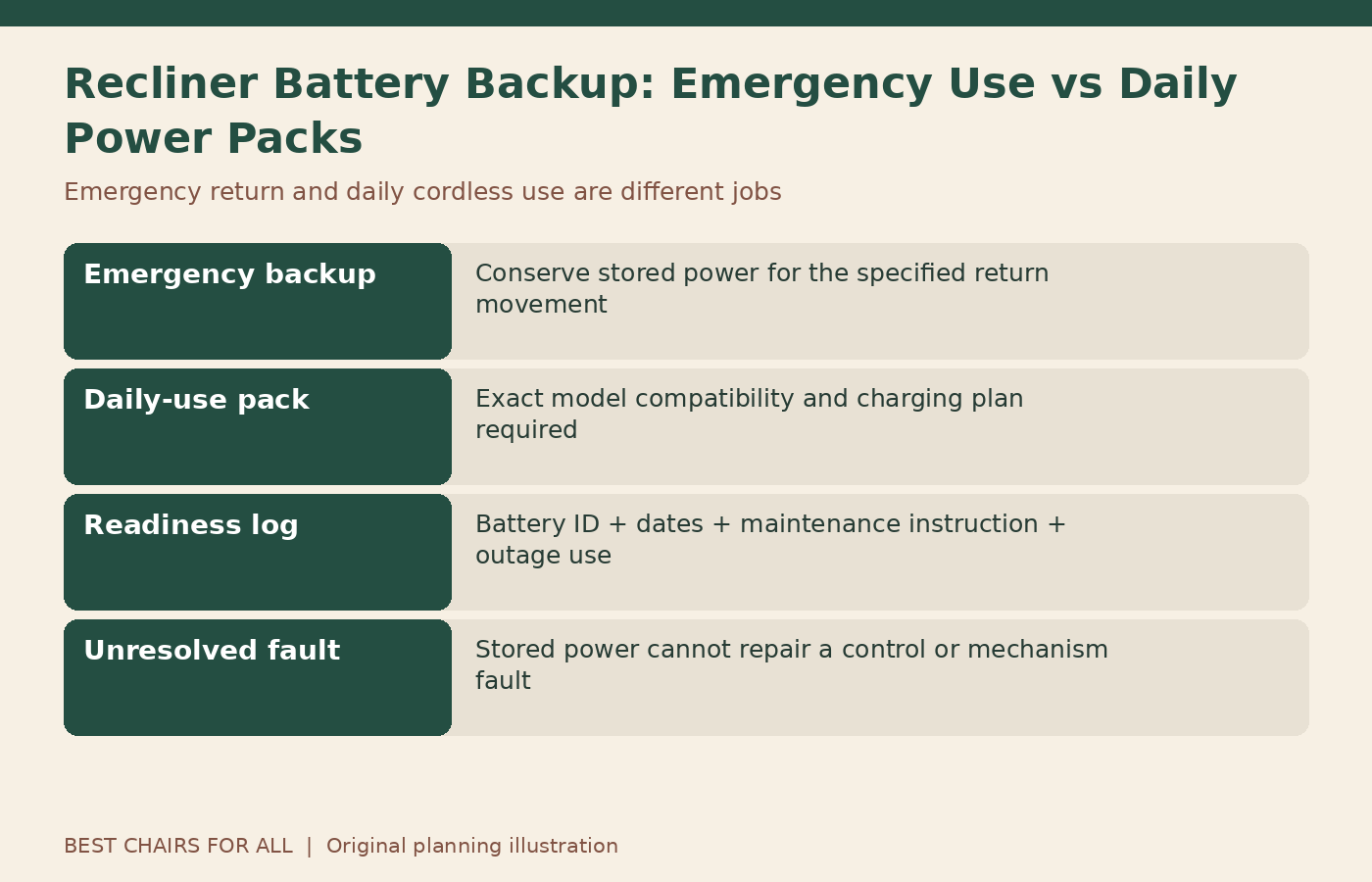
Before buying, ask what the supplied system actually does, which functions remain available, and how batteries are maintained. This guide provides an outage-versus-daily-power comparison record and a readiness log. It avoids promising a universal number of cycles or a guaranteed exit, because performance depends on the model, battery condition, user load, and operating circumstances.
Define the two jobs clearly
Emergency return means conserving available stored power for the movement the manufacturer specifies during loss of mains power. Daily cordless operation means using a compatible rechargeable pack as a routine supply, with a charging plan and documented limitations. Some products can serve both roles, but that must be stated for the exact system. The word backup by itself does not explain the intended duty.
Ask the retailer to write the job in a sentence: this system is intended to return the reclined chair upright, or this approved pack supports routine operation under its instructions. That sentence should reference the chair model and battery product. If the answer remains vague, request the manual before committing to the chair or choosing a room position far from an outlet.
Read a real emergency-backup example
The La-Z-Boy Power Plus DOC016530 manual describes a backup using two 9-volt alkaline batteries for covered products. It states that the purpose is return toward upright closure during interruption, not routine recline, and identifies reduced operation and disabled features. It also specifies replacement timing. These details belong to that manual’s products and are not a universal recipe.
This example shows why a small battery compartment should not be interpreted as a long-duration cordless supply. Ask whether batteries are included, whether the owner must install them, and how readiness is checked under the matching instructions. Do not assume the backup is prepared simply because the sales listing mentions it among the features.
Compare rechargeable systems by intended use
Some manufacturers offer rechargeable lithium-ion packs for compatible furniture. Their installation, charging, and compatibility requirements differ from disposable emergency batteries. A pack described for one product family or regional range should not be assumed suitable for another chair with a similar connector. Obtain a confirmed part number and written compatibility statement from the furniture provider.
La-Z-Boy UK’s after-sales page describes a lithium-ion option with both cordless-operation and outage roles for its supported furniture. That regional information illustrates a category, not proof of US compatibility or availability. For a US chair, use the current US model’s documentation and the provider’s approved accessory list.
Build an outage-versus-daily-power comparison record
Create two columns headed Emergency return and Routine battery use. Under each, ask about intended movements, supported features, compatible models, battery chemistry, charging or replacement method, low-power indication, and service arrangements. Use Not confirmed where the manual does not answer. Do not fill gaps with a cycle count borrowed from another product’s advertisement.
Add a final row for what happens if stored power is unavailable. That question matters most where a user relies on powered movement to leave the chair. A household assistance plan should be appropriate to the individual and developed with the relevant provider or professional when needed. The presence of a battery is not a complete plan for every outage or equipment fault.
Distinguish a power outage from a chair fault
A backup may address unavailable mains electricity while doing nothing for a damaged control, disconnected chair cable, failed motor, or mechanical obstruction. If the chair is unresponsive during an outage, do not assume that installing a different battery will resolve it. Follow the model’s permitted checks and stop for damage, unusual odor, fluid entry, or abnormal movement.
The Pride lift-chair owner manual discusses backup arrangements and troubleshooting for its covered models. Match the instructions carefully because Pride products can use different battery systems. An emergency power feature is part of a specified electrical arrangement, not a substitute for identifying the actual fault.
Do not compare battery capacity numbers alone
A battery’s printed capacity does not directly tell you how many reclining cycles your chair will perform. Motors, loads, motion duration, electronic standby use, and accessory features vary. Two systems with similar advertised capacity can have different compatibility and performance. Avoid calculating a guaranteed operating time from a single label without the manufacturer’s validated conditions.
Ask what any published cycle or duration claim assumes: which chair, which movements, which features, what load, and what state of charge. If those conditions are not supplied, treat the claim as a limited marketing reference rather than a household guarantee. Your readiness plan should not depend on reaching the maximum advertised use before recharging or replacing batteries.
Include every power-consuming feature
USB charging, lights, heat, vibration, headrests, lumbar motors, and wireless systems may behave differently on stored power. Some features may be disabled; others may reduce available operating time. Ask the manufacturer which loads are supported and whether any accessories should be unplugged during battery operation. Do not infer permission from the fact that a feature turns on briefly.
For emergency return, prioritize the manual’s specified operation instead of using the remaining stored energy for optional features. For daily battery use, include accessory habits in the charging plan. A chair used to charge a phone throughout the day may not match the usage conditions behind a furniture-motion claim. Keep the battery instructions with the control guide for other household users.
Follow the exact charging arrangement
Use only the charger and connections approved for the battery and chair. The provider should explain whether the pack charges in place, must be disconnected, or uses another documented arrangement. Do not open the battery case, replace internal cells, alter connectors, or adapt a general-purpose battery to the furniture. Charging instructions are part of compatibility, not an optional convenience detail.
Choose a charging location that follows the product’s temperature, ventilation, moisture, and placement requirements. Keep leads out of walking routes and chair movement. A daily-use pack may remove a mains cord during normal sitting but still require a practical safe route while charging. Include that route in the room plan before assuming the chair can sit anywhere.
Keep a readiness log that matches the system
For disposable emergency batteries, record the installation date, replacement interval stated by the manual, and any outage use that triggers replacement. For a rechargeable pack, record the approved charging instructions, low-power signal, and dates or reminders relevant to your use. Do not impose the replacement schedule of a 9-volt backup on a lithium-ion system or vice versa.
A useful log includes chair model, battery model, maintenance action, date, and source instruction. Store spare batteries only as directed and keep them away from children. If the manual requires replacement after emergency use, update the log immediately rather than leaving the chair apparently prepared with depleted batteries. Record any unexpected behavior for the provider.
Plan a demonstration without wasting emergency capacity
Ask the retailer to demonstrate the backup or explain its approved test procedure before delivery. Do not repeatedly disconnect household power and cycle an emergency-only system to estimate its limit. Such testing can consume the reserve intended for an actual interruption and may fall outside the documented duty. Use the manufacturer’s readiness method instead.
If the chair is part of an individual’s support arrangement, include the user and relevant helper in the explanation of what to do during an outage. Confirm which control action is required and where the instructions will be kept. If the user cannot reliably perform the specified action, discuss an appropriate plan with the provider rather than assuming memory buttons or automatic return will solve it.
Recognize battery and cable warning signs
Stop using a battery system that is visibly damaged, swollen, leaking, unusually hot, or producing an unusual odor, and follow the manufacturer’s service guidance. Do not continue charging to see whether it recovers. Damaged cables or connectors also require an approved repair or replacement. If there is an immediate fire or electrical emergency, prioritize emergency assistance over furniture troubleshooting.
Do not dispose of rechargeable batteries through an improvised method. Ask the manufacturer or local battery-collection service about the correct route for the specific battery, especially if it is damaged. Keep identifying information available for that conversation. A battery’s chemistry and condition matter to handling, so a general household-battery assumption may be inappropriate.
Ask about warranty and replacement availability
A chair’s mechanism warranty may not provide the same coverage for its battery, charger, or external supply. Obtain the battery-specific terms, replacement route, and expected service support in writing. Ask whether replacement parts must be installed by a technician and whether labor or shipping is included. Do not infer battery life from the length of the chair-frame warranty.
If an approved pack is discontinued, ask for a manufacturer-confirmed successor rather than buying a visually similar substitute. Record the new part number and any revised charging instructions. A replacement that connects physically may still be electrically incompatible or outside the chair manufacturer’s supported system. Confirmation is especially important when several furniture brands share component suppliers.
Decide which system actually meets the need
If the goal is an occasional outage return, select a chair with a documented backup arrangement and a realistic maintenance and assistance plan. If the goal is routine placement away from an outlet, confirm an approved daily-use pack and workable charging routine. If neither can be verified, reconsider the room location or power arrangement instead of treating backup as a promise of unlimited cordless use.
Keep the completed comparison record, readiness log, and exact manuals with the chair. Revisit them after an outage, replacement battery, or change in the user’s needs. The useful answer to whether a power recliner works without electricity is therefore specific: only through its documented stored-power system, within that system’s limits, and with readiness maintained as instructed.
Something unclear or out of date? Send a correction with this article’s title and the detail to check.
Sources, research & corrections policy ↗