A hook-on high chair is supported by the table, so table compatibility is a safety requirement rather than a convenience feature. Check the exact chair manual against the tabletop material, thickness, edge shape, underside obstructions and table support before attaching it or seating a child.
Start with the table as the supporting structure
The CPSC hook-on chair guidance defines this type of chair as a legless seat supported solely by the table on which it is mounted. That makes a hook-on chair fundamentally different from a booster resting on an adult chair. The table must be an allowed structure under the manufacturer’s instructions, and the clamping surfaces must meet its requirements.
A table can feel solid when used for plates and still be prohibited for a suspended child seat. A glass top, a loose top or a leaf can be disallowed regardless of apparent thickness. Do not apply body weight, hang from the edge or use a child as a test load to see whether the table can cope. Read the exclusions first; an excluded table does not proceed to the measurement stage.
Use one model’s dimensions as an example, not a universal range
The Inglesina USA Fast Table Chair FAQ gives a tabletop thickness range of 0.8 to 3.5 inches and requires at least 3.25 inches between the table edge and an underside skirt. It also requires full contact for the relevant upper arms and lower clamps. Those figures are for the Fast configuration described by that source. Other hook-on seats and older manual revisions can differ.
Record the model and manual revision alongside the range. A search result for an older Fast manual can show a different thickness limit, so do not choose the more permissive number without resolving which document belongs to the chair. The physical chair label and manufacturer confirmation should settle the question. On travel days, bring the matching instructions, not only a screenshot that omits the table exclusions.
Measure thickness at the actual contact zone
Use a ruler or suitable measuring tool on the empty table. Measure the thickness where the chair’s upper arm and lower clamp will contact, not at a decorative area farther from the edge. A bullnose, bevel or built-up edge can make the visible edge thickness different from the flat load-bearing surface. Identify any changing thickness along the arm’s insertion path.
Do not assume a maximum clamp opening establishes safe compatibility. A clamp may physically fit around a thick molding while lacking the full upper and lower contact the manufacturer requires. Likewise, a thin central panel behind a thick edge may not provide the intended lower bearing surface. If the geometry cannot be matched clearly to the manual, ask Inglesina or the relevant manufacturer and use another suitable dining arrangement meanwhile.
Inspect the underside before attaching anything
An apron or skirt runs below the table and can stop the arm or clamp from reaching its intended position. Measure its distance from the edge at the exact seat location. Look for rails, brackets, extension mechanisms, drawers and reinforcing blocks. An unobstructed spot near one corner does not establish that the center of the same table is suitable.
Photograph the underside in relation to the edge, with the measuring points labeled. Do not remove a table support or loosen a rail to create clearance. A folding leaf or extension joint can create a separate prohibited condition even if there is enough room around the hardware. Consider the whole table configuration being used that day, including whether an extension is installed or the top is removable.
Read the prohibited table list literally
The Inglesina FAQ excludes glass tables, loose tops, leaves, card tables, single-pedestal tables, tablecloths and placemats for the Fast. The manufacturer’s Fast instructions also emphasize stable support and table-profile restrictions. An attractive central-pedestal restaurant table does not become acceptable because the top is thick wood.
Do not place padding, a folded cloth, a silicone mat or an improvised shim between the chair and table to improve grip or protect the finish. Such an addition can change the contact surfaces and is not authorized by a general claim of compatibility. If an approved seat could mark a valuable finish, discuss that concern with the table and seat manufacturers or select a different feeding seat. Protecting the finish cannot take priority over the required installation.
Check what the child could push against
The surrounding space matters as well as the clamp. Read the warnings about nearby structures and keep the child from having an ordinary chair underneath or other supports they can use to push away, as specified by the product instructions. Do not add a stool as a “backup” under the suspended seat. That can introduce the very pushing opportunity the warnings address.
Check table legs, island cabinetry, walls and adjacent seating in the actual dining position. A location clear in an empty room may change when another adult slides a chair beneath the table. Explain the required space to everyone at the meal. Do not allow another child to pull, climb or hang on the hook-on seat. Keep reachable hot objects, cords and sharp utensils outside the child’s access.
Separate table eligibility from child eligibility
The chair’s instructions also specify who may use it, including the child’s ability and size limits. A compatible table does not make a child eligible, and a child within a stated weight limit does not make an unsuitable table acceptable. Follow the required restraint procedure and keep the child in view. If there is uncertainty about the child’s sitting support, ask their clinician rather than using an insert or improvised padding to force a fit.
Hook-on seating is for the documented dining use. It is not an infant sleep product, vehicle restraint or a chair to carry while occupied. Do not lift or reposition the table with the child in the seat. Follow the manual for installation, pre-use checks and removal, keeping children away while hardware is being adjusted. A product’s portable label describes transport convenience, not permission for occupied transport.
Make travel compatibility a destination question
Before visiting a restaurant or family home, ask about the table type and obtain photographs of the edge and underside when practical. Bring an alternative suitable arrangement if compatibility cannot be confirmed. Staff may know that a table is sturdy without knowing its construction, attachment or edge profile. Do not ask them to approve a configuration contrary to your seat’s manual.
At the destination, repeat the table and surrounding-space checks rather than relying on a previous visit. A different dining table, added cloth, relocated seating or changed top can alter the result. If the manual leaves a question unresolved, choose the alternative and contact the manufacturer later. A portable chair is useful only when the destination supports its intended installation; declining an incompatible surface is part of using it correctly.
Hook-on table compatibility: stop-or-continue worksheet
| Check | Evidence and decision |
|---|---|
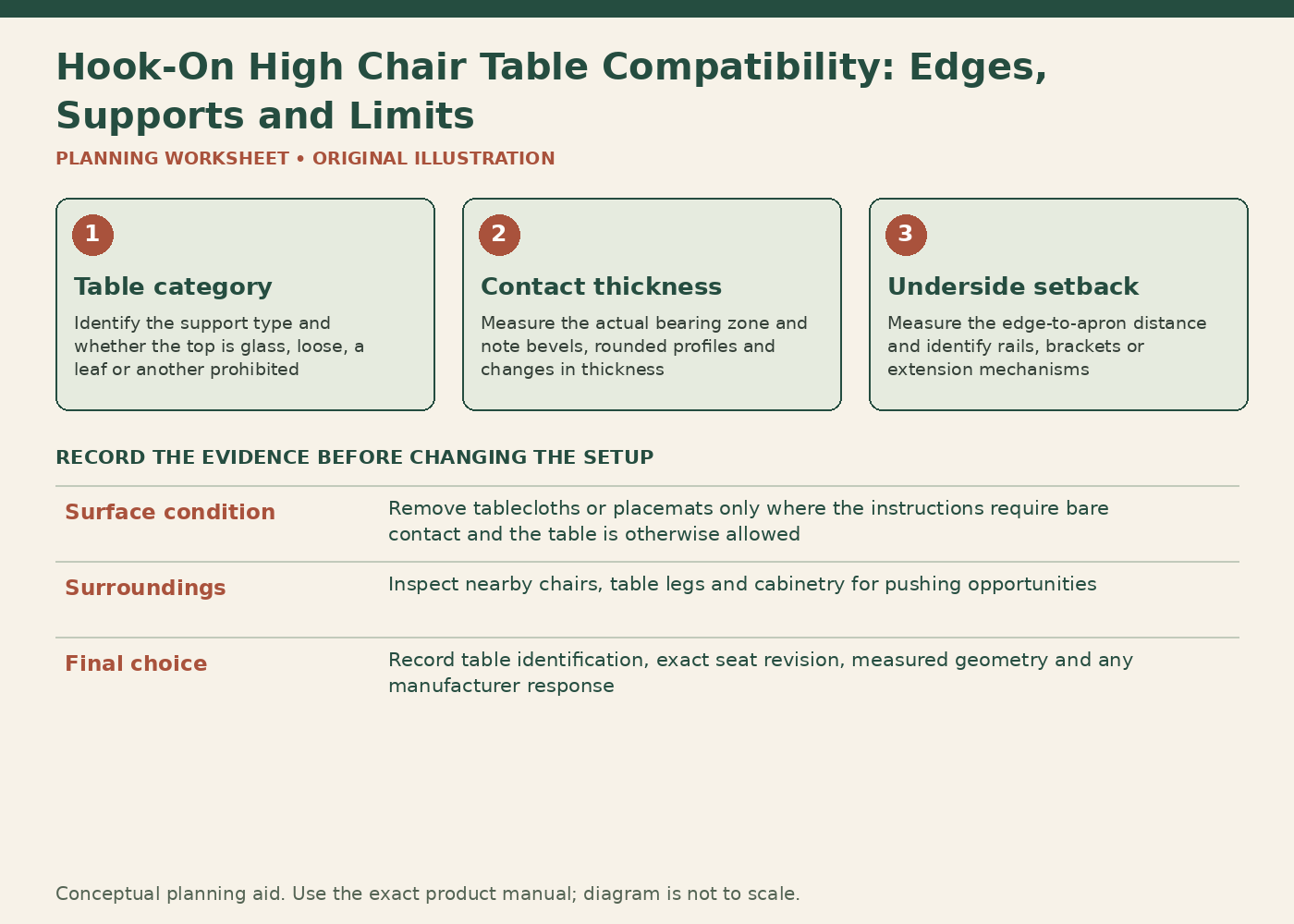
| Table category | Identify the support type and whether the top is glass, loose, a leaf or another prohibited construction. Apply the manual’s exclusions before measuring. A failed category check ends the assessment even if the clamps appear to reach. |
| Contact thickness | Measure the actual bearing zone and note bevels, rounded profiles and changes in thickness. Compare with the exact chair’s limits. Do not equate a clamp’s ability to open around an edge with full approved contact. |
| Underside setback | Measure the edge-to-apron distance and identify rails, brackets or extension mechanisms. For the cited Fast FAQ, the skirt setback is at least 3.25 inches. Other models need their own figure and contact geometry. |
| Surface condition | Remove tablecloths or placemats only where the instructions require bare contact and the table is otherwise allowed. Do not add padding or a grip mat. If finish protection creates a conflict, use another suitable dining seat. |
| Surroundings | Inspect nearby chairs, table legs and cabinetry for pushing opportunities. Preserve the manufacturer’s required clear environment throughout the meal. An ordinary chair beneath the suspended seat is not a backup support plan. |
| Final choice | Record table identification, exact seat revision, measured geometry and any manufacturer response. If any required condition remains unresolved, select the alternative seating arrangement. A passed measurement does not replace restraints, supervision or child eligibility. |
Worked example
Consider three hypothetical tables for the Fast described by the current US FAQ. Table A is a single-pedestal table with a 1.25-inch wooden top. Its thickness falls within the listed range, but the support type is excluded, so the assessment stops. Table B has four legs and a 1.5-inch top, but its apron begins only two inches from the edge. It fails the cited skirt-setback requirement even though the surface thickness looks promising.
Table C has an allowed support structure, a 1.5-inch top and four inches of underside setback. Those measurements address only part of compatibility. The caregiver must still confirm the edge profile, full arm and clamp contact, stability, condition, surrounding space and the matching manual’s other requirements. Table C is a candidate for the complete documented check, not automatically an approved installation. This order prevents a common error: measuring one favorable dimension and allowing that number to override a separate exclusion.
Sources checked November 6, 2026
Use the current document for the exact model, market and production revision. These sources establish the cited instructions and distinctions; they do not certify an individual chair or replace a personal assessment where one is needed.
- Inglesina USA: Fast Table Chair compatibility FAQ
- Inglesina: Fast Table Chair instructions
- CPSC: Portable hook-on chair definition and safety requirements
- CPSC: Resellers Guide to Selling Safer Products, 2025
- CPSC recalls and product safety warnings
Something unclear or out of date? Send a correction with this article’s title and the detail to check.
Sources, research & corrections policy ↗