A traditional papasan supports a loose cushion in a rigid bowl above a separate base. A folding saucer chair usually stretches a padded fabric seat across a metal rim attached to folding legs. Both can create a rounded, relaxed seat, but their frames, cushion replacement options, and storage routines are quite different.
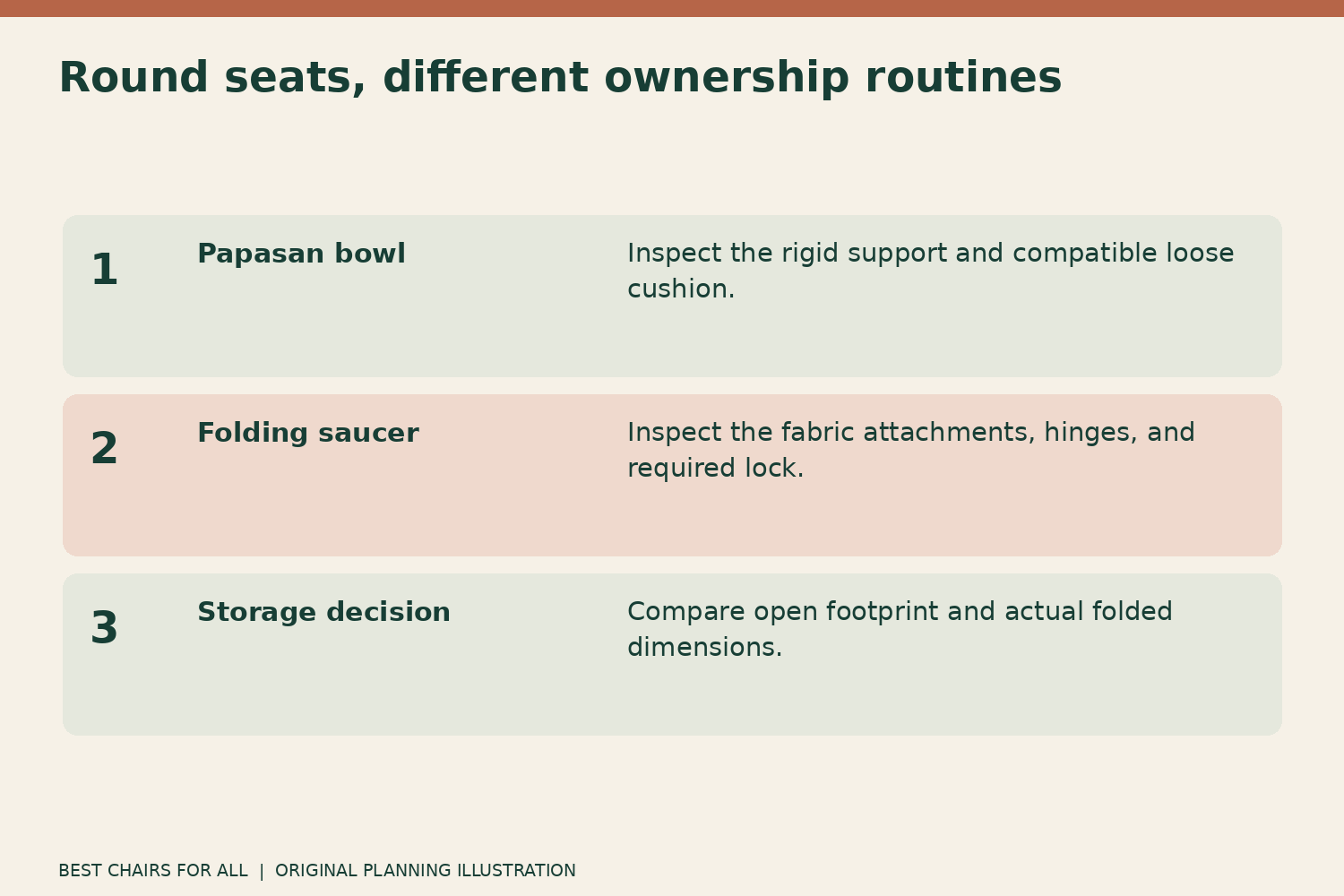
Choose by deciding whether the chair will stay assembled as a permanent living-room seat or be put away between uses. Then inspect the exact construction. Retailers sometimes use papasan, saucer, moon chair, and bowl chair loosely, so the name alone cannot establish whether a chair folds, swivels, or has a removable cushion.
Follow the load path through the frame
In a traditional papasan, the bowl forms a continuous support beneath the cushion. The bowl then transfers load to the base through its designed contact or attachment points. Rattan versions may use bent poles and wrapped bindings; modern versions can use a metal frame and synthetic weave. Those are materially different products despite sharing the rounded silhouette.
World Market’s rattan papasan frame is a documented example of the separate-base-and-bowl arrangement. Its specification describes bent pole rattan and rattan-peel binding, with the cushion sold separately. That separation gives you access to both the cushion and the support structure when inspecting or maintaining the chair.
A typical folding saucer chair has a different load path. Fabric and padding span the seat rim, and the rim connects to the folding leg frame. Inspect seams, attachments, hinges, and locking features rather than looking for rattan bindings. A torn seat or damaged hinge is not equivalent to a worn loose papasan cushion; it may affect the chair’s structural function.
Understand the cushion difference
A loose papasan cushion can often be replaced independently when the frame remains sound, provided a compatible cushion is available. The replacement has to suit the bowl’s size and shape. A large round floor cushion is not automatically a suitable substitute, because thickness, tufting, filling, and overhang affect how it rests in the frame.
For instance, World Market’s corduroy papasan cushion is specified for its papasan frame and has its own care directions. The product is listed at 52 inches in diameter and 6 inches high. Those are cushion dimensions, not the diameter of every compatible-looking chair frame.
On a saucer chair, the padded seat may be attached as an integrated component rather than supplied as a replaceable cushion. Ask whether the cover is removable, whether removal is intended for cleaning, and whether replacement seat assemblies exist. A zipper is not enough evidence that a seat can be safely removed or machine washed.
This difference affects long-term ownership. A papasan frame with a tired cushion may have a straightforward replacement route. A folding saucer chair with a worn load-bearing fabric seat may require a manufacturer-supplied component or retirement. Do not improvise a sling, cut attachment straps, or add a cushion to conceal structural fabric damage.
Compare how each seat feels when occupied
A papasan’s rigid bowl can create a deep enclosed posture, with the loose cushion determining how much of the rim and weave you feel. A saucer seat can flex between its attachments, giving a more suspended feel. Neither effect tells you whether the seat will support your preferred reading or television posture comfortably.
Try sitting back, placing both feet down, changing position, and standing. Notice whether the seat edge contacts the backs of your thighs and whether the rounded rim constrains your shoulders. The user should not have to perch on an unsupported edge to make the chair work. Stop the trial if the frame feels unstable or the position is uncomfortable.
Bring the item you normally use in the chair, such as a paperback or game controller. Rounded seats can put the arms and elbows in a different position from a conventional armchair. If you want sustained forearm support, inspect the actual contact area rather than assuming the wide rim functions like an armrest.
Foldability changes storage, not just floor space
A folding saucer chair can be useful when a room alternates between seating and open floor. Walmart’s Mainstays adult microsuede saucer chair is an example with a foldable steel frame designed for flat storage. Its own listing specifies the intended model and load information; those details should not be generalized to other saucer chairs.
Measure the folded width, height, and thickness, not only the open chair. A flat folded chair can still be too wide for a closet opening or too tall for the chosen shelf. Also check the space needed to open it fully. A storage location is only convenient if you can remove and unfold the chair without moving several other objects.
Practice the folding sequence with the exact instructions. The chair must be empty, and fingers, clothing, and loose items need to remain clear of hinges. Confirm that any required lock is engaged before use. If the mechanism does not open or lock normally, do not force it or bypass the feature to make storage quicker.
A traditional papasan does not become compact simply because the bowl separates from the base. The bowl remains a large rigid object, and the loose cushion requires its own dry storage area. Confirm permitted separation and handling; some modern papasan designs are bolted together and are not intended for frequent disassembly.
Use a weekly-use worksheet
This original exercise compares the routines rather than assigning a universal winner. Imagine two rooms: a permanent reading corner and a multipurpose room that needs clear floor space several evenings each week. Fill in the worksheet using the actual models you are considering and your own storage location.
| Question | Papasan evidence | Saucer evidence |
|---|---|---|
| Where does it live during use? | Full bowl and cushion footprint | Open frame and approach space |
| Where does it go afterward? | Usually remains assembled | Measured folded storage slot |
| What wears independently? | Loose cushion, bindings, frame | Fabric attachments, hinges, feet |
| What can be replaced? | Compatible cushion if available | Only manufacturer-supported parts |
| What is the daily action? | Position cushion and inspect support | Open fully and verify required lock |
In the permanent reading corner, a compatible replaceable cushion may matter more than folding. In the multipurpose room, frequent storage can make a rigid bowl inconvenient even if it is comfortable. Conversely, a folding chair that is difficult for its intended user to open will not deliver its theoretical storage advantage.
Plan the occupied footprint accurately
A papasan base is normally narrower than the bowl. Keep the projecting rim clear of walls, tables, and neighboring chairs at its actual height. For a saucer chair, include the spread of the open legs, which may extend beyond the seat projection. Measure both products assembled in their intended operating positions.
Do not compare a papasan’s bowl diameter with a saucer chair’s folded width. Use open overall width and depth for room planning, then separately compare the storage envelopes. If either chair swivels or rocks, add its actual movement envelope. Motion is a model feature, not an automatic property of either name.
Check the exit route with someone seated. A deep round seat can require feet to be placed farther forward before standing, and a folding frame can create low projections near the path. Keep a side table and any footstool outside that ordinary movement. A taped rectangle becomes more useful when it includes the user’s actions.
Compare cleaning access and drying
A removable papasan cushion can give access to the entire bowl, but the cushion itself may be bulky and spot-clean-only. Follow its exact label. The cited World Market corduroy cushion specifies spot cleaning; its loose form does not authorize machine washing or soaking. A thick filling can be difficult to dry if too much moisture reaches the interior.
For a saucer chair, check the seat’s instructions before applying liquid. An integrated fabric assembly can hide seams and padding against the frame. Clean only as directed and allow the permitted areas to dry fully before folding for storage. Trapping moisture in a closed folded chair is an avoidable maintenance problem.
Inspect the floor-contact components during cleaning. Missing caps, rough edges, loose bindings, or damaged feet deserve attention according to the manufacturer’s guidance. Do not attach improvised pads where they could interfere with a folding joint or lock. Protection for the floor must remain compatible with the chair’s normal operation.
Read load and intended-use information per model
The Mainstays example lists support up to 225 pounds, but that figure applies to the listed product. Do not extend it to a visually similar chair, a different size, or a secondhand version without identification. Also distinguish an adult model from seating designed for another user group; similar fabrics and silhouettes do not establish equivalent construction.
For either design, inspect the label and manual for intended indoor or outdoor use. Rattan appearance does not establish weather resistance, and a folding chair is not automatically camping furniture. The cited World Market frame is for indoor use. An outdoor-rated cushion cannot convert an indoor frame into an outdoor chair.
Choose the papasan when its fixed bowl, compatible cushion options, and permanent footprint fit your routine. Choose the saucer chair when its exact seat support and folding process work for you and the measured storage space exists. The practical advantage comes from the frame and ownership routine, not from which rounded-chair name appears more inviting in the listing.
When comparing ownership cost, price the complete usable seat rather than the advertised frame alone. A papasan listing may exclude its cushion, while a saucer chair may include the integrated padding. Add any verified replacement component and delivery charge to your worksheet. Leave unavailable replacement prices blank instead of assuming that inexpensive-looking fabric will be cheap or practical to replace later.
Something unclear or out of date? Send a correction with this article’s title and the detail to check.
Sources, research & corrections policy ↗