A papasan chair has several different sizes worth knowing: the bowl diameter, the base footprint, the assembled outside dimensions, and the cushion size. Those numbers are rarely identical. The bowl usually projects beyond its base, and a cushion can be intentionally larger than the rim because it follows the curved seat. Measure the component named in the specification rather than treating every diameter as the chair’s floor footprint.
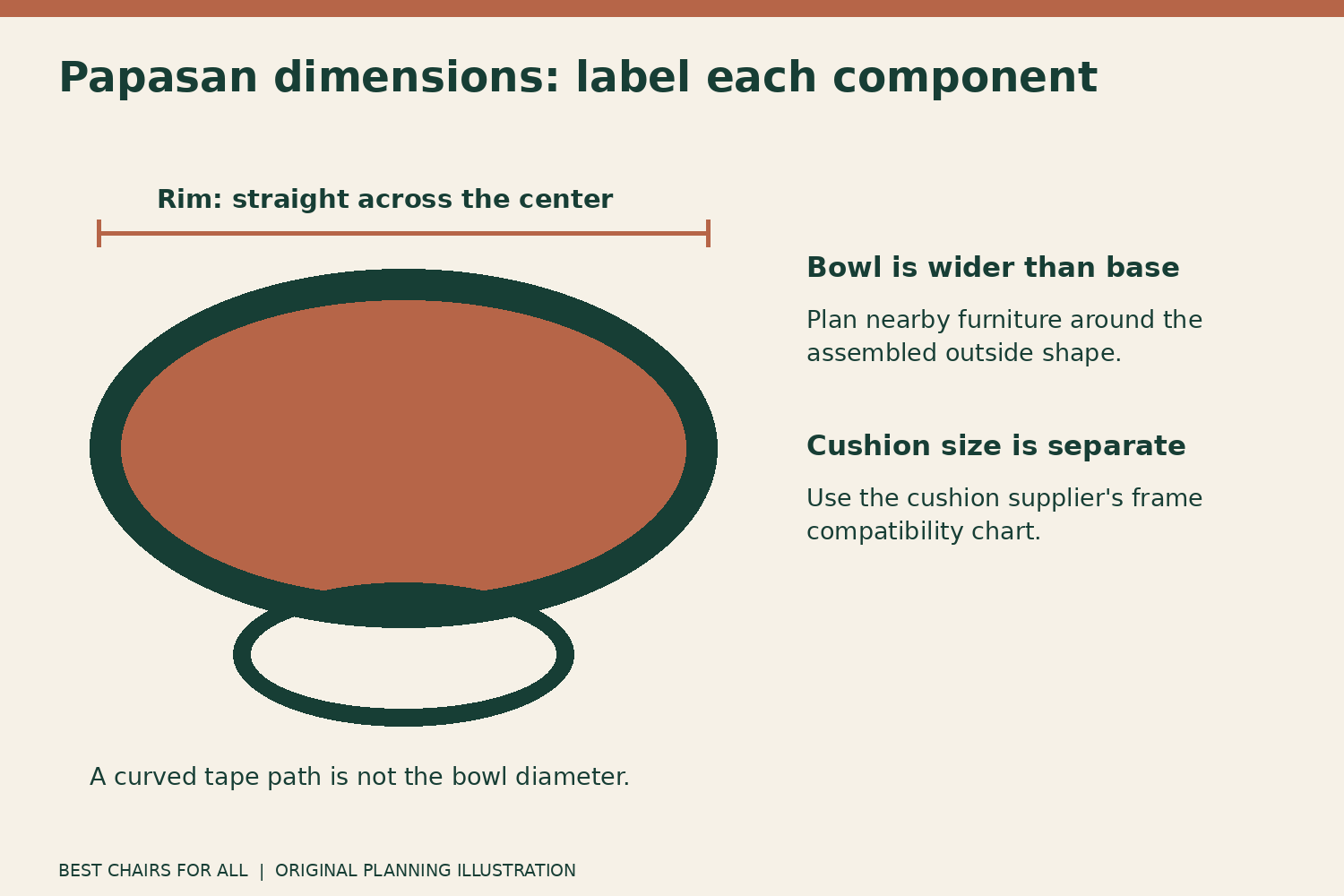
This distinction matters when buying a chair, replacing a cushion, or deciding whether a papasan fits a corner. A narrow base may make the chair look compact in a photograph, while the bowl occupies much more width at arm height. Use the full assembled shape for room planning and the manufacturer’s compatibility information for cushion selection.
What bowl diameter tells you
Bowl diameter is the straight distance across the circular rim, through its center. It does not follow the curve into the seat. Measure rim to rim with the cushion removed if the chair’s instructions allow normal removal. Take a second diameter at right angles to the first, especially on an older handmade frame that may not be perfectly round.
World Market’s rattan papasan frame provides a useful documented example: the bowl is listed at 45 inches in diameter and 13½ inches high, while the base is listed separately at 27½ inches in diameter and 12 inches high. These describe different components of the same chair.
Do not use a flexible tape draped over the bowl as its diameter. That measures a curved path and gives a longer result. Curved measurements can be useful if a cushion maker specifically requests them, but they need a different label. Record “straight rim diameter” and “curved interior span” separately so a supplier knows which number you mean.
Why the base footprint is smaller
The base supports the bowl near its center and does not normally extend to the outside rim. In the World Market example, subtracting the 27½-inch base diameter from the 45-inch bowl diameter gives 17½ inches. With concentric horizontal circles, that represents an illustrative overhang of 8¾ inches on each side. The assembled tilted chair has a more complicated outline.
That arithmetic explains why measuring only the base can seriously understate the chair’s presence. A side table, wall, or neighboring seat can collide with the bowl above the floor even when the base has ample space. Use the maximum outside width at the relevant height when placing nearby furniture.
A base diameter also does not establish stability, load capacity, or whether the bowl may be repositioned. Those are product-specific design questions. Follow the assembly instructions for how the bowl sits on or attaches to the base. Do not improvise wedges, risers, or a replacement support to change the angle without the manufacturer’s approval.
Read overall width, depth, and height separately
When a circular bowl is tilted, its front-to-back projection changes, and the rear rim rises. Consequently, a chair with a round bowl can have different assembled width and depth. The cushion adds thickness beyond the frame and can alter the highest and foremost points. A diameter alone cannot describe that three-dimensional envelope.
World Market lists its example frame overall at 45 inches in diameter by 36 inches high. Use the seller’s assembled specification as the starting point, then confirm the orientation and cushion allowance that apply to the exact setup. If a listing mixes a frame-only measurement with a photograph showing a cushion, ask which configuration its dimensions represent.
For an existing chair, measure the maximum width, maximum front-to-back depth, and maximum height in its intended assembled position. Keep the tape straight and use a second person or a vertical reference beside projecting edges. Do not lean on the rim to make it fit a measurement or change the bowl position while somebody is seated.
Cushion diameter is a compatibility specification
A papasan cushion is not merely a flat disc laid across the top of the bowl. It settles into the curved interior and typically extends over the rim. This is why a cushion can have a larger advertised diameter than the bowl it is intended to cover. The needed difference depends on the supplier’s construction and fit guidance.
For example, World Market’s cotton-woven papasan cushion is listed at 52 inches in diameter and 6 inches high and is specified for that retailer’s papasan frame. The cushion’s 52-inch figure is not evidence that the associated frame has a 52-inch bowl.
Another supplier uses a different sizing relationship. Papasans Unlimited’s single-papasan sizing information maps its 44-inch cushion to a 42-inch frame and its 48-inch cushion to a 46-inch frame, while offering larger options for some frames. Follow the supplier’s actual chart rather than inventing a universal rule to add a fixed number of inches.
For replacement shopping, provide the frame brand and model if known, straight rim diameter, bowl depth, and photographs. Also ask whether the cushion’s advertised measurement is taken flat, over the filled surface, or under another method. A thick tufted cushion’s nominal size can be difficult to reproduce with a tape after years of compression.
Usable sitting space is smaller than the rim suggests
A 45-inch rim does not provide a 45-inch-wide flat seat. The bowl curves upward, and the cushion occupies part of the interior. Your sitting position depends on where the cushion compresses and where the slope begins. This makes conventional armchair seat-depth comparisons imperfect: the papasan’s center and sides do different jobs.
Try the chair with the intended cushion. Sit upright, then move into your usual relaxed position. Notice whether you settle too deeply, whether the rim is perceptible through the padding, and how your feet reach the floor. A very thick replacement cushion can change your height and position within the bowl rather than simply making the same seat softer.
Also test leaving the chair. A deep, curved seat may feel enclosing but require a movement that does not suit every user. The rim should not be treated as a guaranteed weight-bearing grab point. Follow the intended use, and choose another seat type if the ordinary entry or exit feels difficult for the person using it.
A five-number papasan worksheet
Use this original worksheet to keep component measurements from becoming mixed together. The documented examples refer to the World Market products above; the personal-fit entries must come from an occupied trial. When comparing another brand, replace every example value with that brand’s actual information rather than assuming interchangeability.
| Number | What to record | Example or method |
|---|---|---|
| Rim diameter | Straight across the bowl’s center | 45 inches for the cited frame |
| Bowl height | Depth of the bowl component | 13½ inches for the cited frame |
| Base diameter | Outside width of supporting base | 27½ inches for the cited frame |
| Assembled envelope | Maximum width, depth, and height | Confirm orientation and cushion allowance |
| Cushion compatibility | Supplier’s intended frame match | 52-inch cited cushion for its specified frame |
Add a note for the occupied seat: where your feet rest, whether you feel the rim, and whether you can change position comfortably. This is deliberately descriptive rather than a single “seat depth” number. A bowl-shaped chair needs more information than a rectangular cushion when you are deciding how it will support you.
Plan a corner using the widest part
Mark the assembled outside envelope on the floor. If the chair is placed diagonally, rotate the outline to match, and remember that a round bowl still projects beyond a smaller base. Use a cardboard panel or boxes near rim height to visualize conflicts with a table, wall, windowsill, or curtain.
Leave a practical approach and exit route. The space in front of the bowl may need to remain open so the user can place their feet and stand normally. If a footstool is added, include it in the trial. Avoid planning a route that requires stepping over the base or squeezing beside the projecting rim.
For a swiveling papasan, the turning envelope requires a separate check. A circular-looking bowl may have projections, a tilted back, or an off-center relationship to its pivot. Measure the actual model through its permitted movement and keep nearby objects clear. A fixed rattan bowl resting in a base should not be assumed to swivel simply because another papasan does.
Check transport and replacement parts
A bowl can be bulky even when it separates from the base. Ask whether the chair is delivered assembled, in components, or in a box, and obtain the dimensions of the largest delivered piece. A 45-inch round rim may pass an opening in one orientation but still need room to rotate on both sides of the doorway.
For a secondhand frame, inspect the bindings, rim, base, and joints before spending money on a cushion. Dimensional compatibility cannot correct a cracked support or loose structural connection. Confirm whether the frame is intended for indoor use; the cited World Market rattan frame is indoor-only, so a sunroom or patio location needs that limitation considered.
Keep the final worksheet with a photograph and model label. If the cushion eventually wears out, you will already have the frame information that matters. The most useful papasan dimension is not the largest number in the listing; it is the correctly labeled measurement for the decision you are making.
When working across inches and centimeters, retain the original published unit beside your conversion. For example, 45 inches converts to 114.3 centimeters, but a handmade frame should not be assumed accurate to a tenth of a centimeter because the conversion has a decimal. Measure the actual rim if the cushion fit is close, and give the supplier both perpendicular readings rather than rounding them into a more convenient nominal size. Manufacturing variation and measurement precision are different issues.
Something unclear or out of date? Send a correction with this article’s title and the detail to check.
Sources, research & corrections policy ↗