Zero gravity on a massage chair is a manufacturer-defined reclined position, usually combining a lowered backrest with an elevated legrest. It does not remove gravity, make the body weightless, or establish a medical outcome. Treat it as a positioning preset whose comfort, room requirements, and controls need to be checked on the exact chair.
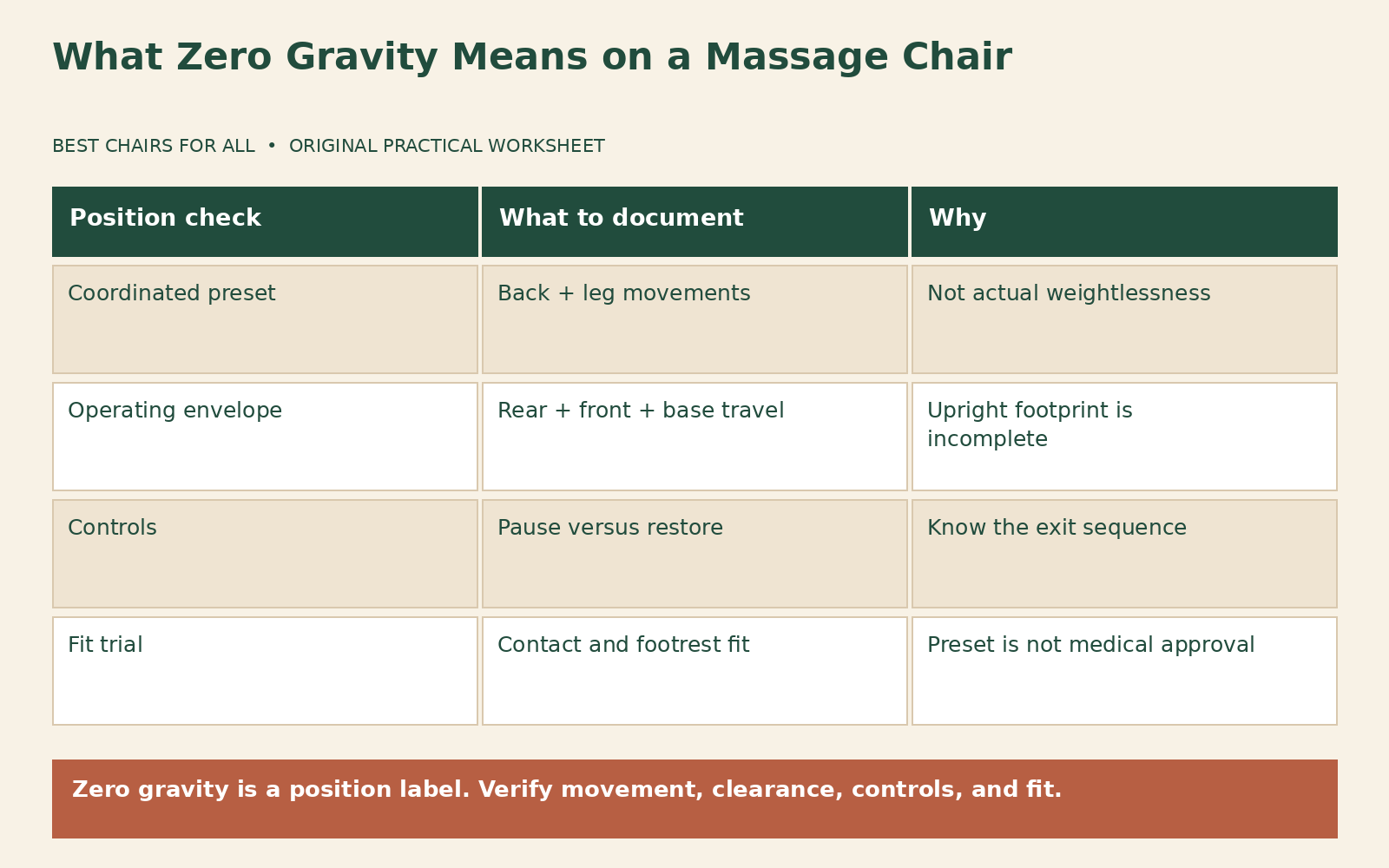
The useful buying questions are mechanical: what moves, how many preset positions exist, can the backrest and legrest move independently, and how does the chair return upright? Read the manufacturer’s safety information before use. For health-related suitability questions, consult a qualified clinician rather than assuming the zero-gravity name makes a position appropriate for you.
Translate the name into visible movement
A chair can recline the back, raise the legs, slide its base, or combine those movements. Zero gravity usually names one coordinated arrangement of those parts. The resulting angles and heights vary by design and by where a user sits within the padding. Do not assume that every zero-gravity chair reaches one universal numerical angle or that a photograph proves the same geometry across brands.
The Human Touch Super Novo 2.0 controller guide identifies a ZeroG button and describes raising the feet above the heart. That is the manufacturer’s explanation of its preset. It does not supply a clinical measurement of the user’s actual body position, and this article does not adopt the guide’s promotional relief language as a promised benefit.
Infinity’s Celerity manual describes a zero-gravity indicator and notes that manually changing backrest or legrest position takes the chair out of that preset. That example clarifies the difference between a named coordinated position and any position with the legs raised. Read the manual for your model to learn what its status indicator actually means.
Separate zero gravity from massage functions
Positioning and massage are different functions even when a program combines them. A zero-gravity button may change the chair’s geometry without selecting a roller technique. An automatic program may include a position change while also changing rollers and air pressure. Determine which actions occur before starting. Do not assume turning off one massage feature stops all powered movement or returns the chair upright.
Human Touch’s Super Novo 2.0 use-and-care material lists separate controls for backrest, legrest, footrest extension, massage intensity, and other functions. These distinctions help you read the remote as several systems rather than one relaxation button. They do not mean another chair uses the same button layout or stop sequence.
A different position can change how firmly your body contacts the massage mechanism. That does not establish that the massage became medically stronger or more effective. If the position makes the experience uncomfortable, stop and use only the permitted adjustments. Do not chase a deeper recline as a way to make a program “work better.” Comfort and appropriate use remain separate from the feature name.
Check the full moving envelope
Measure the chair in its upright and fully operated configurations using the manufacturer’s dimensions and clearance diagram. Include footrest extension, backrest movement, base travel, and any required gap behind the chair. A space-saving mechanism can reduce rear-wall clearance while still needing substantial length in front. “Wall hugger” does not mean the chair can touch a wall or operate inside its upright footprint.
Check nearby tables, lamps, shelves, curtains, and cables. An object can sit outside the upright outline but inside the moving envelope. Do not test clearance by letting the chair push against it. Use the documented dimensions to plan the area, then keep the space clear during the prescribed first operation. Ask the manufacturer for missing dimensions rather than estimating from a lifestyle photograph.
Overhead clearance also deserves attention when shelves or sloped ceilings are nearby. The tallest point may occur upright or during transition, not at the final reclined endpoint. Include room for a person to sit and stand as well as the furniture itself. If the manual supplies only rear clearance and overall height, request clarification about the intended location rather than treating those two numbers as a complete installation plan.
Know the exit sequence before reclining
Locate the stop, pause, power, and restore controls and read what each does. A pause function may stop massage without returning the chair upright. A power action may start a return sequence, or may behave differently depending on how long it is pressed. These are model-specific operations. Practice identifying the controls while the chair is in its normal ready state, following the manual, before relying on them during use.
Keep the remote in its intended holder or within easy reach. Do not place it where it can fall behind the chair or into a moving gap. If the model uses an app or voice control, retain the documented physical control method as instructed. Network availability or a phone battery should not be assumed to replace the chair’s specified operating and emergency procedures.
Wait for the chair to complete the instructed return movement before leaving. Do not climb over an elevated footrest, stand on it, or use it as a step. Keep children, pets, and other people away from moving gaps according to the manufacturer’s warnings. If the chair stops in an unusual position or loses power, follow the manual’s procedure and contact support rather than forcing the mechanism by hand.
An original position-and-room worksheet
Draw two outlines: upright and zero-gravity operating envelope. Add arrows for backrest motion, footrest extension, and base travel if the model has it. Write confirmed dimensions beside the arrows and mark unknowns explicitly. Include a separate walking route and the place where the user stands to enter and leave. This is a room-planning drawing, not a claim that you measured the chair yourself.
For a hypothetical calculation, suppose the documented operating length is 76 inches and the designated clear area is 88 inches long. The difference is 12 inches before considering the manufacturer’s additional clearance requirements and your access route. That spare length is not automatically enough. If a required rear gap or footrest access consumes it, the installation may still fail. These figures demonstrate the method and are not specifications for a named chair.
Now add a side table that projects six inches into the proposed front area. The upright chair may still look as though it fits, while the extended footrest no longer has the planned space. Move the table on the drawing first rather than operating the chair into it. A room layout is successful only when every required movement and access route remains clear, not when the final reclined photograph looks tidy.
Compare presets without medical claims
During a permitted demonstration, ask the salesperson to show the zero-gravity preset, independent backrest and legrest adjustments, and the normal restore sequence. Ask whether there are multiple presets and how they differ mechanically. Do not accept vague claims about circulation, decompression, or treatment as substitutes for those demonstrations. This guide does not establish those outcomes or recommend a position for a health condition.
Record what you can actually observe: readable controls, tolerable contact, adequate footrest fit, and the ability to return and leave as instructed. Stop if a position is uncomfortable. A brief showroom experience cannot predict every future session, but it can reveal a remote you cannot comfortably reach or a footrest that does not accommodate your proportions.
If multiple household members will use the chair, evaluate each person’s fit separately under the safety instructions. One person’s feet may sit differently in the foot compartment, and shoulder alignment may need a separate scan or adjustment. A shared zero-gravity button does not eliminate those differences. Keep any personal health information private and seek appropriate individual advice where needed.
Read the specification before paying for the label
Ask for the exact model manual and installation dimensions, not only a sales brochure. Confirm whether zero gravity is a single preset or several positions, whether it works independently of massage, and whether manual movement cancels its indicator. Ask how the chair behaves at the end of a program and after interruption. Do not assume these behaviors from another chair in the showroom.
Clarify the difference between a zero-gravity massage chair and an ordinary reclining chair marketed with a similar position. Rollers, airbags, heating, controls, and warranty coverage are separate features. A comfortable recline does not establish the quality of those systems, and a complex massage system does not guarantee a suitable recline for your room or body. Compare each function on its own merits.
Keep a separate line for the chair’s behavior when a program ends. Some users expect automatic upright return while others expect the chair to remain positioned; neither expectation should substitute for the manual. Ask whether massage stops before movement begins and which control starts a normal restore. Do not assume a timer ending means it is time to step over the footrest.
For a room shared with ordinary seating, draw the occupied walking route while the chair is reclined. A person carrying a drink or passing behind the chair should not need to squeeze through the moving area. Check that curtains cannot hang into the mechanism and that the power cord remains outside the travel path. These are layout observations to resolve before operation, not obstacles to discover by testing the chair against them. A slightly different location can sometimes preserve both recline space and routine access without changing the selected preset.
The practical meaning of zero gravity is therefore a coordinated furniture position you can identify, fit into the room, operate, and leave predictably. Your worksheet should show both the moving chair and the person using it. If the geometry or controls do not work for you, the label is not a reason to accept the mismatch. Choose based on documented movement and a tolerable, usable fit, with the manufacturer’s safety information guiding every trial.
Something unclear or out of date? Send a correction with this article’s title and the detail to check.
Sources, research & corrections policy ↗