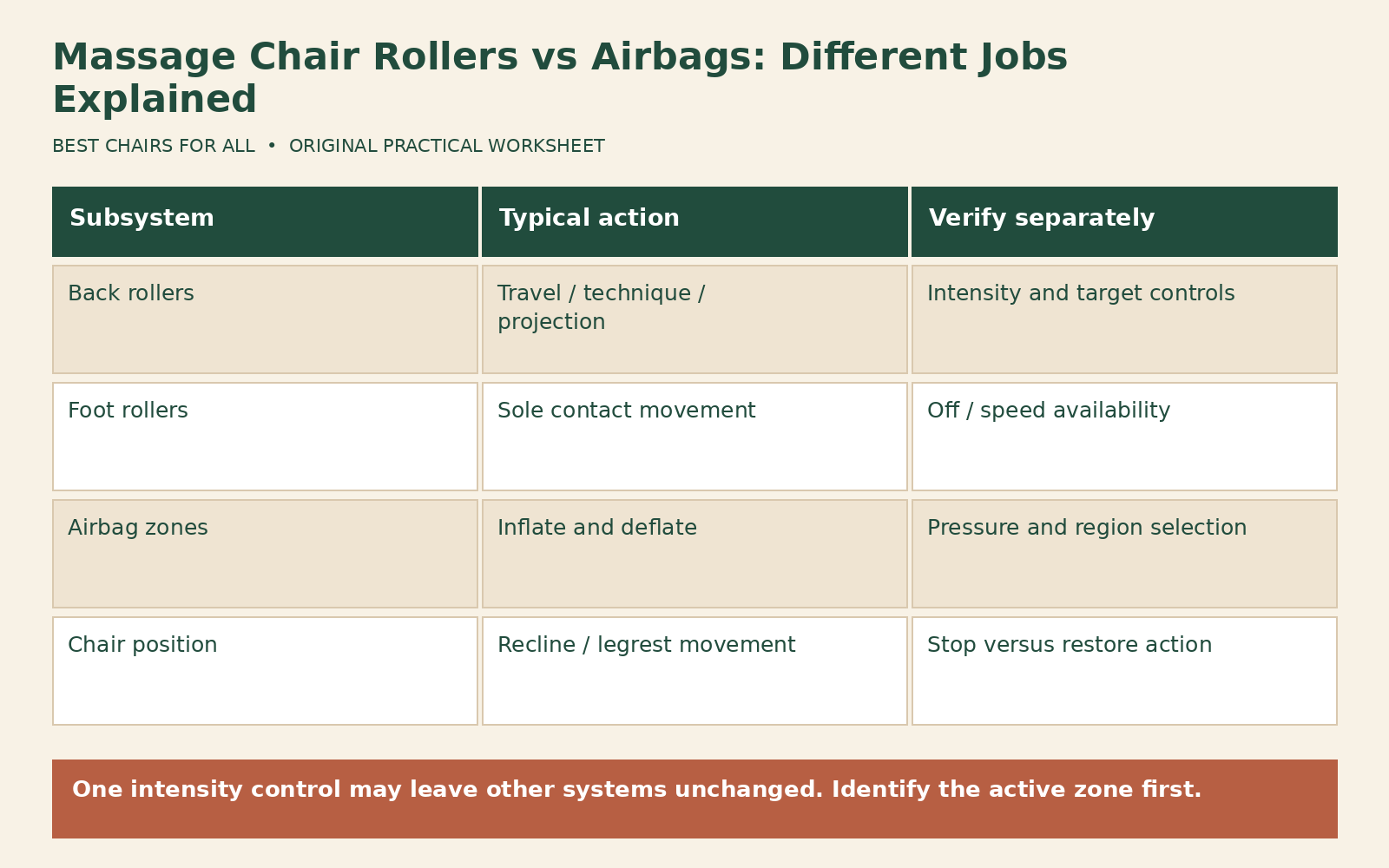
Massage-chair rollers and airbags perform different mechanical jobs. Rollers move or rotate against selected contact areas, often along a back track or beneath the feet. Airbags inflate and deflate to apply distributed compression around areas such as arms, calves, shoulders, or feet. A chair may combine both, and changing one intensity control may leave the other unchanged.
Read the exact model manual before use, including its safety information. These mechanisms are consumer-appliance features, not evidence of treatment effectiveness or medical suitability. If a function feels uncomfortable, stop and follow the manufacturer’s instructions. For questions involving a health condition, consult a qualified clinician rather than choosing between rollers and airbags based on promotional benefit claims.
Map mechanisms by body area
Draw a chair outline and mark back rollers, foot rollers, and each documented airbag zone separately. Do not shade every part of the chair merely because the sales page says full body. The phrase may describe a combination of mechanisms rather than rollers traveling everywhere. Ask which component contacts each area and which zones can be turned off or adjusted independently.
Infinity’s manufacturer manual with internal-component diagram labels a massage mechanism, separate air-pressure units, and sole rollers. That separation is a useful model for reading specifications. It is not permission to open the chair to inspect those components. Use the published diagram and exterior controls, leaving internal hoses, motors, and linkages to authorized service.
Human Touch’s Super Novo 2.0 controller guide distinguishes Cloud Touch intensity from back-massage controls and roller positioning. The Infinity Evolution manual likewise separates 3D intensity and airbag intensity controls. These examples demonstrate why one prominent intensity number is not a complete description of what the chair is doing.
Understand what rollers change
A back mechanism may move vertically along a track while changing width, technique, speed, or projection under the model’s available settings. A longer track describes travel coverage, not a guarantee of stronger or better contact. A named technique describes a programmed movement pattern, not the same experience as a clinician or massage professional providing individualized care.
Marketing labels such as 2D, 3D, and 4D are not enough to compare chairs by themselves. Ask which physical movement or timing parameter the manufacturer associates with the label and which adjustments the user can make. A control called speed may alter rhythm rather than projection; a control called intensity may affect the back mechanism but not the foot rollers. Use the manual’s definitions.
Foot rollers are another subsystem. A chair can offer adjustable back intensity while providing only an on/off control or a separate speed setting for the feet. Do not assume a low back setting makes every contact gentle. Check the footrest fit and the specific control before use. Do not add improvised padding over moving foot mechanisms unless the manufacturer explicitly permits the accessory and placement.
Understand what airbags change
Airbags expand within their designed compartments to create pressure around a broader area. Their effect depends on placement, shape, inflation sequence, and the user’s fit as well as the available pressure setting. A larger advertised airbag count does not automatically mean a more comfortable chair. Manufacturers may count chambers differently, and a count does not reveal whether important zones can be controlled independently.
Ask whether you can select regions, reduce pressure, or disable a zone while keeping another function active. Read whether those choices are available in automatic programs, manual mode, or both. A chair may reset settings when the program changes. Do not assume an airbag adjustment made once will remain active for every future session or for a different household user.
Compression around a limb can feel quite different from a moving roller under the back or feet. If one area feels too intense, identify the active subsystem instead of reducing an unrelated control. Stop first if the sensation is uncomfortable, then consult the manual. Do not tighten straps, shift a limb into an unintended gap, or lean against a compartment to change its action.
Separate coverage from control
Coverage tells you where a mechanism can operate. Control tells you whether you can change or stop it in the way you need. A chair with many zones but limited independent control may be less adaptable to your preferences than a simpler model with clearly separated settings. Compare both columns rather than treating feature count as the purchase decision.
Create a control matrix with rows for back mechanism, feet, shoulders, arms, calves, and any other documented zone. Columns should identify on/off availability, intensity, speed, target area, and program restrictions. Write “not documented” where the manual is silent. A blank cell is a research question, not permission to assume the feature exists under a hidden menu.
Include the stop and restore actions in a separate row. Pausing massage, disabling an air zone, and returning the chair upright can be different commands. Locate them before starting a trial. A chair that combines motion and massage in one automatic program needs an especially clear explanation of what stops when a button is pressed. Follow the exact safety sequence rather than experimenting under uncomfortable pressure.
A subsystem-identification worksheet
Use four questions after stopping an uncomfortable or confusing trial: where was the sensation, what mechanism was active there, which documented control applies, and what is the next safe action? The next action may be a permitted lower setting, disabling a zone, checking fit, or contacting support. It should not be internal adjustment or repeated testing beyond tolerability.
Here is a hypothetical example. A user lowers back intensity but still finds calf compression uncomfortable. The worksheet identifies calf airbags as a separate system. The manual describes an air-pressure control or zone selection, so the user follows that instruction after stopping. The useful result is identifying the correct control. It does not establish that any particular pressure level is safe or suitable for that user.
A second example concerns foot contact. Back rollers feel acceptable, air pressure is low, but the sole rollers remain unpleasant. The user checks the separate foot-roller setting rather than assuming the chair is ignoring the main intensity control. If the model lacks a tolerable permitted setting, the user stops using that function and asks about fit or return options. More settings elsewhere do not solve an unadjustable subsystem.
Compare automatic and manual modes carefully
An automatic program can coordinate roller movement, airbags, heat, and chair position. The program name may not tell you every active feature. Read the status display and manual rather than assuming “gentle” means all subsystems are at their lowest settings. A program can also change its behavior over time, so a comfortable first moment does not establish the whole sequence.
Manual mode may expose controls hidden during automatic programs, but it can also behave differently. Record which mode you are evaluating and which settings apply only there. The Super Novo 2.0 documentation specifically separates manual settings from other program families. Do not present a manual-mode adjustment as a universal change to every automatic routine without confirmation.
For a showroom demonstration, ask the representative to show each subsystem separately where the product permits. You do not need a long or intense trial to learn whether the controls are understandable. Watch how the screen identifies active zones, how settings change, and whether the user can stop and return as instructed. This is a control and fit demonstration, not a treatment assessment.
Read maintenance descriptions without attempting repair
Ordinary operating sounds can differ between roller travel, air inflation, and chair movement. The manufacturer may describe some sounds as normal, but a new loud noise, erratic motion, loss of pressure, or failure to stop needs support. Record the active mode and subsystem when the issue occurs. Do not repeatedly reproduce a concerning fault just to capture a better recording.
Do not open upholstery, straighten internal hoses, bypass sensors, or service motors based on a generic troubleshooting table. Even when a manual lists possible internal causes, confirm which steps the owner is authorized to perform. A blocked hose is a diagnosis for service unless the exact instructions identify a safe accessible owner action. Keep powered components isolated as the manufacturer directs before any permitted exterior care.
Use only approved accessories and cleaning methods around the compartments. Extra covers or pads can change contact or interfere with intended movement. A removable liner may have its own wash label, while the original upholstery remains nonremovable. Protecting a surface should not create a new fit or movement problem. Ask about compatibility before buying an accessory marketed as universal.
Make a feature decision from the matrix
A useful comparison states what matters to you mechanically: independently adjustable calf air pressure, a foot-roller off option, clear back projection control, or a readable stop-and-restore sequence. These are verifiable requirements. “More airbags” and “higher D number” are weaker substitutes because they do not describe whether you can operate the chair comfortably under its instructions.
When comparing airbag counts, ask whether the stated total counts separate chambers, paired units, or zones. If the manufacturer does not explain, keep the count as a descriptive listing figure and avoid calculating a percentage advantage over another chair. More chambers can be concentrated in the same region rather than extending coverage. A zone diagram and independent-control demonstration provide more actionable information than a count alone. Add the answer to the matrix so you can distinguish an actual control benefit from a larger marketing number.
Save the completed mechanism map with the exact manual links and date. If two models differ, explain the specific tradeoff rather than declaring one system better in every case. Rollers and airbags complement different contact patterns, and either can be unsuitable if fit or controls are wrong. The practical endpoint is understanding which part is acting where, which control changes it, and when to stop and seek guidance.
Something unclear or out of date? Send a correction with this article’s title and the detail to check.
Sources, research & corrections policy ↗