Before a massage chair arrives, verify the exact model’s supply voltage, frequency, grounding requirement, power rating, and cord route. Match those requirements to the installation location with manufacturer guidance and, where needed, a qualified electrician. Do not assume that every chair uses the same outlet, that a plug adapter changes voltage, or that a nearby receptacle proves the circuit is suitable.
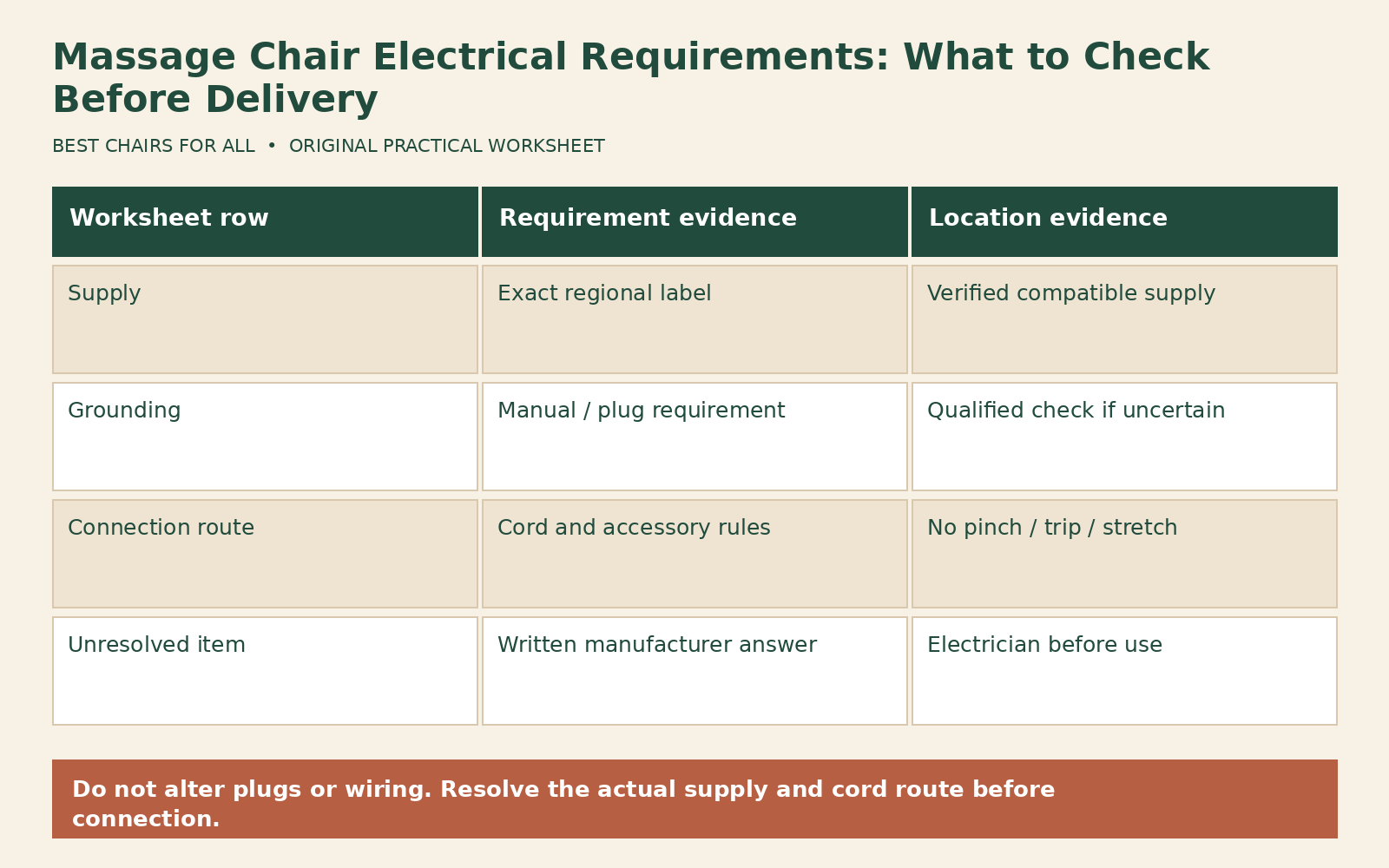
This is a pre-delivery information checklist, not a wiring procedure. Do not open outlets, alter plugs, replace breakers, or repair the chair’s electrical system yourself. If an outlet is loose, damaged, discolored, unusually warm, or associated with tripping or other abnormal behavior, stop using that location and arrange qualified inspection. The chair’s manual takes priority for its permitted connection method.
Read the rating for the actual regional model
Find the rating label and manual for the chair sold in your country. Record voltage, frequency, and the stated current or power consumption exactly as written. A model sold internationally may have regional electrical versions. Similar appearance and product names do not establish interchangeable supplies. Ask the seller to confirm the delivered unit’s rating before a cross-border purchase or relocation.
The Human Touch Super Novo 2.0 use-and-care material directs connection to a grounded 120-volt outlet and lists an AC 110–120 V, 60 Hz operating supply. That is an example for the named North American model, not a general specification for all massage chairs. Check the delivered label and obtain clarification if it differs from the order documentation.
Infinity’s Smart Chair X3 manual describes a nominal 120-volt circuit and a grounded three-prong connection. The useful common principle is matching the specific appliance to its specified grounded supply. Do not remove the grounding pin or use an improvised adapter to make a plug fit. An electrician can assess an unsuitable or uncertain installation.
Do not confuse watts, amps, and accessory outputs
A chair specification can list input current, power consumption, USB output, and wireless charging on adjacent lines. They describe different things. A USB output rating is not the chair’s mains requirement. Copy the label under its correct heading and ask the manufacturer if a web page’s formatting makes the units ambiguous. Do not use an obviously confusing table entry as a basis for selecting electrical accessories.
For planning, keep a photograph of the actual rating label once the chair arrives. Before delivery, request the regional manual and a written confirmation of its supply requirement. If the retailer and manufacturer give different figures, resolve the discrepancy before installation. Product revisions and transcription errors are possible; guessing which number seems plausible is not an adequate electrical check.
A simple arithmetic example can illustrate units without certifying a circuit. An appliance labeled 120 V and 1 A corresponds to 120 volt-amperes by multiplication. That does not automatically establish real power consumption, startup behavior, or whether a shared circuit has adequate capacity. Use the manufacturer’s stated input requirements and an electrician’s assessment where circuit loading is uncertain, rather than treating an approximate calculation as approval.
Ask whether a dedicated circuit is required
Some sellers casually recommend a dedicated outlet or circuit without explaining whether it is a manufacturer requirement or a preferred installation choice. Ask for the exact manual wording. A dedicated receptacle and a dedicated branch circuit are not necessarily the same thing. Two outlets in different parts of a room may share a circuit, while a single wall plate tells you little about the wiring behind it.
List other equipment ordinarily used near the chair, such as a space heater, dehumidifier, entertainment system, or cleaning appliance. Do not assume those devices are on separate circuits merely because they use different receptacles. A qualified electrician can identify the circuit and evaluate the load. Do not solve repeated tripping by installing a larger breaker or moving the chair among uncertain outlets.
If the manufacturer does not require a dedicated circuit, that still does not establish that every shared household circuit is suitable. Conversely, do not state that every massage chair needs new wiring without evidence. The practical task is to gather the chair’s requirements and the location’s condition, then resolve the actual mismatch. This keeps the delivery plan factual rather than unnecessarily expensive or falsely reassuring.
Plan the connection without an extension-cord assumption
Place the chair so its supplied cord can reach the intended outlet with the slack required for normal movement, under the manual’s rules. Measure the route around furniture and along the planned safe path, not a straight line through the chair’s mechanism. Ask the manufacturer for cord length if it is not published. Do not assume an extension cord or power strip is permitted because the plug fits.
The CPSC’s extension-cord guidance addresses cord capacity and overheating risks. It is general safety information, not product-specific permission to use an extension with a massage chair. If the chair manual prohibits one, follow that prohibition. If the instructions are unclear, ask the manufacturer and have an electrician resolve the placement or outlet question.
Do not run cords under rugs, through pinch points, around moving joints, or where chair travel can pull them taut. Do not daisy-chain strips or adapters to reach the desired corner. A surge protector’s marketing does not establish that it is approved for the chair or suitable for the circuit. Confirm permitted accessories before purchase and retain the answer with the installation record.
Make the moving envelope part of the electrical plan
A chair that slides forward while reclining can change the distance between its cord connection and the wall outlet. A footrest may also move across a route that looked clear in the upright position. Use the manufacturer’s clearance diagram and cord-routing instructions together. Do not conduct a powered collision test to find out whether a cord will snag.
Draw the upright outline and full operating envelope on your room plan. Mark the outlet, the chair’s power inlet, and the route between them. Include nearby doors, walking paths, baseboards, tables, and cable bundles. Keep the plug accessible as the manual requires, without reaching through moving gaps. A visually hidden outlet is not always a practical operating location.
If delivery personnel are assembling the chair, ask what electrical connection and functional demonstration are included. White-glove delivery does not automatically include electrical inspection or new outlet work. Resolve any required electrician visit before the delivery date where possible. Do not pressure an installer to connect the chair through an unsuitable workaround just to finish the appointment.
A pre-delivery electrical worksheet
Create two columns: manufacturer requirement and location evidence. Add rows for model/region, voltage/frequency, current or wattage, grounding, permitted connection accessories, cord reach, circuit question, and service contact. Every row should end with confirmed, unresolved, or requires qualified inspection. An unresolved electrical row is a reason to resolve the installation before use, not an invitation to try it briefly.
A hypothetical example: the chair’s regional manual specifies a grounded 120 V supply. The planned corner has an old two-slot receptacle and no confirmed suitable alternative. The worksheet marks grounding unresolved and schedules an electrician, while the chair remains unconnected. A travel adapter is not entered as a solution because it does not establish a grounded installation. This example describes a decision process, not instructions to modify wiring.
A second example: the outlet is suitable but the supplied cord would cross a doorway in the proposed layout. The owner redraws the room plan and finds a manufacturer-compliant location with an unobstructed route. If none exists, the next step is an electrical or layout solution from qualified help, not a chain of longer leads. Cord routing is part of installation quality, not an aesthetic detail to postpone.
Check the delivered chair before first use
Inspect the accessible cord and plug for shipping damage without opening the appliance. Match the rating label to the confirmed order information. Follow the manual’s sequence for plugging in and switching on. If anything differs from the documented requirements, stop and ask the seller or manufacturer. Do not power a damaged unit merely to demonstrate the damage to support.
Understand any battery-backup feature from the exact manual. The Super Novo 2.0 documentation describes a one-time incline function for exit during power failure, with batteries not included. That is not a promise of battery-powered massage or a substitute for an appropriate mains connection. Confirm battery type, installation, checks, and power-failure procedure directly from the model’s instructions.
If the chair is being moved to another home, repeat the location side of the worksheet even when the appliance has not changed. A previously suitable outlet does not establish the condition or capacity of the new location. Confirm the regional supply again for an international move and contact the manufacturer before using a transformer or other conversion device. Physical plug compatibility is only one part of the question.
For a rental property, coordinate any required outlet work through the appropriate owner or manager and a qualified electrician. Provide the appliance’s actual requirements, the planned position, and the unresolved issue in a concise written request. Do not ask a delivery crew to make electrical alterations or hide a cord under a rug while waiting for work to be arranged. The chair can remain unconnected until a compliant placement is ready. This preserves a clear boundary between furniture delivery, appliance setup, and building electrical work.
Keep the worksheet, label photograph, manual, and any electrician or manufacturer correspondence together. Future room moves, outlet changes, and accessory purchases should return to that record. A successful electrical plan has a verified supply and a protected, usable cord route before the chair is operated. It does not depend on a plug adapter, a guessed rating, or a temporary workaround becoming permanent.
Something unclear or out of date? Send a correction with this article’s title and the detail to check.
Sources, research & corrections policy ↗