For many furniture sellers, left-arm and right-arm are named while you stand facing the front of the chair or sectional. Your left while facing it is opposite your left while sitting in it. However, a complete sectional’s name may refer to a particular component rather than directly identifying the projecting chaise. Read the seller’s own convention and the selected configuration drawing before ordering.
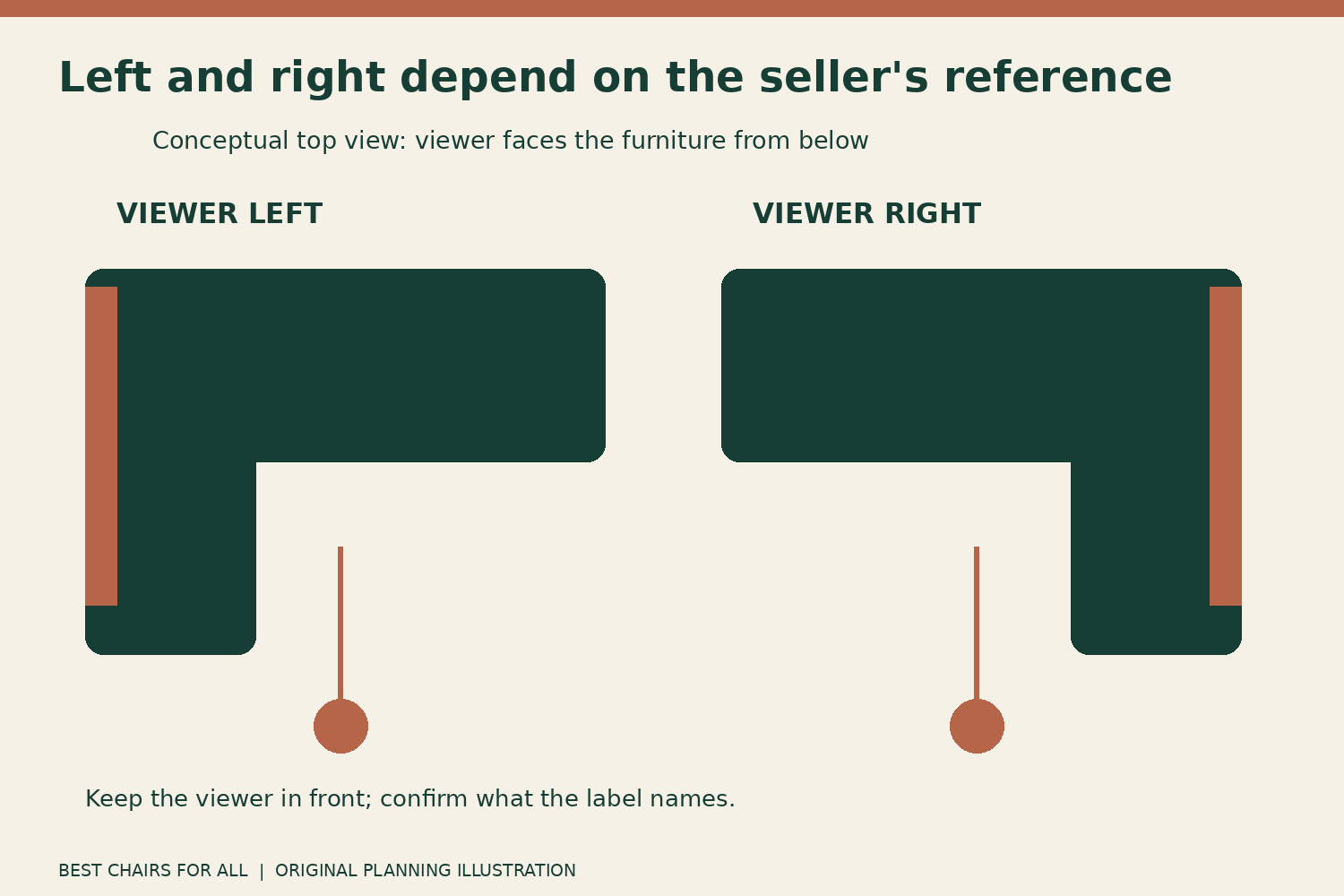
The safest description combines three things: the seller’s exact label, a sketch showing the furniture from above, and a room landmark such as the window or doorway. That removes the ambiguity of a sentence like “I want the chaise on my left,” which changes meaning when the speaker changes position.
Establish the viewing position first
Stand in front of the furniture and look toward the seat and back. Under a facing convention, an arm on your left is a left arm, while an arm on your right is a right arm. If you then sit down facing the room, the same physical arm appears on the opposite side of your body.
West Elm’s sectional guide explicitly uses the head-on facing perspective for its left-facing and right-facing descriptions. It is a clear example of the convention, but the correct purchasing step remains checking the guide and drawing for the exact seller and product you are considering.
Do not use the room entrance as the reference unless you are actually standing directly in front of the furniture there. A doorway to one side can make a perspective description confusing. On your sketch, draw a small observer symbol at the front and label the furniture’s back. Keep that orientation fixed while comparing options.
Separate the arm from the chaise projection
A freestanding single-arm chaise has an arm along one side. A sofa-chaise sectional has an extended leg-support section at one end of the overall arrangement. Those are related but different descriptions. A label can identify the arm on a component, the projecting chaise component, or the name of the complete sectional configuration.
Room & Board’s sectional guidance says left and right are assessed while looking at the sofa and explains its right-arm-chaise and left-arm-chaise arrangements in terms of the side that extends. Use that stated relationship when reading its drawings rather than switching to a seated viewpoint halfway through the decision.
For an individual chaise, confirm both the arm side and the open entry side. An arm beside a wall may suit the room while the open side faces the walkway. If the arm is reversed, the same overall length and width can create an inconvenient entry even though the footprint technically fits.
Why a complete sectional name can be misleading
A sectional’s configuration name does not always use the chaise as its naming reference. Pottery Barn’s Seabury furniture guide lists a Left Sofa with Chaise Sectional made from a Left Arm Love Seat and a Right Arm Chaise. Its complete-set label therefore does not directly name the chaise component’s side. That is a different question from simply asking which side has the long projection.
This does not make the facing convention wrong. It means you must identify what the word left or right modifies. A right-arm sofa component can be joined to a left-arm chaise component within one arrangement. Reading only one phrase from the set’s name can therefore produce the wrong mental picture.
Find the complete component list and compare it with the top-view drawing. Write each piece’s exact name and stock-keeping code beside its position. If the complete set’s title and your interpretation of the image disagree, ask the seller to confirm the assembled orientation in writing before placing the order.
Use a room landmark that cannot change perspective
Replace “on my left” with a statement tied to the room: “The projecting chaise should be nearest the window, with its open side toward the central walkway.” Then add the seller’s corresponding label. The landmark identifies the physical position even if a salesperson, partner, or delivery team views the furniture from somewhere else.
Label doors, windows, the back wall, and any fixed cabinet on the sketch. Avoid using a movable lamp or temporary table as the only reference. Include the furniture’s front edge and viewing arrow. A simple hand drawing is enough if its orientation and dimensions are clear.
For a freestanding chaise, also show where the head or back support sits. A long rectangle alone does not tell the seller which end faces the window or which side carries the arm. The arm, back, and open side all need to be represented for the sketch to resolve the actual question.
A worked orientation example
Imagine a sofa placed along the north wall of a room, facing south. The window is on the west side. A person standing south of the sofa and facing it sees west on their left. Under a seller’s facing convention that directly names the chaise position, a chaise projecting at the window end would be the left-facing option.
A person seated on that sofa and facing south sees the west window on their right. Saying “right when seated” describes the same physical position as “left when facing” in this example. The room has not changed; only the observer’s direction has changed.
Now suppose the seller names complete configurations after the loveseat arm instead. You cannot carry the first label across without consulting that seller’s drawing. Keep the physical requirement fixed—projection at the west window—and ask which exact configuration code produces it. This is why a landmark and sketch are more dependable than memorizing one universal left/right rule.
Complete an orientation confirmation card
This original worksheet is designed to be copied into order notes or a message to the retailer. Fill in the physical description before the catalog label. That order makes it easier to notice if a selected option conflicts with the room plan rather than merely repeating the product name back to the seller.
| Field | Your entry |
|---|---|
| Back of furniture | Named wall or fixed room landmark |
| Projection location | Window end, doorway end, or another fixed reference |
| Open entry side | Which route the user approaches from |
| Seller’s viewing convention | Facing, seated, or other stated definition |
| What the label describes | Chaise component, arm, loveseat, or full set |
| Exact selected item | Model, configuration, and component codes |
| Confirmation evidence | Saved drawing and written seller response |
A useful confirmation sentence is: “Please confirm that configuration code X has its long chaise at the window end shown in my sketch, with the open side toward the central walkway.” Attach the drawing and selected product screenshot. This asks about the assembled result instead of inviting another ambiguous left/right answer.
Reversible and modular are different promises
A reversible chaise may use a movable ottoman and a cushion arrangement designed to work at either end. A modular sectional may allow components to be rearranged, but an armed chaise component can still be permanently handed. Do not assume modular means every arm can be transferred or every connector can attach in either direction.
West Elm’s Harmony Modular component page lists distinct left-arm and right-arm chaise components. The separate choices illustrate why a modular collection can still require an orientation decision. Confirm reversibility for the exact selected component rather than inferring it from the collection name.
Ask what changing sides actually involves and which configurations the manufacturer permits. Moving a loose ottoman is different from relocating fixed arms, swapping connector hardware, or reversing upholstery panels. Do not make structural alterations to convert a handed chaise based on photographs of another model.
Do not confuse rotation with mirroring
Turning a single-arm chaise 180 degrees changes which end faces the room, but it does not create the same arrangement as a mirrored opposite-arm model with its back in the original location. The arm and back move together. This is a geometry issue that is easy to miss when looking at a simple rectangular floor outline.
Make a paper cutout that shows the back and arm, then rotate it on the room sketch. You will see whether the proposed workaround places the head support at the wrong end or blocks the intended entry side. Use this exercise before accepting a seller’s suggestion that the opposite orientation can simply be turned around.
Check selected images and documents together
Retail pages may show several configurations in a gallery. After changing the left/right option, check the selected item name, component list, dimensions, and main drawing rather than relying on one lifestyle image. Save a screenshot of the actual selection with its code and date for your own order record.
If a drawing appears reversed relative to its label, do not guess which is correct. Ask the seller to identify the exact assembled orientation and update the order details if needed. A written confirmation tied to a model code is more useful than an informal assurance that left always means the same thing.
Verify the physical result at delivery
Compare package or component labels with the order before assembly where practical. Then compare the assembled shape with the saved room sketch. Follow the retailer’s delivery and issue-reporting procedures if the components differ. Do not modify an incorrect arm or connector arrangement to make it resemble the intended version.
Once the orientation is confirmed, retain the card with the furniture instructions. It helps if you later order another module, a replacement cover, or move the chaise to a different room. The reliable answer to left versus right is the seller’s defined label attached to an unmistakable physical drawing of the result you need.
For resale listings, request a photograph taken directly from the front and one from above or from a clearly identified corner. A photograph of the rear can reverse your immediate impression of the arm side. Match the visible back and open edge to your cutout before arranging collection.
Something unclear or out of date? Send a correction with this article’s title and the detail to check.
Sources, research & corrections policy ↗