Size a child’s desk chair together with the desk and the activity. The useful checks are supported feet, usable seat depth, comfortable access to the work surface and room beneath it. Age labels and catalog dimensions help narrow choices, but they do not establish an individual fit.
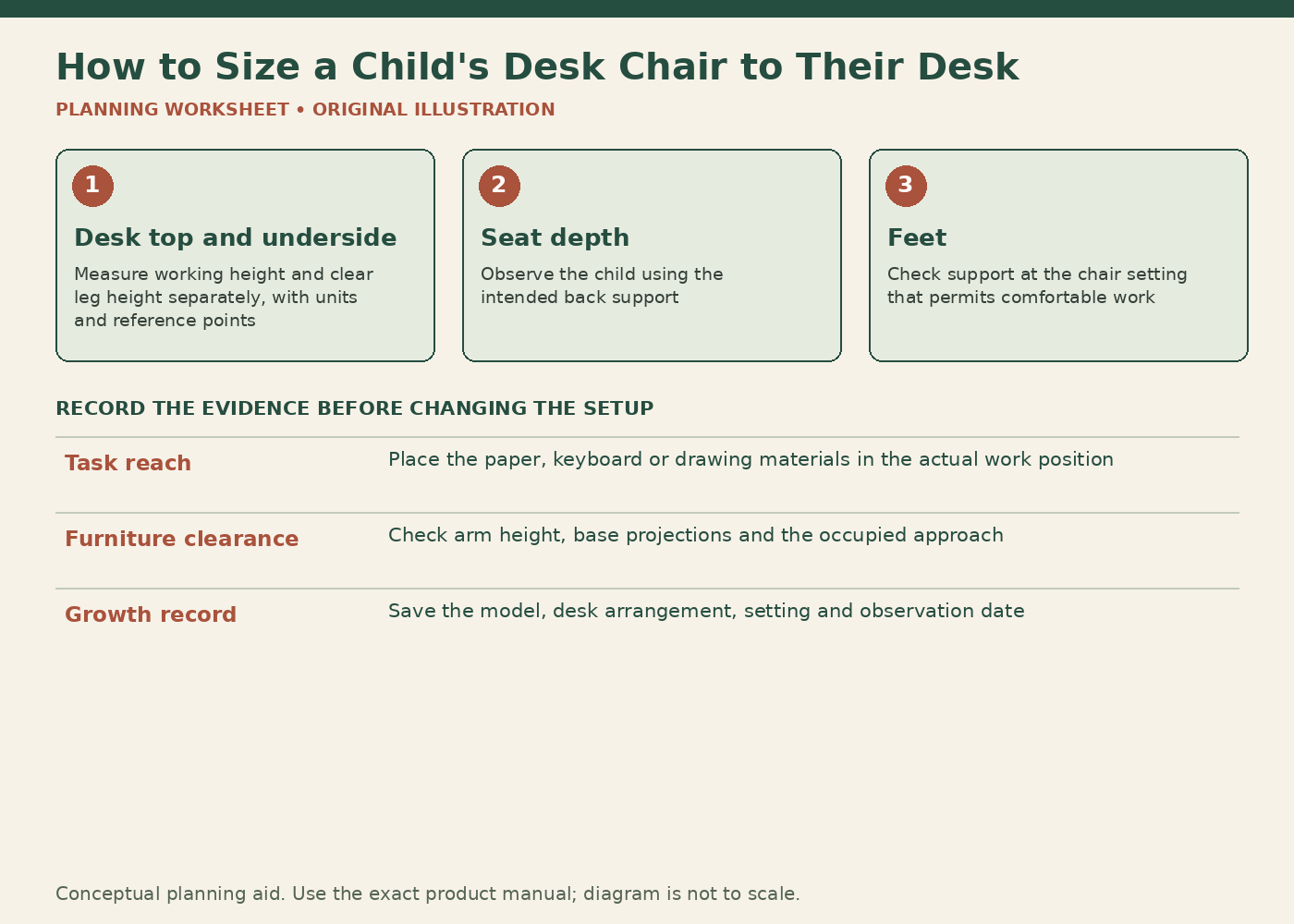
Measure the desk before choosing chair height
Record the floor-to-top height of the working surface and the clear underside height where the child’s legs will go. Note a drawer, apron, keyboard tray or crossbar. A desktop can look high enough while its underside leaves little room after the chair is raised. Measure the actual writing or keyboard position, including a thick desk mat if used.
Then identify whether the desk itself adjusts and what its manufacturer permits. A child’s chair with a wide height range cannot correct every mismatch with a fixed adult desk. Raising the child to reach a high tabletop can leave their feet unsupported; lowering the chair to reach the floor can make them lift their shoulders to work. Those linked observations are the reason to assess the furniture as a pair.
Check the sitting position before adding the task
Have the child sit normally in an age-appropriate chair placed on its specified floor surface. Observe whether they can use the back support without the seat edge pressing uncomfortably behind the knees and whether their feet have stable support. OSHA’s computer workstation guidance describes supported feet, relaxed shoulders and aligned working positions for workers. These are useful observation concepts, not a pediatric treatment prescription or a requirement to hold a child rigidly in one pose.
If the seat is too deep, the child may move forward to bend their knees or reach the floor, leaving the backrest behind. Record that as a depth issue rather than automatically lowering the seat. Total height does not reveal leg length, and two children of the same age can need different geometry. Persistent pain, unusual fatigue or special support needs warrant discussion with a qualified clinician.
Bring the actual activity into the comparison
For writing or drawing, place the paper where the child ordinarily uses it and check whether they can approach the desk without a long reach. For keyboard work, observe the hands and forearms at the keyboard and mouse, not merely at the bare tabletop. A laptop combines screen and keyboard, which can create competing placement needs; do not assume a chair adjustment alone resolves those relationships.
Ask the child what feels awkward in concrete terms. “I cannot get close because the arms hit” identifies a furniture clearance issue. “My feet hang when I reach the keyboard” identifies a relationship between work height and foot support. Let them change position and take breaks. The aim is a comfortable, usable activity area, not an instruction to maintain an exact body angle for the entire homework session.
Read adjustment range and seat depth separately
The researched IKEA USA ÖRFJÄLL 805.018.85 page lists a seat-height range of 15 to 19¼ inches, seat depth of 13⅜ inches and seat width of 15⅜ inches. It recommends that model for children eight years and older. Those facts describe one chair and do not make it suitable for every eight-year-old or prove that it fits a particular desk.
A height range answers whether the seat can reach a position; the fixed depth answers whether the child can use the backrest comfortably in that position. Compare both with the actual trial. Check the exact adjustment mechanism in the instructions rather than looking for a lever copied from an adult office chair. Follow the manufacturer’s setup and safety directions, including any caster or flooring requirements, without modifying a mechanism to make it behave differently.
Use foot support as a planned part of the workstation
If a fixed desk requires a higher chair setting, an appropriate stable footrest may be part of the setup. OSHA’s desk guidance discusses foot support and clear leg space in workstation planning. For a child, choose a suitable product and configuration rather than a loose stack of books, a toy box that rolls or a cushion pile. Make sure support does not interfere with the chair base or the route out.
A footrest cannot shorten an overly deep seat, lower an obstructing desk apron or make an age-inappropriate chair eligible. Identify which problem you are solving before buying another accessory. If the child slides forward to find the support, inspect depth and placement again. Do not add a raised platform beneath the entire chair to reach the desk; that introduces a different support arrangement that the chair instructions may not permit.
Check arms, base and the route around the desk
An armrest can prevent the chair from approaching the work surface. Measure both its height and its relationship to drawers or the apron. A chair that fits underneath when empty can occupy more space when a child is sitting and changing position. Note the base width and where wheels or legs project, especially beside a bed, bookshelf or sibling’s chair.
Preserve a straightforward approach and exit. Avoid placing the activity chair beside a window where it creates a climbing opportunity or near reachable blind cords. Keep power leads outside the chair’s movement and walking route. Do not disable a wheel lock or alter the base to make an inconvenient setup fit. A different chair or desk arrangement can address the underlying mismatch without changing the product’s safety features.
Review growth with a repeatable short trial
Save the desk measurements, chair setting and two or three actual observations. Repeat the same trial when the child grows, switches activities or changes furniture. Useful triggers include feet losing support, knees contacting the underside, increasing reach to the desk or a backrest that is no longer used. A scheduled look at the start of a school term can help notice changes without treating the old setting as permanent.
For a shared desk, record a setting for each child and make the adjustment understandable to the supervising adult. Do not average two children’s dimensions into one supposedly ideal setting. If the desk and chair cannot provide a usable arrangement for both, compare a different adjustable work surface, separate activity spaces or another documented chair size. Growth allowance should mean an available range that fits now, not accepting a poor present fit for a hoped-for future one.
Child, chair and desk fit worksheet
| Check | Evidence and decision |
|---|---|
| Desk top and underside | Measure working height and clear leg height separately, with units and reference points. Record the apron, drawer and crossbar. An adjustable chair can reach the tabletop but still leave insufficient space beneath it. |
| Seat depth | Observe the child using the intended back support. Note whether the front edge interferes behind the knees or whether the child slides forward. Record the actual issue instead of selecting depth from an age chart alone. |
| Feet | Check support at the chair setting that permits comfortable work. If a footrest is needed, confirm its stable placement and suitability. Do not use loose household objects or change the chair’s base to raise the entire assembly. |
| Task reach | Place the paper, keyboard or drawing materials in the actual work position. Look for reaching, raised shoulders or arms blocked by furniture. Ask for the child’s description of the difficulty before changing several settings together. |
| Furniture clearance | Check arm height, base projections and the occupied approach. Preserve the exit route and keep cables clear. A chair that tucks under a desk for storage may still fail the working-position check. |
| Growth record | Save the model, desk arrangement, setting and observation date. Recheck after growth or an activity change. For shared furniture, write a separate entry for each child rather than relying on one average position. |
Worked example
A hypothetical child can rest both feet on the floor with a chair set at 15 inches, but must raise their shoulders to write at a fixed desk. Raising the seat to 17 inches improves access to the paper and leaves the feet unsupported. The problem is the relationship between the work surface and support, not evidence that one of the two numbers is universally correct.
The family checks the underside clearance and seat depth, then compares an appropriate footrest arrangement with a lower adjustable desk option. If the seat is too deep in both trials, a footrest will not correct that separate limitation. They change one relationship at a time and note the outcome. The final record might say “comfortable paper reach with stable foot support and clear underside,” rather than claiming an ideal pediatric posture from a tape measurement. These invented dimensions illustrate the process; they are not recommended heights for a particular age or child.
Use a separate line for any underside projection. For example, a hypothetical desk top 28 inches above the floor with a four-inch apron leaves 24 inches to that apron, before considering anything else below the desk. Raising the chair changes the space between the seat and the apron. The subtraction describes furniture clearance only; it does not establish how much leg space a particular child needs. Measure where the child actually sits, since a central drawer can create a different restriction from the open area at one side. That location belongs on the drawing beside the height figure.
Sources checked November 6, 2026
Use the current document for the exact model, market and production revision. These sources establish the cited instructions and distinctions; they do not certify an individual chair or replace a personal assessment where one is needed.
- IKEA USA: ÖRFJÄLL child’s desk chair 805.018.85 dimensions and age recommendation
- OSHA: Good working positions at computer workstations
- OSHA: Computer workstation desks
- IKEA USA: MAMMUT children’s chair advice and instructions
Something unclear or out of date? Send a correction with this article’s title and the detail to check.
Sources, research & corrections policy ↗