Move an office chair by planning the whole route, protecting projecting controls and upholstery, and choosing a handling method that suits the chair’s weight and shape. Rolling it across a clear level room is different from carrying it down stairs or transporting it in a vehicle. Decide which situation you have before removing parts or lifting from the nearest convenient armrest.
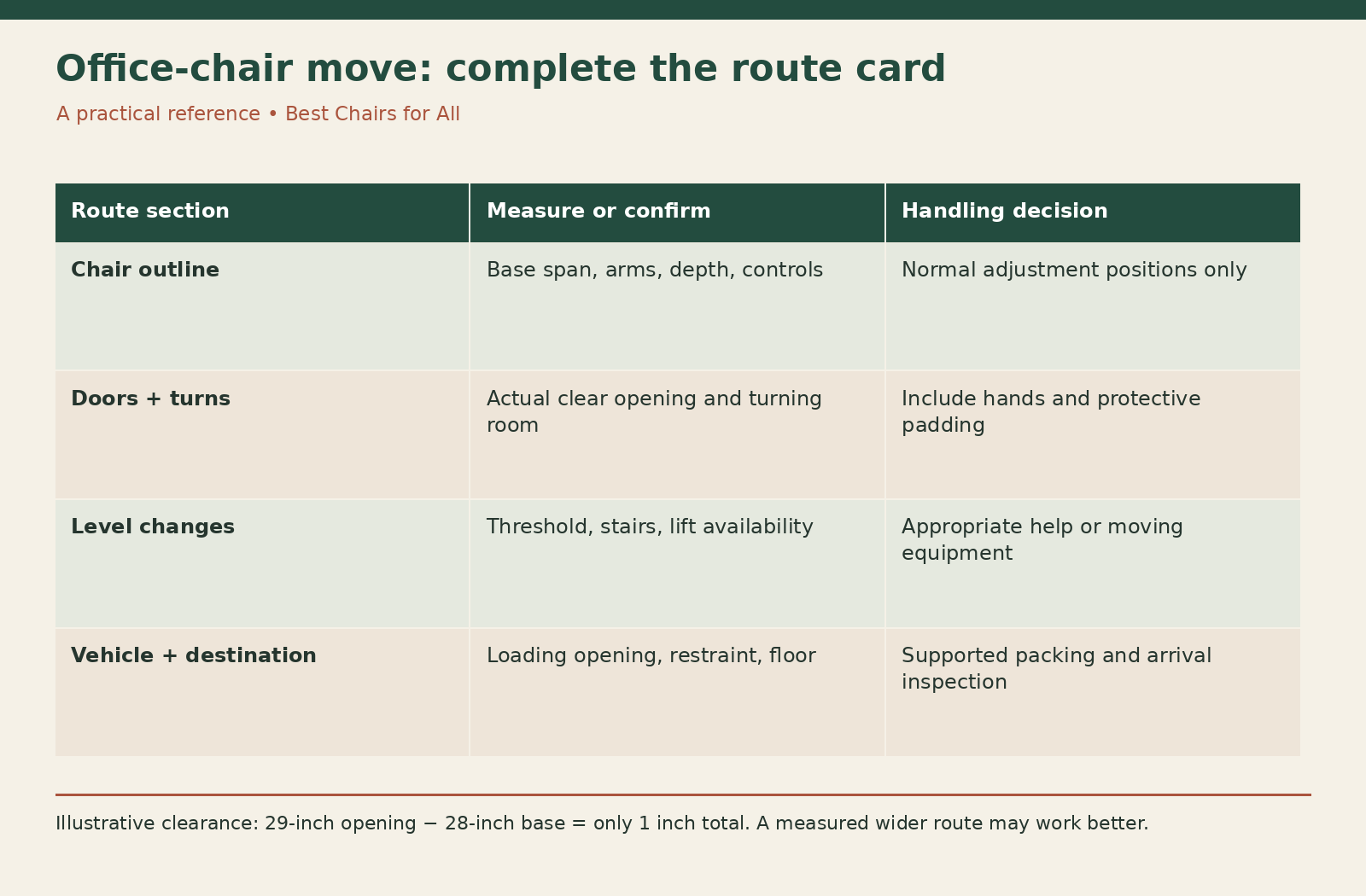
The route card below helps you measure the chair, openings, turns, and destination in advance. Keep pressure cylinders and internal mechanisms outside an improvised moving procedure. If reducing the chair for transport requires service work, obtain the manufacturer’s instructions and qualified help rather than dismantling it by trial and error.
Inspect before moving
Check for a loose back, damaged base, partly detached caster, or arm that no longer holds correctly. A move can put stress on an existing fault even when nobody is sitting in the chair. Photograph the starting condition and product label, particularly before handing the chair to a mover or carrier.
Remove loose items such as a seat cushion or unattached accessory. Check whether an installed headrest, cable, bag, or other addition projects beyond the main outline. Do not assume an accessory can support lifting or restraining loads simply because it is securely fitted for everyday use.
If the chair is recalled or visibly compromised, keep it out of use and follow the applicable remedy or service advice. Tell anyone helping about the condition. An ordinary moving plan should not depend on somebody gripping a damaged backrest or loading a cracked base.
Build a route card
List the starting point, every doorway, tight turn, threshold, lift, staircase, vehicle opening, and final room. Walk the route empty-handed first. Remove trip obstacles and check lighting and floor condition. Plan a place to set the chair down if the route cannot be completed in one controlled movement.
The HSE manual-handling guidance emphasizes avoiding hazardous handling where possible and assessing the task that remains. Its principles are useful here because a chair’s bulk, grip points, and route matter alongside weight. Do not convert an advertised chair weight into a universal declaration that one person can carry it safely.
Record who will handle the chair and what appropriate aid or professional assistance is needed. In a workplace, use the site’s moving and facilities arrangements. A clear lift or accessible route can eliminate a difficult carry, while an unplanned stairwell can make an otherwise short move much more demanding.
Measure the whole chair and the real opening
Measure the widest base span, arm-to-arm width, overall height, and front-to-back depth. Include projections such as levers and a headrest. Take measurements in any normal adjustment position you intend to use for the move; do not count on forcing a component past its range.
Measure clear openings, not nominal door sizes. A door left partly open, a handle, or a closer can reduce usable width. At a turn, consider both the opening and the space beyond it where the base must rotate. Passing a straight doorway does not prove the chair can negotiate a narrow right-angle corridor.
For an illustrative comparison, a 28-inch base and a 29-inch clear opening leave only one inch of total side clearance when aligned straight. That is little allowance for padding, hands, and control of the load. A wider planned route may be more practical than trying to squeeze the unprotected chair through. These dimensions are examples, not a minimum moving-clearance rule.
Use normal adjustments to reduce projections
Lower the seat or arms only through their intended controls and according to the guide. Return a reclining back to an appropriate supported transport position if the manufacturer specifies one. Make a note of the working settings if you want to restore them at the destination.
Do not remove arms, a back, or a headrest unless the actual instructions support that task and you can retain and reinstall the correct hardware. Some parts are service assemblies even when their fasteners are visible. A smaller outline achieved by an unsupported alteration can cost more in damage and repair than using a better route.
Never cut, heat, drill, open, or attempt to depressurize the gas cylinder for a move. A cylinder that is tight in its tapered connections is not a reason to use an improvised destructive removal method. Ask the manufacturer or a qualified provider whether the chair can remain assembled for transport.
Choose rolling only for a suitable route
On a clear level indoor surface, rolling an intact chair can avoid lifting. Keep it empty and guide it under control. Do not sit in it to travel, tow another person, or use it as a cart for boxes. The chair’s normal seating capacity does not turn it into moving equipment.
Check each floor transition. Small casters may catch a threshold, mat edge, or gap, and tread suited to one floor may be inappropriate for another. Avoid pushing hard through a snag, which can load the base or make the chair lurch. Stop and select a suitable handling method for that section.
Do not roll the chair down stairs, steps, or a sloping outdoor route. A caster brake intended for normal office use is not a substitute for controlling a transported load. Use appropriate assistance or professional moving arrangements for those changes in level.
Protect the chair’s vulnerable areas
Use clean padding where the chair might contact a doorway or vehicle, without tightening it across mesh or controls. Keep straps, tape, and rough fabric away from delicate finishes and upholstery unless the relevant packing method supports them. Adhesive directly on a finished surface can create another cleanup or repair problem.
Protect levers and knobs from side impacts. A chair that clears the opening by its arm width can still catch a control underneath the seat. Include that projection in the route measurements and keep the chair positioned so it remains visible to the people guiding it.
Do not stretch protective wrap so tightly that it compresses a pad or bends a support. Packaging should protect rather than act as an improvised lifting sling. Keep the chair dry and use clean materials that will not transfer dye or grit to the upholstery.
Handle from supported structural points
Use the manufacturer’s handling guidance and identify secure structural support points before lifting. Do not rely on a swiveling pad, decorative back trim, or adjustable headrest as a handle. The upper assembly and base can move relative to one another, making a chair awkward even when it is not especially heavy.
The Canadian Conservation Institute’s furniture-handling guidance advises checking condition and supporting chairs at their strong seat area rather than pulling by backs or arms. It concerns furniture conservation; for an office chair, use that principle with the maker’s specific construction and instructions rather than assuming every seat edge is a lifting handle.
If a controlled grip cannot be maintained without awkward posture or obstructed vision, stop and change the method. Add appropriate help or use a suitable handling aid under its instructions. A helper is most useful when both people agree on the route, support points, and set-down location before the lift begins.
Plan vehicle transport and packaging separately
Measure the vehicle opening and interior, including the angle needed to load the chair. Confirm the chair can be restrained appropriately without putting load across adjustment controls, mesh, or unsupported arms. Use the vehicle or mover’s suitable cargo arrangements; do not let an unrestrained chair roll inside a van.
Steelcase’s fully assembled chair unboxing resource includes a reboxing reference. It illustrates that packaging guidance can be specific to the supplied chair and carton. Obtain the relevant current packing method from your seller, especially for a return or carrier shipment, rather than assuming reversing assembly is the correct shipping method.
Retain fitted inserts if they are still available and appropriate. A large empty box alone may not prevent movement or pressure on vulnerable parts. Ask the carrier or mover about packaging requirements and declared dimensions, then choose the supported arrangement before booking transport.
Use the route card to compare two options
Imagine the direct route has a narrow door and one flight of stairs, while an alternative route uses a wider door and a lift. On the card, list the clear widths, turns, surface changes, handling method, and assistance required for each. The physically shorter route is not necessarily the simpler or safer one.
Suppose the wider route allows the chair to remain assembled and be rolled on suitable level surfaces, with controlled handling only at a threshold. That may avoid unsupported disassembly and a long carry. Confirm lift access and building arrangements before relying on it; do not discover a locked access door while holding the chair.
If neither route works, contact a professional mover or the manufacturer about appropriate preparation. The card has already done useful work by revealing the actual constraint. It is better to solve that constraint in advance than to force the chair through the final turn after all other options are blocked.
Inspect and reset at the destination
Place the chair on its intended floor and remove protective materials carefully. Compare the base, casters, controls, and upholstery with the starting photographs. Check for loose attachments or new damage before anyone sits. Report transport damage promptly under the relevant service or carrier process.
If approved parts were removed, reinstall them using the proper hardware and exact instructions before functional checks. Confirm caster retention, ordinary control operation, and the expected stance. Do not treat the chair as ready merely because the pieces look assembled.
Restore the workstation setup for the new desk and floor. Seat height, arm clearance, and caster application may need review even when the chair arrived intact. Keep the route card and packing information with the records if another move is likely; the next relocation can then begin with measured evidence instead of another improvisation.
Something unclear or out of date? Send a correction with this article’s title and the detail to check.
Sources, research & corrections policy ↗