Mixed dining chairs look intentional when they share a clear visual connection and give everyone a workable seat. The connection can be the shape of the back, a repeated color, a similar frame weight, or a common upholstery. It does not have to be matching wood stain. The functional fit, however, needs checking chair by chair.
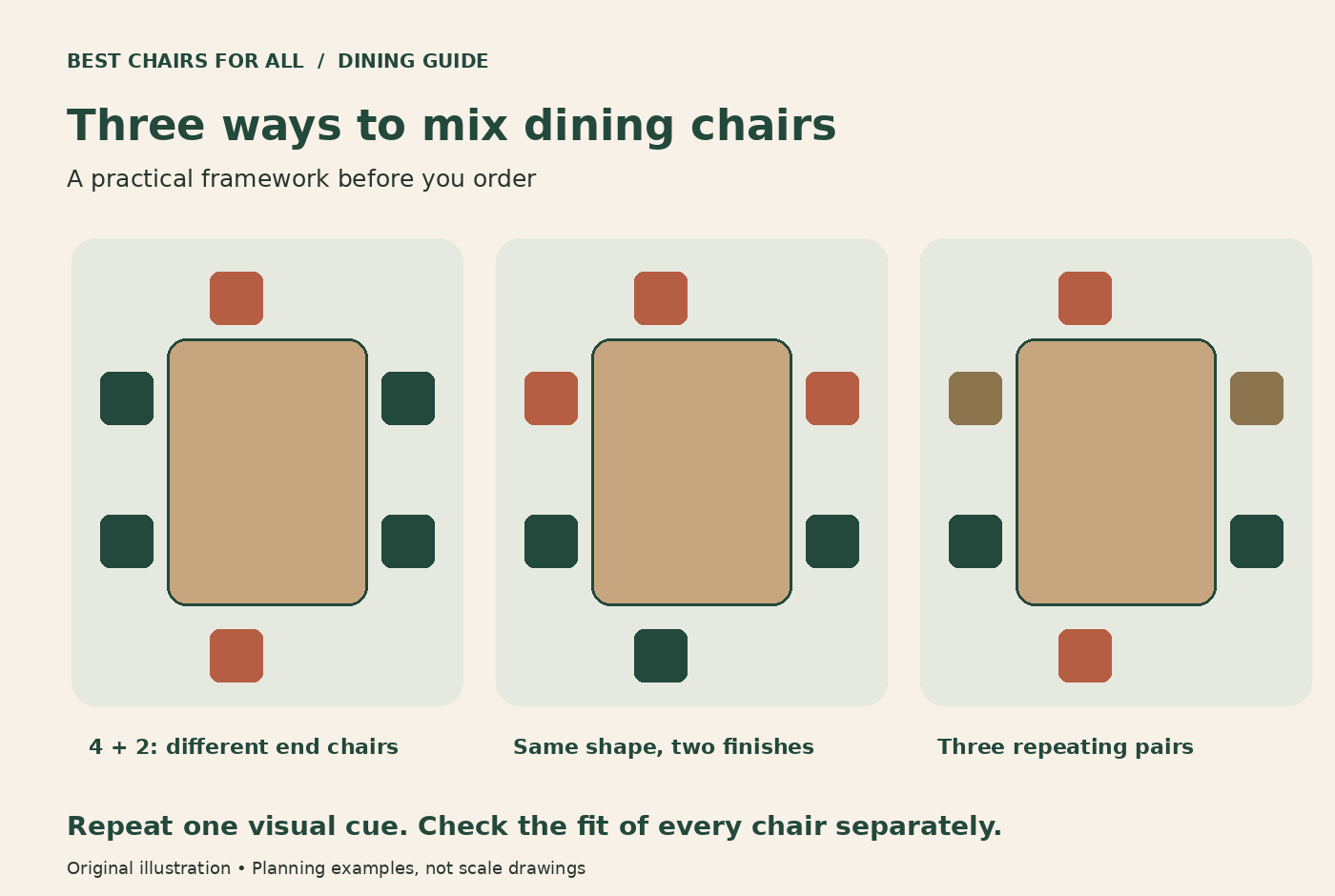
Start with the chairs you already own and the table you actually use. This guide offers a repeatable planning method, three layout formulas, and a shopping worksheet. The formulas are editorial design suggestions rather than decorating rules. You can break them; their purpose is to make the decision easier to explain before you buy more furniture.
Separate the fit decision from the style decision
Before comparing finishes, record the table height, underside height, distance between legs, and the space available behind seated diners. For each chair, record seat height, widest point, depth, arm height, and overall back height. These numbers answer different questions. Overall height describes the silhouette; seat height helps determine the eating position; arm height affects whether the chair can slide under the table.
Room & Board’s dining-room guide specifically calls attention to chair width, arms, seat height, table apron, and leg placement when checking fit. Its guidance also supports mixing wood, fabric, and leather seating. Use those dimensions as a checklist, then test your own combination because a product photograph cannot show your table’s underside.
A chair can fit beside its neighbor and still be uncomfortable under the table. Equally, a comfortable chair can block a cupboard when pulled out. Move a real chair through the complete motion of sitting, eating, and standing. Include anyone who uses the room regularly. Do not assign someone an awkward chair simply because it creates a pleasing symmetrical photograph.
Choose one visual anchor
Select the feature that will repeat across the mix. If you want very different chair shapes, choose a limited color palette. If you want multiple colors, keep the silhouettes related. If the table is already highly patterned or sculptural, quieter chairs may be easier to combine. The anchor is a practical editing device: it tells you which attractive chairs to leave out.
Try describing your plan in one sentence: “All the chairs have curved backs and warm wood,” or “The side chairs are simple black frames, with two upholstered end chairs.” If the explanation needs six unrelated details, simplify the first version. You can always add complexity after living with the arrangement, but returning several special-order chairs may be difficult.
Formula one: four repeated side chairs and two different end chairs
This is a straightforward arrangement for a rectangular table with six seats. Use one side-chair design along the long sides, then introduce a contrasting pair at the short ends. The end chairs can be upholstered, slightly more sculptural, or a different finish. Their repeated placement makes the difference easy to read.
Check the end positions carefully. A pedestal, trestle, or stretcher may restrict feet even when the tabletop is large enough. Wider end chairs can also intrude into the corner diners’ elbow space. Place the exact widths on a floor plan and trial the closest real chairs you have before committing. A visual hierarchy should not require diners to negotiate around furniture.
For example, imagine four slim oak side chairs and two green upholstered end chairs. The oak connects to a warm table, while the repeated green pair links to a painting elsewhere in the room. This is a hypothetical scheme, not a product recommendation. Its success depends on the actual shapes, comfortable seat heights, and available circulation space.
Formula two: one chair shape in two finishes
If you want color variation without a busy collection of silhouettes, choose the same chair model in two finishes. The repeated proportions provide structure, and the contrasting finish supplies variety. Before ordering, confirm that both versions truly share dimensions; similar product names sometimes cover different bases or arm configurations.
A four-chair round table might use two pale chairs and two dark chairs, positioned in a balanced sequence. Alternatively, keep three chairs neutral and let one be a deliberately special seat if that suits the household. Neither arrangement is objectively correct. Look at it from the doorway and from adjacent rooms, because the visible distribution changes with the viewing angle.
Ask whether the finish changes the care routine. A painted version, natural oiled wood version, and upholstered version may require different maintenance even when their silhouettes match. Keep separate care instructions if necessary. Decorative consistency should not tempt you to clean every surface with the same product.
Formula three: use pairs to organize an eclectic set
For a collected look, try three pairs around a six-seat table. Each pair repeats at least one strong feature: identical chairs, the same color, or closely related back shapes. Arrange and photograph several options before deciding whether to place pairs together or opposite each other. Repetition helps the eye understand that the variation is deliberate.
This approach can work when combining inherited chairs with newer pieces. Identify what deserves preserving first: perhaps two well-built wood chairs with personal meaning. Then choose additions that connect to those pieces instead of buying a completely unrelated set and trying to force everything together afterward. If an old chair is loose or damaged, have its condition assessed before treating it as daily seating.
Mix wood tones without chasing an exact stain match
Compare real samples in your room. “Oak” names a wood family, not a single finished color, and photographs can hide undertone differences. Place the candidate beside the table, floor, and nearby cabinetry. Decide whether you prefer a clear contrast or a close relationship. An almost-match can be more distracting to you than an obviously different finish.
Room & Board’s wood-tone guidance suggests shared undertones and repeated use of each wood as ways to create cohesion. Apply that idea modestly: a chair finish might reappear in a picture frame or sideboard. You do not need to buy additional decor just to satisfy a numerical rule.
If the room contains several strong wood surfaces already, introduce a painted or upholstered chair to reduce the number of near-matching stains. Alternatively, let one wood be the dominant surface and use the others as smaller accents. These are visual choices, so view them under the lighting you use for meals rather than relying only on a bright showroom.
Keep seat comfort compatible across the mix
Identical nominal seat heights do not guarantee identical sitting positions. A padded seat compresses, a curved shell may support the sitter differently, and a sloped seat can place the front edge higher than the center. Whenever possible, trial the chair at the table with a normal place setting and sit long enough to notice where the edge and back contact you.
Ask each regular diner which seat works for them before permanently assigning chairs. A mix can be helpful when people prefer different levels of firmness or need different access, but avoid assuming everyone can use an armchair or low seat equally. Select suitable seating for the person first and integrate its finish afterward.
IKEA’s mix-and-match dining guide places everyday comfort at the center of the arrangement and discusses adding appropriate seating as household needs change. That is a useful priority: a coherent room should support the people using it rather than demand that they adapt to a decorative scheme.
Use a simple comparison worksheet
| Check | Write down | Decision |
|---|---|---|
| Seat fit | Height and comfortable position at your table | Keep or reject |
| Side-by-side space | Widest frame or arm dimension | Trial with neighboring chair |
| Under-table clearance | Arm height and apron obstruction | Full or partial tuck |
| Visual anchor | Repeated color, shape, or material | One clear connection |
| Care | Approved method for each finish | Routine you can maintain |
| Ownership | Return, repair, and replacement terms | Acceptable commitment |
Give every candidate its own row in a notebook or spreadsheet. A chair that fails a necessary fit check should leave the shortlist even if it is the best color match. For the remaining candidates, compare the visual anchor and maintenance burden. This keeps the process from becoming an endless search for a chair that is theoretically perfect in every dimension.
Test the arrangement before buying the full set
Use existing chairs, cardboard footprints, and fabric samples to build a rough mockup. Mark the table legs and the widest part of each chair, including arms that project beyond the seat. Pull the chair back as though a guest is standing up. Open nearby doors and drawers. Leave the mockup in place long enough to walk through the room during an ordinary day.
If you can order a single returnable chair first, read the return policy before doing so. Original packaging, restocking fees, custom finishes, and shipping charges can change the value of that trial. Avoid ordering a complete custom-upholstered set solely because the website offers an attractive rendering.
Fix a mix that feels wrong by changing one variable
If the arrangement looks chaotic, remove the most visually complicated pair and look again. If it feels heavy, compare the amount of solid upholstered back against open frames. If the wood tones seem disconnected, try moving an existing object in a related finish into view. Adjust placement before buying new accessories.
If it looks attractive but functions poorly, return to measurements. A bulky end chair may belong in another room; a different placement may free a walkway; fewer everyday chairs may suit a table that only expands for guests. Keep any occasional seating stable, suitable, and properly stored. The strongest mix is one you can use comfortably every day and expand without turning dinner into a furniture rearrangement project.
Plan for future additions without making them match exactly
A mixed arrangement can be easier to expand if you document its logic. Save a photograph of the room, the chair dimensions, and a short note describing the repeated feature. “Curved backs, dark frames, quiet upholstery” gives a future replacement search a useful direction. A vague instruction to find something similar often leads back to an exhausting search for a discontinued model.
Consider everyday capacity separately from occasional capacity. If four people eat at the table daily and six visit occasionally, first make the four everyday seats work well. Then identify where two additional chairs can be stored and whether the extended table actually gives them a comfortable position. Storage dimensions matter as much as dining dimensions when the extra chairs spend most of their time elsewhere.
Keep the solution proportionate to the room. Two dining chairs used at desks or in bedrooms may offer a practical source of occasional seats, provided they are appropriate for both tasks. Do not assume a decorative bedroom chair is suitable at the table just because its color fits the palette. Trial it at the table exactly as you would a new purchase.
Finally, allow a replacement to be visibly different when that makes the arrangement better. Preserving the visual anchor is often more achievable than reproducing every old detail. A comfortable, well-fitting chair that repeats the frame color may serve your household better than an awkward near-copy selected only to maintain a matching photograph.
Something unclear or out of date? Send a correction with this article’s title and the detail to check.
Sources, research & corrections policy ↗