Measure replacement patio chair cushions using the chosen cushion maker’s instructions, then confirm the order against the chair frame. Width, depth and thickness are only the beginning when a seat tapers, corners curve or a back cushion sits on top of the seat cushion. Keep a labeled sketch so every number has a defined starting point and direction.
Do not assume all suppliers want the same measurement. Some ask for frame dimensions; others describe measuring an existing cushion or request finished cushion dimensions. A worn cushion can spread or flatten, so copying it blindly can reproduce the wrong shape. Establish the supplier’s convention before rounding numbers, adding allowances or placing a custom order.
Identify the cushion arrangement
Remove loose cushions and look at the frame. Decide whether the replacement is a seat pad only, a separate seat-and-back set, a hinged one-piece cushion, a deep seating assembly or a chaise cushion. Photograph the chair with its original arrangement before taking anything apart. Mark the seat and back pieces so their measurements do not get mixed together.
Check how each cushion is retained. Ties, straps, hook-and-loop tabs and shaped pockets can matter as much as dimensions. Record where they attach and whether the replacement maker can provide that arrangement. A pad that fits the frame but slides during ordinary use may be unsuitable. Do not plan to tie a cushion to a moving mechanism unless the chair maker permits it.
Find the chair model if possible. Original replacement cushions may offer a clearer fit route than a generic size. Ask whether the frame has changed across generations and whether any cushion part number matches yours. A collection name without a model or year can be insufficient, particularly when manufacturers keep similar product names after a redesign.
Follow the supplier’s measuring convention
Cushion Source’s deep-seat guide directs customers to measure the chair rather than old cushions and recommends a firm tape. It also asks for a template when the shape is not rectangular or square. That is one documented ordering method, not a rule to replace every other maker’s instructions.
Frontgate’s replacement-cushion guide asks for width checks at the front, between the arms and at the rear, and defines front-to-back depth through the seating surface. That provides useful reference points for its ordering process. Read the relevant diagram together with the order form. A measurement called “length” on one page may be called “depth” on another.
Before measuring, write the supplier name and product style at the top of your sheet. Copy the dimension labels exactly and add your own arrows. If the supplier wants finished cushion dimensions, do not silently provide the full outside width of the chair. If it wants frame dimensions, do not add sewing allowances or foam oversizing based on a separate DIY upholstery tutorial.
Measure seat width in more than one place
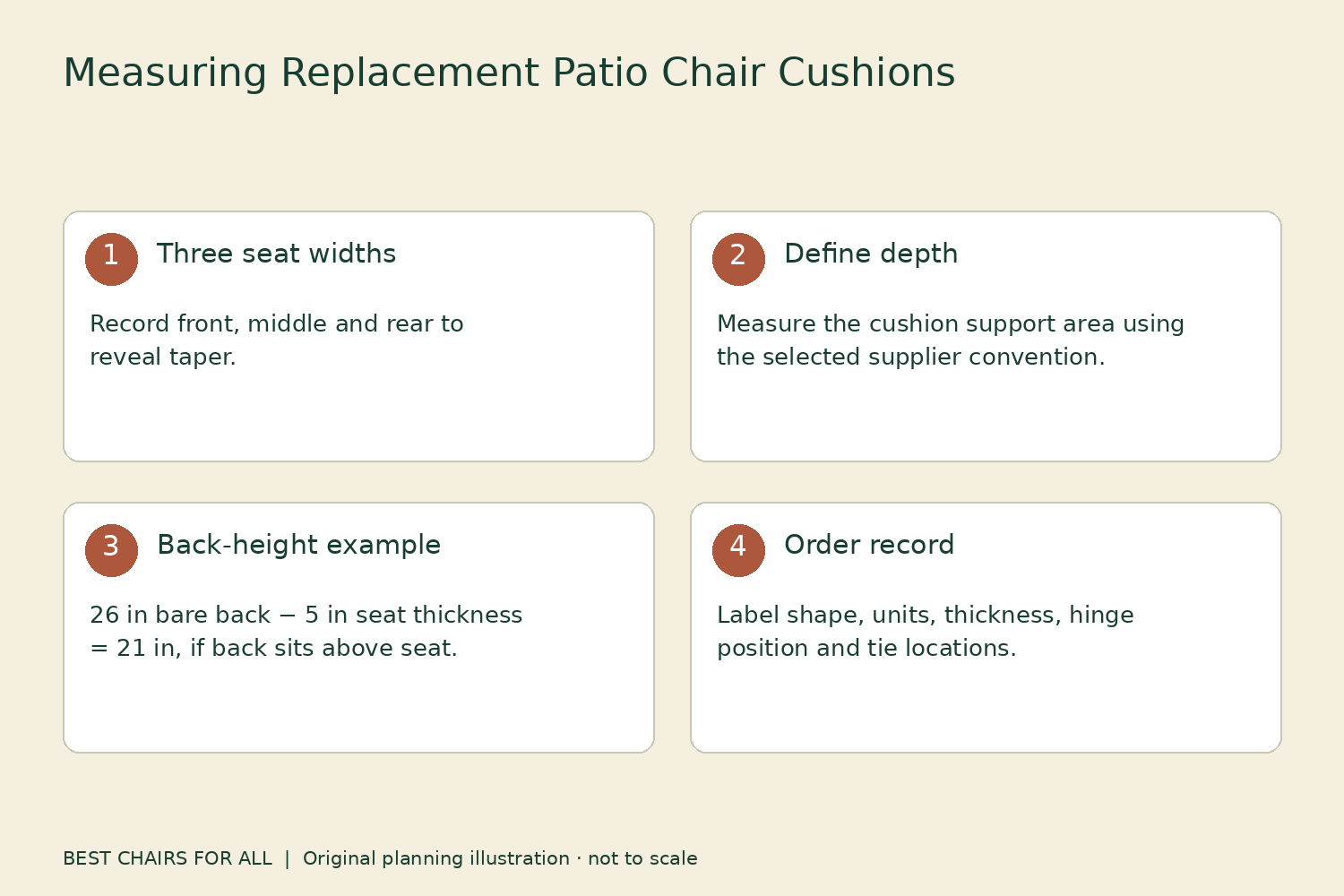
On a rectangular seat, measure side to side between the boundaries the supplier specifies. Keep the tape level and straight rather than bending it along a curved arm. Repeat at the front, middle and rear so a taper is visible. Do not assume that a square-looking chair has equal front and rear widths.
Label each number. For example, a hypothetical seat might be 22 inches wide at the front and 20 inches at the rear. A single entry of “22 wide” hides the taper and could lead to a rectangular cushion that crowds the back. These invented figures show why multiple measurements matter; they are not a suggested cushion size.
If the chair has curved sides or a rounded back edge, ask for the maker’s template procedure. A few widths do not capture every contour. Trace only as instructed and mark front, back, top face, chair identity and any corner reference. Keep a copy or photograph of the template before sending it so a later question can be resolved against the same shape.
Define where seat depth begins and ends
Measure front to back along the intended cushion support area, not the entire chair’s outer depth. A backrest may lean beyond the seat base, and the front frame may project beyond the cushion location. Use the starting and ending points shown in the supplier’s guide. Record whether the back cushion occupies part of the measured seat area.
A separate back cushion can rest on the seat cushion, sit behind it, or overlap it in another designed arrangement. Those positions change the usable sitting depth. Do not automatically subtract back-cushion thickness from a seat measurement without confirming the intended construction. Ask the cushion maker to review a side photograph if the relationship is unclear.
Check both sides for unusual geometry. A chair frame that has shifted or been repaired may no longer match the original dimensions. Replacement cushions should not hide structural damage or compensate for a bent frame. Resolve a loose joint, broken support or distorted rail before asking a cushion manufacturer to fit new upholstery around it.
Seat thickness changes the back calculation
For a back cushion that rests on top of a seat cushion, seat thickness can reduce the available back height. Cushion.com’s chair guide explains deducting seat cushion thickness when ordering its two-piece arrangement. Cushion Source describes the same relationship for its deep seating measurement process.
As a hypothetical worked example, suppose the supported back area measures 26 inches from bare seat base to its top, and the selected seat cushion is 5 inches thick. If the chosen construction places the back above that seat, the simple starting calculation is 26 minus 5, or 21 inches. Confirm the supplier’s final convention and desired shape before ordering.
Do not confuse thickness with front-to-back depth. A five-inch-thick seat is a vertical dimension; its sitting depth could be much larger. Misreading these labels can produce a dramatically wrong back cushion. Draw the vertical thickness arrow at the side of the seat and the depth arrow along the top surface so the distinction remains clear.
Choose thickness with the whole chair in mind
A thicker cushion raises the uncompressed sitting surface and changes the relationship to arms and backrest. It can also reduce usable seat depth when the back cushion is thick. A thin pad on a frame designed for a substantial cushion may leave the seat too low or expose uncomfortable support surfaces. Follow the chair maker’s intended cushion system where available.
Thickness alone does not describe softness or occupied height. Filling type, density, construction and compression affect the experience. Ask the supplier what the published thickness means and whether it describes an unoccupied finished cushion. Do not promise yourself a specific seated height by simply adding foam thickness to a frame height.
Try the intended thickness using an appropriate sample or display cushion when possible. Do not sit on an unstable stack of loose objects as a measuring shortcut. If you use a visual spacer to understand height, keep the chair unoccupied and make clear that it represents geometry only. Confirm actual comfort through a proper cushion trial.
Measure hinged cushions by their sections
A one-piece cushion needs the seat section, back section and hinge or fold position recorded separately. Measuring the total end-to-end length can hide a fold that lands in the wrong place. The back may extend above the frame while the seat portion must stop at a particular front edge. Follow the maker’s diagram for the actual cushion style.
For a chaise, record the back-to-seat break and any additional leg section or taper. Do not assume a chaise cushion is a long rectangle. Curved corners, varying width and attachment points can affect fit. Put the chair in the position specified by the cushion guide while measuring, and keep clear of recline mechanisms.
If the old hinge location was uncomfortable, tell the supplier rather than altering the numbers without explanation. A custom change may be possible, but it should be reviewed as a design decision. The aim is a cushion that fits the support and bends where intended, not a set of apparently precise measurements with different unstated assumptions.
Complete a dimensional order sheet
| Field | Entry |
|---|---|
| Chair and cushion identity | Brand/model; seat only, two-piece, hinged or chaise |
| Measurement basis | Frame dimensions or finished cushion dimensions, per supplier |
| Widths | Front, middle and rear, with unit |
| Seat depth | Defined front and rear reference points |
| Seat thickness | Supplier’s stated finished convention |
| Back | Width, height, thickness and relation to seat |
| Shape and retention | Corner/template details; tie locations and attachment type |
| Review | Second measurement and supplier confirmation for ambiguities |
Measure again without looking at the first set of numbers, then compare. If results differ, resolve the reference points rather than averaging the answers. Keep units consistent. Inches and centimeters can both work, but a sheet that mixes them invites errors. Follow the supplier’s rounding rule instead of rounding every measurement to a whole inch for convenience.
Confirm the construction before finalizing
Check whether the order is for a complete filled cushion, a cover only or replacement foam. These products require different information. A cover does not necessarily fit an old swollen filling simply because the old cover had similar outer dimensions. Ask whether the manufacturer accounts for seams, batting and filling behavior within its finished size.
Record fabric, filling, zipper location and cleaning instructions alongside the dimensions. Outdoor fabric performance does not guarantee that the whole cushion is waterproof or machine washable. Storage and drying requirements affect how practical the replacement will be, particularly for thick deep-seating cushions. Fit and care need to work together.
Before approving a custom order, send the supplier a labeled sketch and clear photographs if any shape or dimensional convention remains uncertain. Retain the approved drawing and order confirmation. A careful measurement sheet is useful because it preserves the decisions behind every number, making the replacement easier to check when it arrives and easier to reorder later.
Something unclear or out of date? Send a correction with this article’s title and the detail to check.
Sources, research & corrections policy ↗