An outdoor hanging chair stand has to match the chair’s suspension arrangement, working height, permitted movement, and load instructions. Measuring only the base or choosing the largest advertised capacity leaves several important questions unanswered. Start with the exact chair and stand model numbers, then use measurements to check the manufacturer’s compatibility information. A tape measure can reveal a mismatch; it cannot establish that an unapproved combination is safe.
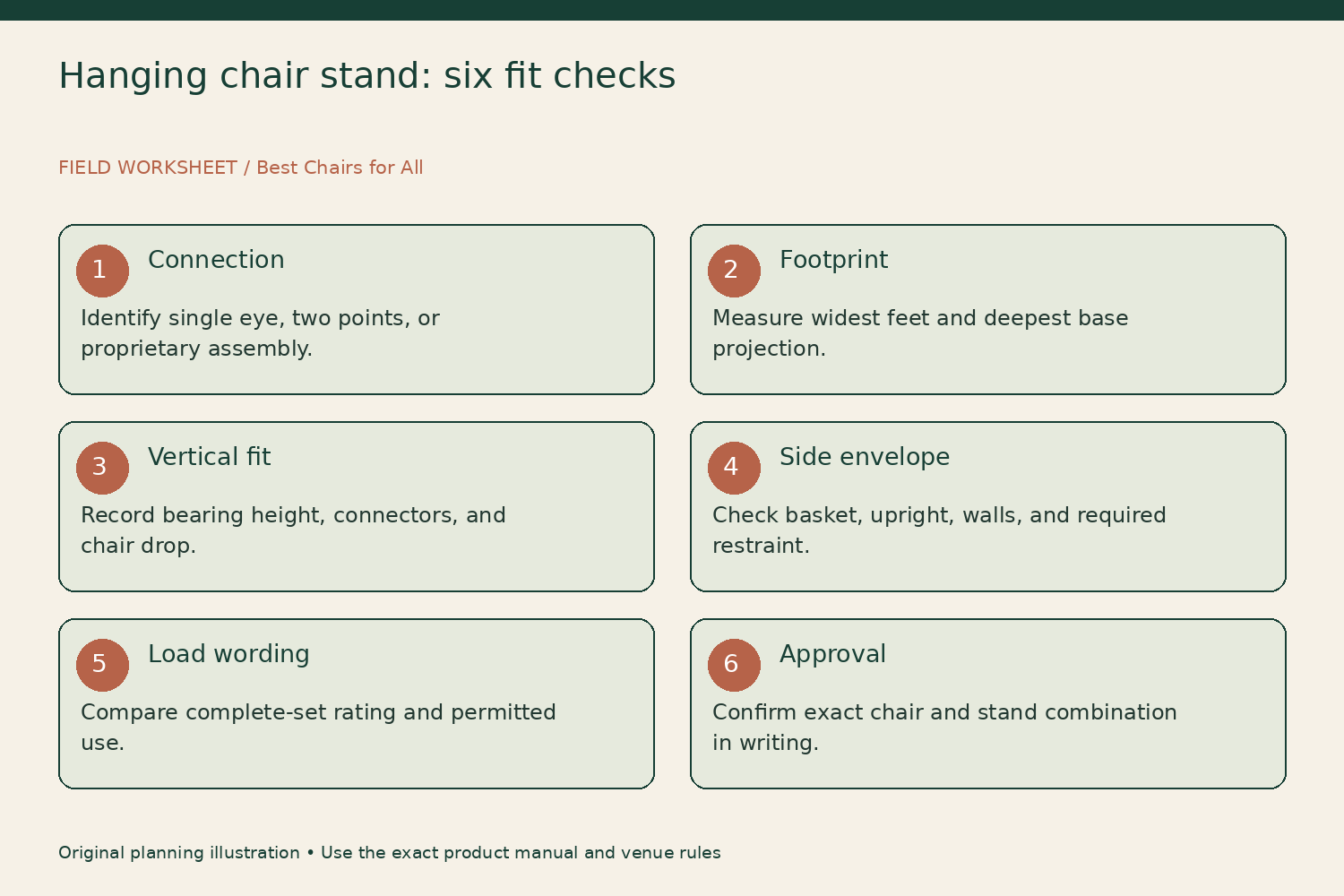
This guide separates the dimensions you can measure at home from the decisions that require the manufacturer. It also provides a fit worksheet for comparing a replacement stand with an existing basket or hammock chair. All numerical examples below are planning examples, except where a named manufacturer’s specification is identified. Do not treat an example clearance as an installation requirement.
Begin with the suspension type
A single-point fabric hammock chair, a rigid egg basket, and a two-point hanging seat may look similar in a shopping photograph but transmit their loads through different connections. Record whether the chair uses one overhead eye, two spaced attachment points, a spreader bar, or a proprietary suspension assembly. Photograph the connection before separating any supplied components. Include the chain, spring, retaining connector, and any movement-limiting strap in the photograph.
A stand advertised for hammock chairs does not automatically accommodate a rigid egg chair. The basket may strike the upright, and its attachment may load a connector in a direction the manufacturer did not intend. Conversely, a stand designed around a particular basket may lack enough hanging height for a long fabric chair. Ask the supplier about the complete combination rather than asking whether the hook is big enough.
Measure the stand as an installed object
Measure the maximum base width and depth, including feet, leveling pads, protruding bolts, or stabilizing pieces. Measure with the stand assembled according to its instructions on a suitable level surface. The shipping carton, nominal product width, and distance between two visible feet may all differ from its true footprint. Mark that footprint with removable tape where you plan to place it, allowing for the route people use beside the chair.
Next record overall height and the height of the actual suspension bearing point above the floor. These are different measurements. An arch can extend above its hook, while an adjustable upright can change the hook height without changing the base dimensions. Record the available settings rather than assuming the adjustment is continuous. Check overhead beams, roof edges, lights, and door swings separately; fitting beneath a roof does not settle side clearance.
Read a real specification without overextending it
The Sunnydaze HH-AHC stand listing describes a 45-inch-wide by 53-inch-deep frame, a maximum height of 93 inches, five height options from 79 to 93 inches, and a 330-pound capacity. Those figures identify that stand; they do not approve every chair that fits within the outline. Its included chain, carabiner, and extension spring also show why the suspension assembly belongs in the measurement.
For comparison, the manufacturer’s Caribbean XL chair and adjustable stand set lists a 300-pound capacity for the complete set. That is a useful reminder to read the rating of the combination rather than transferring a stand-only number to a different assembly. Keep the product page and manual for the exact version you are considering, including its SKU and publication date when available.
Build a vertical fit worksheet
Create five worksheet entries: suspension bearing height, total approved connector length, chair height from attachment to its lowest unloaded point, required occupied clearance from the manual, and adjustment options. Add the spring’s occupied extension or the chair’s fabric stretch only when the manufacturer supplies that information. A photograph of an empty hanging chair cannot tell you its loaded position. Do not have someone sit in an uncertain combination simply to discover its clearance.
For a paper example, suppose the bearing point is 84 inches high, the approved connector assembly occupies 10 inches, and the unloaded chair extends 52 inches below its attachment. The arithmetic leaves 22 inches beneath the unloaded chair: 84 minus 10 minus 52. That answer is only geometry. It says nothing about occupied stretch, permissible movement, stability, or the clearance the chair’s instructions require. Label the worksheet result ‘unloaded estimate’ so it cannot become a false safety approval.
Check the basket envelope and upright
Record the basket’s widest and deepest points, including the cushion when it projects beyond the frame. Note the relationship between the top suspension eye and the rear edge of the basket. A basket can be narrow enough for the base yet hang too far back toward the upright. On a drawing, mark the upright and the manufacturer’s permitted chair position. Include any restraint strap exactly as supplied; its length and attachment points can be central to the design.
Ask whether the basket is intended to rotate, swing gently, or remain substantially stationary. Do not assume that a hanging chair is playground equipment. Manufacturers may restrict twisting, bouncing, or sideways movement. Leave the required clearance to walls and other furniture even when the base itself fits. If the manual does not define an operating envelope, ask the manufacturer instead of inventing a circular clearance from the basket width.
Treat capacity as a system question
Make separate entries for the chair rating, stand rating, supplied hardware rating or identification, and complete-set rating. Also record whether the stated load includes the chair and accessories or refers to the occupant; do not silently choose an interpretation when the wording is unclear. The lowest published number is a useful rejection screen, but matching numbers alone does not establish compatibility. Geometry, loading direction, and required restraints still matter.
Do not enlarge a hook, substitute an open connector, add an unapproved extension chain, or remove a spring to make the dimensions work. Household hooks and recreational carabiners are not interchangeable simply because they can be connected. Send the manufacturer photographs and model numbers if a replacement component is needed. Obtain the specified part or a documented approved alternative, together with its installation instructions.
Check recalls before buying a used combination
Hanging-chair recalls show why a visual match is insufficient. The CPSC recall for Novogratz outdoor metal hanging chairs identifies tipping and suspension breakage hazards in specified models and directs owners to stop using the recalled products. Compare labels and style numbers, not just basket color. A later replacement cushion does not change the identity of the underlying stand or chair.
Search the current CPSC recall database again when you purchase or put a stored chair back into service. Search both the retailer and brand, along with ‘hanging chair,’ ‘swing chair,’ and any model number. An unsuccessful search is not a certification. If the label has disappeared and the seller cannot identify the set, you cannot reliably match its manual, load rating, parts, or recall status.
Compare two candidates on one page
Use columns headed ‘existing chair,’ ‘candidate A,’ and ‘candidate B.’ Put connection type, approved chair models, hook height, base footprint, occupied clearance information, movement restraint, capacity wording, and replacement-part support in rows. Write ‘unknown’ where documentation is missing. This prevents an attractive specification from covering up a more consequential unanswered question. A stand with a smaller footprint may actually be the worse fit if its upright interferes with the basket.
Give every comparison item a status: confirmed from the manual, measured at home, or awaiting supplier confirmation. For example, a 53-inch base depth copied from a listing is not the same as a measured 53-inch clear patio space; the latter still needs room for feet, circulation, and the chair’s permitted movement. Keep these evidence types separate. It makes a support inquiry much more useful than a general request for reassurance.
Send a precise compatibility inquiry
A useful inquiry says: ‘I own chair model X with a single suspension eye and the attached original hardware. I am considering stand model Y. Do you approve this exact combination, which components must be used, and what occupied floor and side clearances apply?’ Attach photos of labels and the suspension arrangement. Ask whether any strap or spring must be retained and whether the stated load covers the complete suspended assembly.
If the answer is only that the hook should fit, follow up about the basket geometry and load instructions. Keep the written reply with the receipt. When a manufacturer will not approve a mixed combination, a complete matched chair-and-stand set may resolve the uncertainty more effectively than buying increasingly large stands. Compare the installed dimensions of that set before ordering; a matched assembly still needs suitable space at home.
Finish with an installation record
Once the manufacturer-approved combination is assembled, retain the manual, model labels, original parts list, and your measurements together. Record the height setting and take an unloaded photograph showing the whole stand and restraint arrangement. Follow the manual’s inspection and tightening instructions before use. A fit worksheet should support that process, never replace the assembly sequence or the manufacturer’s checks.
Revisit the worksheet after moving the chair, replacing a component, adding a thicker cushion, or changing its height setting. Each change can affect the relationship between the basket, floor, and upright. The practical goal is straightforward: a documented matching system, enough measured room for its intended use, and no unresolved questions about the suspension. When one of those is missing, resolve it before anyone sits down.
For an online purchase, also compare the return route with the assembled size. A stand may arrive in manageable pieces yet be awkward to repack after discovering that the basket contacts the upright. Check the seller’s assembly and return conditions before ordering. Keep packaging until the documented fit checks are resolved, and do not discard model labels when removing protective wrapping.
Something unclear or out of date? Send a correction with this article’s title and the detail to check.
Sources, research & corrections policy ↗