Measure a recliner cover using the sizing diagram for that exact cover, then check that its installation is compatible with the chair’s movement and controls. Seat width, outside arm width, back circumference, and draped length are different measurements. A cover can match one of them and still pull tight, block a handle, or leave loose fabric near a moving section.
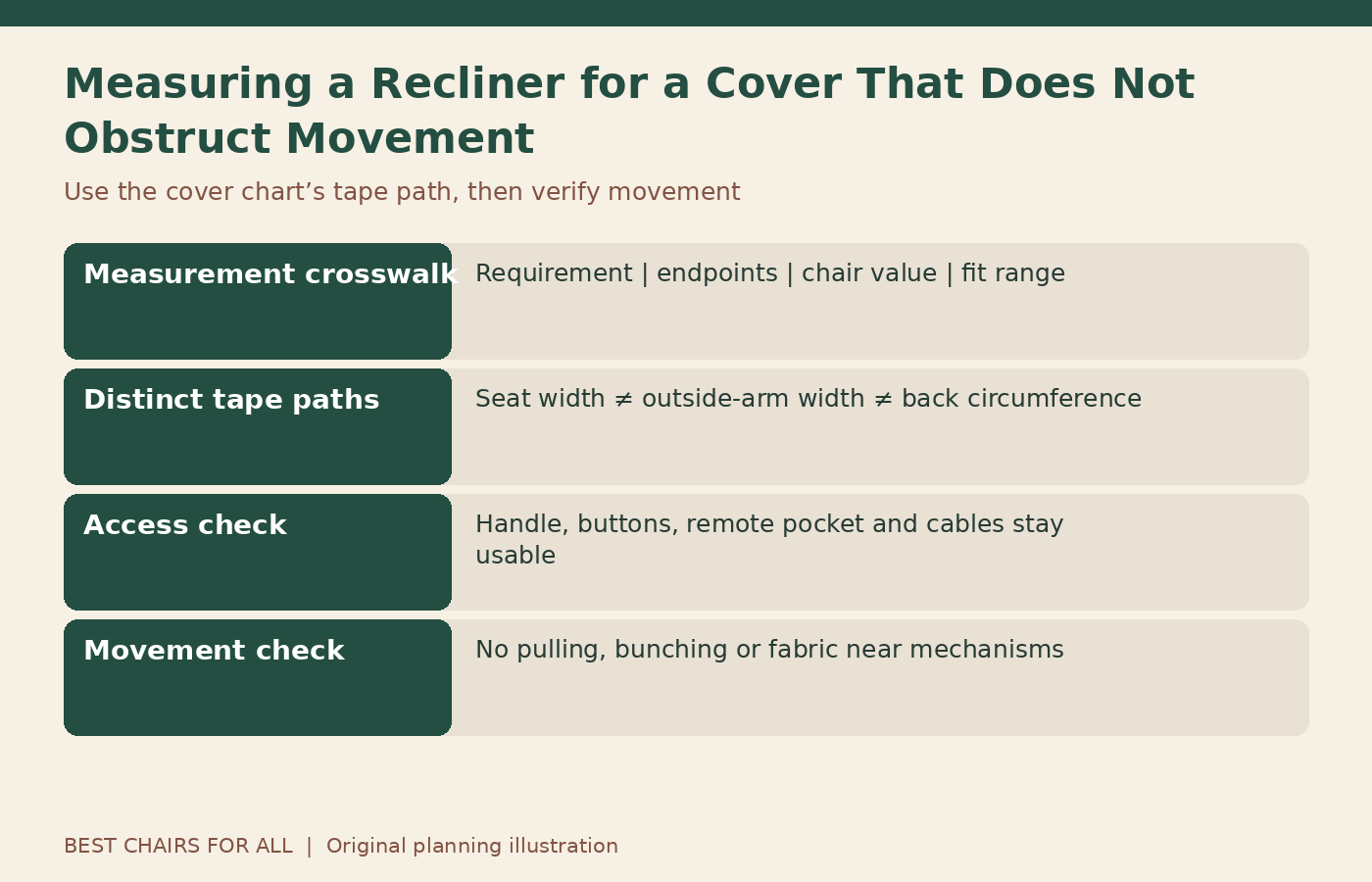
The goal is not simply a smooth photograph of the chair upright. The cover must suit the model, its permitted movement, and its care requirements. This guide provides a measurement crosswalk and a movement-clearance record so you can compare products without treating every stretch recliner cover as universal.
Decide what kind of cover you mean
A fitted stretch slipcover wraps around upholstered sections. A draped furniture protector covers selected contact surfaces. Separate arm or headrest covers protect smaller areas. These designs use different sizing methods and attachment arrangements. A measurement chart for a draped protector should not be used to select a fully fitted cover, even when both product titles include recliner.
Identify whether the chair is a manual recliner, power recliner, lift chair, swivel glider, or another configuration. Covers advertised for one may not suit another. Ask the chair manufacturer whether a particular type of cover is permitted, especially where integrated heat, controls, or moving extensions are present. The cover seller’s general size range does not resolve chair-side compatibility.
Read the chart’s endpoints literally
A chart may ask for the width between the arms, outside arm to outside arm, or circumference around the entire back. Those are not interchangeable. The Sure Fit measuring guide hosted by Fingerhut illustrates several cover categories with different measurement conventions. Use it as an example of why the diagram matters, not as a size chart for unrelated products.
Save the exact product page and current chart for the cover you intend to buy. If the chart is ambiguous, send the seller a photograph and ask them to identify the tape path. Do not infer circumference by doubling a straight width unless the chart explicitly defines that calculation. Upholstered curves and thickness change the result.
Make a measurement crosswalk
Create four columns: cover requirement, tape endpoints, your chair measurement, and confirmed fit range. Add separate rows for every dimension requested by the cover manufacturer. Write the words from the chart, such as outside arms or around back, beside the number. A bare list of widths is easy to misread later when comparing several cover designs.
Keep inches and centimeters separate and use the same units as the chart. Record whether the chair was upright and whether the tape followed the upholstery surface or spanned a straight opening. These details help resolve a seller’s follow-up question. They also prevent a measurement intended for body fit, such as usable seat depth, from being mistaken for a cover’s draped fabric length.
Measure accessible upholstery with the chair stationary
Start with the chair in the position required by the cover sizing instructions. Use a soft tape for curves and a helper if necessary. Keep the tape on accessible upholstered surfaces, not through gaps or around the mechanism. Do not reach beneath the footrest or move the chair while someone holds the tape near a moving section.
For powered furniture, follow the chair’s preparation and isolation instructions before any permitted installation work. A battery may leave the system able to move after the wall plug is disconnected. If a measurement cannot be taken without entering a pinch area, ask the provider or cover seller for an alternative method. A cover purchase does not justify unsafe access.
Record shape as well as dimensions
Photograph the chair’s arms, back wings, seat front, footrest, and controls. Note whether the seat is a box shape, has projecting cushion corners, or forms a continuous chaise pad. A cover can fall within a published width range yet struggle with an unusual shape. The fabric’s stretch does not establish that seams and openings will align on every silhouette.
Record any headrest, lumbar, or footrest extension that moves independently. Those sections may require a cover specifically designed to follow them, or they may make a proposed cover unsuitable. Ask the manufacturer about the exact configuration rather than assuming a single-piece design will stretch around every adjustment without affecting operation.
Measure the control-access requirement
Locate the manual handle, side buttons, USB port, remote pocket, and any release or lock features identified by the chair manual. Photograph their position relative to the arm and seat. Ask whether the cover has a properly located opening or another approved way to preserve access. A handle hole on the opposite side does not become compatible simply because the fabric stretches.
Do not cut a new hole or reroute a control cable without explicit instructions from the relevant manufacturers. A cover should not hold a button down, hide a warning label needed for use, or pull on a remote lead. Test reach from the normal sitting position after an approved installation, not just by standing beside the chair.
Keep attachments away from moving parts
Do not tie straps or elastic loops to arbitrary hardware beneath a recliner. Some cover instructions describe attachment methods for particular products, but those instructions must also be compatible with the chair’s own warnings and allowed attachment points. If an installation requires uncertain access or fastening near linkages, stop and ask both suppliers for a clear approved method.
The Pride owner manual warns about objects and loose materials around its lift and scissor mechanisms. That concern matters when evaluating cover straps and hems. A cover that looks secure while upright may create a loose loop as the footrest retracts, so attachment compatibility cannot be judged by appearance alone.
Compare upright fit with permitted movement
After an approved installation, follow the manufacturers’ instructions for checking operation, with everyone clear and no hands near moving areas. Observe from a safe position whether fabric pulls tight, slides toward an opening, bunches near controls, or approaches a mechanism. Stop immediately if interference appears; do not keep cycling to stretch the cover into place.
The La-Z-Boy DOC014818 manual emphasizes keeping the legrest path clear and avoiding pinched cords and other interference for its covered chairs. Use the matching chair manual for your own movement check. A cover seller’s fit guarantee is not permission to disregard the furniture manufacturer’s operating limits.
A worked crosswalk example
Imagine Cover A asks for outside arm width of 32 to 43 inches. Your chair measures 38 inches across the outside arms. That passes only that stated row. Cover B asks instead for circumference around the back, and your separate soft-tape measurement is 84 inches. The first measurement cannot tell you whether Cover B fits, and the second cannot establish Cover A’s control-opening alignment.
These invented numbers illustrate separate tape paths; they are not specifications for current covers. Add rows for required back height, seat area, and footrest section where the actual chart requests them. Mark unanswered requirements unresolved rather than choosing a size from the one dimension that happens to match.
Avoid treating stretch as spare operating clearance
Stretch fabric can adapt to a range of upholstery sizes, but it can also apply tension across moving sections. Do not assume that a cover at the edge of its stated range will become suitable after several cycles. Ask the cover manufacturer how its fit range accounts for reclining and whether the exact chair type is supported.
Similarly, an oversized drape may leave excess material near the floor or footrest. Tucking it deeply into a mechanism gap is not an appropriate fix. Choose a better size or a different cover design after compatibility advice. A neat appearance achieved by hiding loose fabric where it cannot be inspected is a poor outcome for moving furniture.
Check heat and upholstery compatibility
If the chair includes integrated heat, obtain specific permission for the proposed cover and follow all related limits. Do not assume a thin fabric is automatically acceptable or that a waterproof layer behaves like an ordinary woven cloth. The cover can also affect the feel of the upholstery or transfer color, so follow both products’ care and material guidance.
For leather furniture, ask whether the cover backing or anti-slip material is suitable for the finish. Avoid applying sprays, adhesives, or additional pads to make a cover grip unless the chair manufacturer approves them. A cover should protect the intended contact surfaces without introducing an unverified chemical or mechanical interaction.
Plan removal and laundering before purchase
Read the actual care label, including whether the cover is machine washable, how it dries, and whether all pieces use the same method. Ask whether shrinkage or loss of stretch affects refitting. Do not wash the chair’s fixed upholstery simply because the removable cover is washable. Keep installation instructions so the cover can be refitted in the approved way.
A practical cover must also be manageable for the person who will remove it. If fitting requires heavy lifting, inaccessible straps, or repeated service visits, another design may better suit the household. Compare the complete maintenance routine rather than only the product’s sale image. Preserve access to the chair’s power and control equipment throughout removal and refitting.
Keep a fit-and-movement record
Save the crosswalk, chair photographs, approved attachment explanation, and cover product code. Record the observed upright fit and the result of the permitted movement check. If the cover migrates during normal use, stop and reassess rather than tightening it to unknown frame parts. Recheck after laundering and after any change to the chair or cover.
A successful cover choice has every required dimension confirmed, the chair type supported, controls reachable, attachments approved, and fabric clear of movement. If one of those remains unresolved, the cover is not ready for use merely because its color and seat width match. The measurement process is complete when protection and normal chair operation work together.
Something unclear or out of date? Send a correction with this article’s title and the detail to check.
Sources, research & corrections policy ↗