Measure a chaise lounge from two perspectives: the outside dimensions that occupy the room and the usable cushion area that supports the person. Overall length includes the back and frame, so it can be much longer than the available space from the face of the back cushion to the seat end. Keep those figures separate when comparing models.
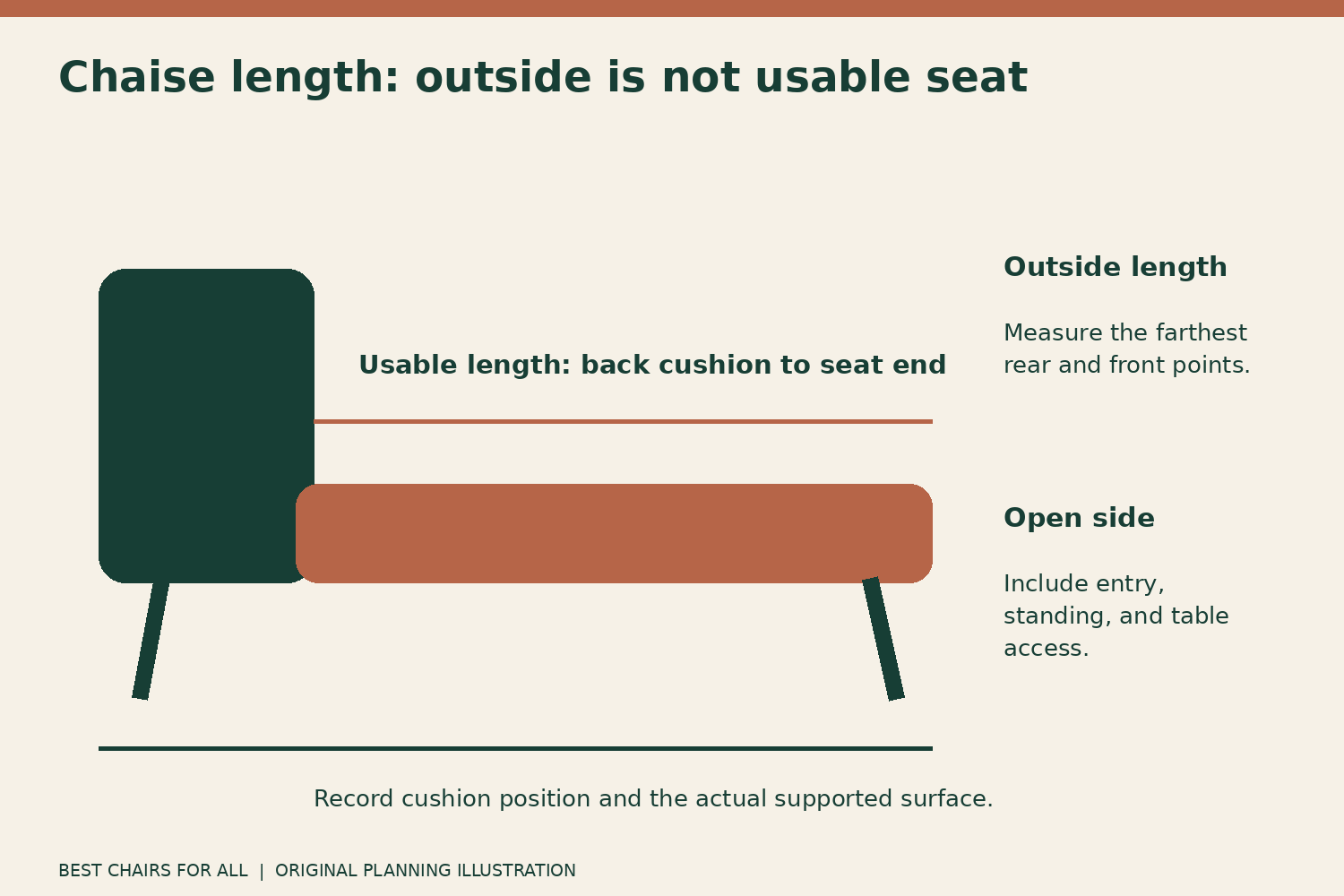
A complete measurement record also includes clear seat width, seat height, arm position, back height, delivery shape, and access to the open side. This guide focuses on indoor upholstered chaises. Adjustable outdoor loungers need their own open, reclined, folded, and manufacturer-specified operating measurements rather than an assumed indoor-chair method.
Identify what kind of chaise you are measuring
A freestanding chaise may have one arm, two arms, or none. A sectional chaise can be a component intended to attach to another module. An ottoman-based reversible design may create the long sitting area from separate pieces. Before measuring, identify the exact assembled configuration that will be used in the room.
Record whether the outside sides are finished for standalone use and whether connectors project from a sectional component. A module photographed alone is not necessarily intended to function alone. Ask the manufacturer if the instructions do not make the permitted configuration clear. Measurements cannot resolve an unsupported assembly choice.
Also note whether the published drawing includes loose back cushions and optional arms. Removing a pillow can change apparent usable length, while adding an arm can change overall width. Save the product code and configuration beside the figures so you do not combine dimensions from different versions of the same collection.
Measure the overall envelope in straight lines
Overall length, sometimes labeled depth, runs from the farthest rear point to the farthest front point. Overall width is the greatest side-to-side dimension, including arms and any projecting feet. Overall height runs vertically to the highest point. Keep the tape straight rather than following the curve of upholstery or a sloped back.
Use a second person or a straight vertical reference beside a projection when the tape’s endpoints are difficult to align. A rolled back can extend behind the legs, and a cushion can overhang the frame. Measure the maximum assembled shape in its normal position without pressing or compressing it to produce a smaller result.
On an asymmetric chaise, the widest point may occur at the arm or back rather than at the foot end. Record widths at both ends if they differ meaningfully. A room plan drawn as one rectangle is conservative, but a more detailed outline can clarify whether a nearby table fits beside the narrower portion.
Measure usable length to the actual back support
Usable length is the distance along the intended sitting area from the front of the back support to the supported end of the seat. Include the normal back cushion. If the cushion is loose and compressible, note whether you measured unoccupied or after the person settled into position.
IKEA’s SÖDERHAMN chaise in Fridtuna dark gray lists 59½ inches overall depth and 39⅜ inches seat depth. The difference is 20⅛ inches. That arithmetic shows why overall length should not be described as equivalent leg-support space.
Do not infer that the difference consists entirely of one component, such as a 20⅛-inch-thick back. The geometry can include frame, slope, and cushion relationships. The useful conclusion is simply that the two dimensions answer different questions. Ask how the manufacturer defines seat depth before comparing another model’s inside-length figure.
Compare two published examples correctly
Room & Board’s Stevens chaise page gives a selected configuration an overall size of 40 inches wide by 66 inches deep, with an inside depth of 52 inches. It also offers different seat-depth choices, so confirm which configuration is selected before recording the dimensions.
The SÖDERHAMN example and the Stevens example should not be ranked from outside length alone. The Stevens example is 6½ inches longer overall, while its listed inside-depth figure is 12⅝ inches greater than the SÖDERHAMN seat-depth figure. Different definitions and cushion arrangements still need confirmation before treating those interior measurements as perfectly equivalent.
| Published example | Outside depth | Listed interior dimension | Question to confirm |
|---|---|---|---|
| IKEA SÖDERHAMN cited version | 59½ inches | 39⅜-inch seat depth | Back-cushion position in the measurement |
| Room & Board Stevens selected version | 66 inches | 52-inch inside depth | Exact depth option and reference points |
These are dimensional examples, not recommendations or evidence of personal testing. Their value is in demonstrating how a compact outside shape can allocate space differently from another chaise. Repeat the comparison with the exact models on your shortlist and a consistent understanding of the interior endpoints.
Check usable width along the cushion
Measure clear width between arms or other boundaries at the back, middle, and foot end. A sculptural chaise may taper, and a curved arm can intrude where the knees rest. If you like to bend your knees or sit diagonally, the narrowest relevant width may matter more than the maximum seat-width number.
Do not include a loose unsupported cushion edge as if it were a stable extension of the seat. Ask the manufacturer which surfaces are intended for sitting or resting. A broad arm is not automatically an extra seat, and the foot end should not be used as a step to test its apparent strength.
For a chaise with separate seat sections, note the seam or joint location. A nominally continuous length can feel different across a change in cushion firmness or a gap between components. Sit in the intended position and observe whether the junction lies beneath a place where you regularly rest your legs.
Record height and slope separately
Measure seat height at the front and at another clearly identified point if the platform slopes. A single front-edge figure may not describe where the pelvis settles. Soft filling introduces another difference between unloaded specifications and occupied posture. Record that behavior in words rather than inventing a standardized compressed measurement.
Measure back height and arm height from the floor for room planning. If the chaise sits below a window, check the actual highest cushion point as well as the frame. If a side table is planned, compare its top with the arm at the location where the hand will reach, because an arm can slope substantially.
Use a personal-fit length trial
Sit against the back in your normal reading or lounging posture. Let the legs rest naturally rather than stretching to reach the end. Note whether the feet remain supported, overhang, or press into a raised edge. There is no universal required usable length based only on standing height; torso and leg proportions and posture differ.
Try a knees-bent position and then return to feet down at the open side. Check whether the arm allows that movement and whether the seat depth makes it awkward. A chaise that supports stretched legs can still be inconvenient to enter or leave, so the fit trial needs more than a photograph of the user lying along it.
Bring your usual book, pillow, or e-reader support. A thick back pillow shortens the usable length and moves the body toward the foot end. Record it in the measurement sheet. If you need to remove a manufacturer’s intended cushion to gain enough length, compare a different model rather than assuming removal preserves the intended support.
Build a room outline that includes the open side
Tape the overall outline at the angle you plan to use. Add the entry side, standing space, nearby table, and lamp base. If the chaise points into the room, check whether its foot end intercepts a main route. A long narrow shape can divide circulation even when there is spare area elsewhere.
Use boxes to suggest the arm and back height. This reveals conflicts with curtains, window controls, shelves, and furniture that a flat outline misses. Check the sightline from neighboring seats too. A single-arm chaise can look open from one side and create a substantial barrier from the other.
Measure the delivered shape, not just the final chaise
Crate & Barrel’s furniture measuring guide emphasizes the complete route, including entrances, turns, stairs, and room placement. A chaise’s long frame can create a turning problem even when its width clears the doorway. Document the approach and the space beyond the opening.
Ask for package dimensions and permitted removable components. A boxed chaise may have a separate back or legs, but do not assume arms can be removed. If the fit is close, send the drawing and route measurements to the delivery team for assessment. Do not rely on a diagonal calculation alone to guarantee a three-dimensional maneuver.
Keep a final chaise measurement card
Record outside width, depth, and height; usable length and width; seat height and slope; arm side; cushion configuration; largest delivered component; and the planned entry route. Mark any missing manufacturer definition explicitly. This card keeps room fit, body fit, and delivery fit connected without confusing their measurements.
Choose after the actual sitting trial and full-scale outline agree with the specifications. The decisive length is not simply the longest number in the listing. It is the usable support available in your preferred posture within a chaise that fits its room, open side, and delivery route.
Read sectional drawings at component level
On a sofa with a chaise, the published overall depth may describe only the projecting chaise side, while the ordinary sofa seats are shallower. Draw both depths on the floor plan and identify where the projection begins across the total width. If the drawing gives only the full sectional rectangle, ask for the component dimensions. Otherwise, you may mistakenly reserve too much floor beside the ordinary seats or overlook the actual corner where the chaise blocks a route.
Something unclear or out of date? Send a correction with this article’s title and the detail to check.
Sources, research & corrections policy ↗