Dining chair seat depth should let you use the back while leaving comfortable room behind the knees and supporting the thighs. The number in a listing is only a starting point because “depth” may describe the whole chair rather than the usable sitting surface. Measure the correct area, compare it with a chair that already fits you, and check the fit at your dining table before ordering a set.
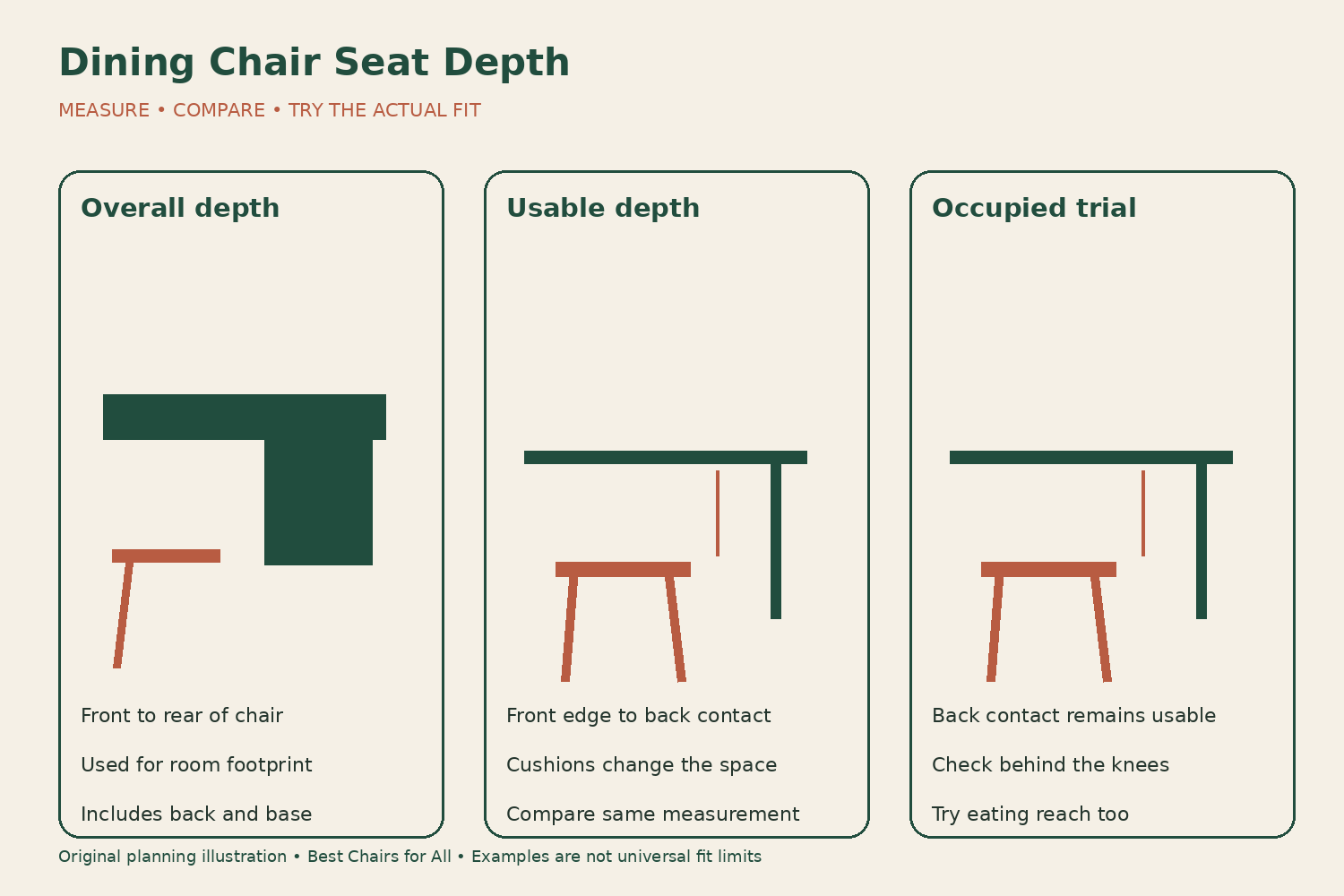
Separate three depth measurements
Overall depth runs from the farthest front projection to the farthest rear projection of the entire chair. It describes footprint and circulation. Seat-pan depth describes the seat itself, sometimes measured before upholstery or without considering the back’s curve. Usable depth is the space you actually sit on between the effective back contact and the front edge. Ask which measurement the seller provides.
A chair with a steeply angled back can have a large overall depth but a shorter usable seat. A thick back cushion can reduce usable depth further. A curved wooden shell may support the pelvis at a different point from its rear outline. Two chairs listed at the same total depth can therefore feel quite different when occupied.
Read dimensional drawings carefully. A horizontal arrow through the base is not necessarily a seat-depth measurement. If only overall depth is available, ask for the usable depth of the exact configuration. Keep the reply with the product information instead of estimating from a perspective photograph, where the camera angle can substantially distort apparent proportions.
Use general seating guidance within its scope
OSHA’s computer-workstation chair guidance discusses allowing shorter users to sit against the back without the front edge contacting the knees, while maintaining support for taller users. This is office-seating guidance, not a dining-chair specification or certification. The general fit relationship is useful; the office-specific base and adjustment recommendations should not be copied indiscriminately to dining furniture.
Similarly, the UK HSE’s display-screen guidance illustrates a small gap between the seat front and the back of the knee. Its diagram is intended for a workstation. Use it as a reminder to check contact and support rather than treating one illustrated dimension as a clinical prescription for every diner.
For a dining chair, the table adds another constraint. A seat can feel comfortable away from the table yet place you too far back to eat comfortably. Depth, back angle, seat height, and the table opening interact. Evaluate those relationships together while keeping the depth observation specific enough to compare different chairs.
Measure a chair that already works
Choose a chair you find comfortable for a normal meal, rather than a sofa you use for reclining. Place it on a level surface and identify where your back actually contacts the support. Measure along the seat from that effective contact area to the front edge. For a heavily contoured or upholstered chair, note the limitations of measuring a three-dimensional surface with a straight tape.
Record both usable depth and overall depth. Photograph the tape position if that helps you repeat the method. Note the seat height, whether a pad is present, and whether the back cushion compresses. The comparison is strongest when you describe the configuration clearly enough that a seller can understand what you are trying to match.
Treat the result as a personal reference rather than a universal target. A second household member may need something different. If no existing chair works well, do not turn its dimensions into the shopping specification merely because it is available to measure. Use in-person trials or seek professional advice for specific seating concerns.
Check the occupied position
Sit back in the position you would use during a meal, with your feet supported. Notice whether you can reach the back without the seat edge pressing into the area behind your knees. Then bring a place setting within normal reach. Avoid deliberately holding an unusually upright or forward position just to make the chair seem to fit for a short trial.
If you slide forward to avoid the edge, notice whether you lose back contact. If you sit farther back, notice whether your feet remain comfortably supported. These observations help distinguish excessive usable depth from excessive seat height. A deep seat and a high seat can produce similar complaints but call for different product comparisons.
Do not continue a trial that causes pain, numbness, or other concerning symptoms. Persistent discomfort or individual pressure-management needs deserve assessment by a qualified professional. Ordinary furniture shopping can identify that a chair feels unsuitable; it cannot diagnose why or establish that another chair will treat the underlying problem.
A worked comparison without a universal rule
Suppose your comfortable reference chair has an estimated usable depth of 17 inches. Candidate A lists 22 inches of overall depth but provides no seat measurement. Candidate B lists 19 inches of seat depth. You do not yet know that B is deeper for the sitter, because A’s 22-inch figure includes the back and base while B’s figure may describe an uncovered seat pan.
Ask both sellers the same question: what is the usable distance from the front edge to the back contact in the configuration being sold? Suppose the replies are 16.5 inches for A and 18.5 inches for B. Those figures now create a meaningful comparison with your reference, while still leaving cushion behavior, contour, and back angle to be tried.
During a trial, you might find A’s curved front edge more comfortable but its back too upright, while B’s back feels pleasant yet requires you to sit forward. Record both results. Choosing by the closest depth number alone would ignore the very interactions the measurement was intended to help you investigate.
Include width and contour
A seat that narrows toward the back may limit how far back you can comfortably sit. Thick side bolsters or arms can have the same effect. Ask for the usable width where your body rests, not only the widest front measurement. A nominal depth becomes less useful if the seat shape prevents you from occupying it in the expected way.
Contoured wood seats can vary in depth and height across the surface. Upholstery can add a rounded edge or a central depression. Try moving naturally within the seat instead of assuming the measurement describes one fixed sitting point. Note whether the design encourages sliding, leaves a hard edge noticeable, or keeps you comfortably positioned for the table.
Room & Board’s dining-chair guide distinguishes contoured wood seats, upholstered chairs, and wood frames with upholstered seats. That range reinforces a practical point: material and shape work together. You cannot reliably infer usable depth or comfort from the fact that a chair is padded or made of wood.
Be careful with added back cushions
An added back cushion can reduce usable depth, but it also changes where your body sits relative to the seat edge, arms, and table. A loose cushion may shift during entry or use, and a thick one can move the sitter beyond the intended support area. Check suitability with the chair manufacturer and consider individual needs before treating it as a simple fix.
If a permitted cushion is part of the planned setup, evaluate the complete arrangement. Record its size and attachment, and try normal dining movements. Do not test the bare chair successfully and then assume a later accessory leaves the fit unchanged. The cushion’s compression and movement matter as much as its advertised thickness.
Avoid cutting a seat, moving a backrest, or changing structural attachments to alter depth without manufacturer-approved guidance. A removable seat used for upholstery work is not necessarily designed for repositioning. If the chair’s basic geometry does not suit the person, a different chair is generally a clearer shopping solution than an improvised structural alteration.
Measure table reach as a separate check
Once depth seems suitable, position the chair at the table. Check how close the seat can move before the frame, arms, or front legs meet the table. A deep apron or pedestal base may stop the chair farther away than expected. The resulting reach problem can be mistaken for excessive seat depth even when the sitting surface itself fits well.
Set out a plate and glass and try ordinary eating movements. Notice whether you lean continuously away from the back simply to reach your place setting. Some movement during dining is normal; the question is whether the furniture forces a position you find unsuitable. Try the candidate in the intended place rather than borrowing the fit of another table.
Check the route behind the occupied chair too. A chair with a compact usable seat can still have a deep overall footprint, particularly with an angled back or splayed legs. Keep both measurements in the room plan. Personal fit and circulation are distinct decisions, and a favorable result in one does not erase a problem in the other.
Keep a depth comparison card
For each candidate, record overall depth, stated seat depth, clarified usable depth, seat height, back angle description, and upholstery configuration. Add your reference chair’s measurements and the date of any seller clarification. Mark unavailable measurements as unknown rather than filling them with estimates from photos.
Add three trial observations: back contact, room behind the knees, and eating reach at the intended table. Record which person tried the chair. When the household includes people with different proportions, one chair may be a compromise or different positions may use different chairs. Make that choice deliberately instead of assuming a single depth suits everyone.
Before buying several, verify that the delivered chair matches the evaluated size and upholstery. Keep the card for future replacements, since a product family can change dimensions between versions. The goal is a usable seat that supports your normal dining position, with enough information to repeat a successful choice rather than relying on one ambiguous catalog number.
Something unclear or out of date? Send a correction with this article’s title and the detail to check.
Sources, research & corrections policy ↗