Choose an ottoman height by testing it with the occupied chair and the resting position you want. A nominal match to the chair’s catalog seat height is only a starting point. Seat slope, cushion compression, ottoman angle, distance, and the place your legs contact the surface can all change the result.
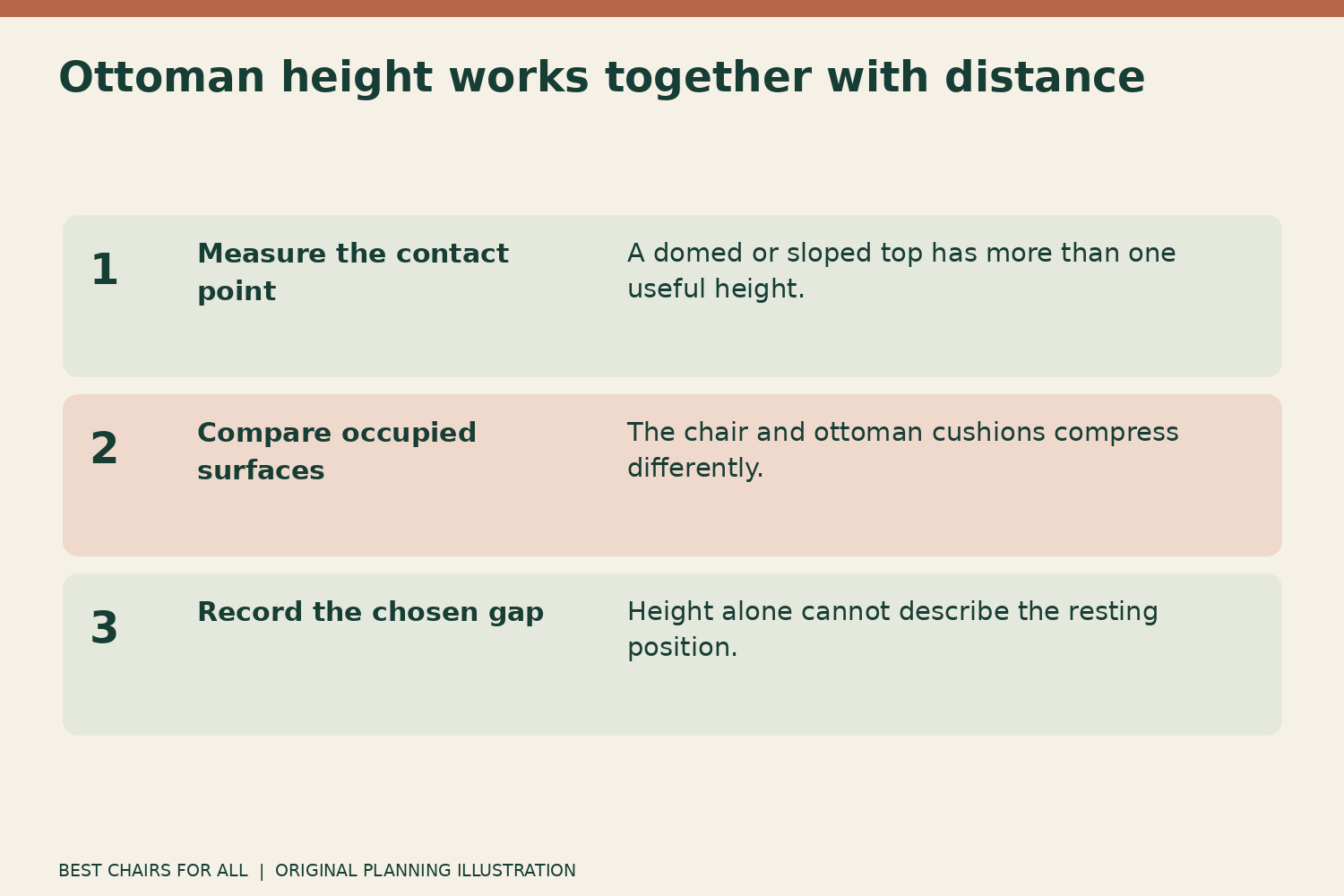
First decide whether you need a low support for feet during upright sitting or an extended leg support for relaxed lounging. Those are different uses. Then measure the chair and ottoman consistently, try the pair together, and preserve a clear way to put both feet down and stand. There is no single ottoman height that suits every chair or reader.
Distinguish foot support from a lounge extension
During upright sitting, a foot support may simply provide a landing place when the floor is too far below your feet. It can be much lower than a lounge ottoman. The purpose is to support the feet while the body remains in the chair’s intended upright position, not to extend the seat into a near-horizontal surface.
The Canadian Centre for Occupational Health and Safety’s work-chair guidance discusses using a footrest when feet cannot rest on the floor. Its context is work seating. That principle can help identify an unsupported-foot problem, but it does not specify the right height for a reclined living-room ottoman.
A lounge ottoman is usually part of a different posture, with the reader leaning back and resting part of the legs on the padded surface. Evaluate the whole position, including the back angle and book location. Do not assume that a tall footrest will fix a chair whose seat depth, back, or height does not otherwise fit.
Measure the occupied chair before measuring the ottoman
Record the unloaded seat height at the front center and note any slope toward the back. Then sit normally and observe where the cushion settles. You do not need an elaborate pressure measurement; the point is to avoid comparing a very soft occupied seat with an untouched ottoman cushion as though both stayed at their catalog heights.
Keep the reference points clear. A sloped chair may have a lower sitting position behind a higher front edge. A soft cushion may compress more under the pelvis than near the knees. Write “front unloaded height” and “occupied sitting position” separately rather than presenting one hand-pressed measurement as an exact loaded seat height.
Use the same rug and normal footwear during the trial where possible. A thick rug beneath one piece changes its relationship to the other, while shoes change where the feet meet a support. These are small details, but they matter when a comparison depends on a modest difference in height.
Read designed pairs as relationships
Manufacturers do not always give a chair and ottoman identical heights. IKEA’s POÄNG ottoman in birch veneer with the Knisa light beige cushion lists a height of 15⅜ inches. That is a specification for this particular ottoman, whose frame and surface work with its intended seating system.
A different designed pair can use another relationship. Herman Miller’s Eames Lounge Chair and Ottoman product sheet gives the ottoman a 17.25-inch height and specifies separate chair sizes and seat-related dimensions. The chair’s angle is part of the design, so matching a single height is not the whole fitting process.
These examples demonstrate variation rather than establishing a target range. Do not choose an ottoman for an unrelated chair merely because it copies one of those numbers. Try the intended combination or reproduce its relevant measurements with a stable, purpose-designed display support supplied by the retailer.
Measure where the legs actually rest
An ottoman can have a domed cushion, rounded edges, or an angled top. Its highest point may not be the point your legs touch. Measure front and rear contact areas if the surface slopes. Also note how much the padding yields during ordinary use; a decorative pouf can compress differently from a framed upholstered ottoman.
Check whether the available support width suits your normal leg position. A narrow piece can force the feet together, while a broad one may make access to the chair awkward. Depth matters too: a shallow surface offers a smaller contact area, and a long surface occupies more of the route in front of the chair.
Do not assume a cushion’s extra thickness can be subtracted neatly from the frame height. Filling compresses unevenly and may move under contact. Compare the complete assembled ottoman, including its actual cushion, feet, and any permitted glides. A frame-only measurement is insufficient for a resting-position trial.
Adjust distance before declaring the height wrong
The same ottoman can feel different when moved closer or farther away. Distance changes which part of the legs contacts it and how the knees settle. Begin with the manufacturer or retailer’s normal arrangement, then make small changes while the chair remains stable and the user remains in a comfortable position.
If the ottoman is too far away, you may stretch toward it or slide forward in the chair. If it is too close, it can crowd the legs and make placing the feet on the floor inconvenient. Record the useful gap between the furniture fronts alongside the height. A preferred height without a preferred distance is an incomplete result.
Keep the test descriptive: “comfortable after moving two inches closer,” or “edge noticeable beneath the lower legs.” Avoid forcing a prescribed angle or using the chair to diagnose a health problem. If a position causes pain, tingling, or other symptoms, stop the trial and seek appropriate individual advice rather than continuing to adjust the furniture around it.
A four-measurement trial sheet
This original worksheet records the pair as used. The hypothetical numbers illustrate the method only; they are not a recommended body fit. Take the same observations for each candidate so that a shorter soft pouf is not compared unfairly with a taller framed ottoman under different conditions.
| Measurement or observation | Example entry | Purpose |
|---|---|---|
| Chair front seat height | 18 inches unloaded | Repeatable catalog-style reference |
| Occupied seat behavior | Settles visibly; back slopes | Shows why nominal matching is incomplete |
| Ottoman contact height | 16 inches at chosen resting area | Measures the relevant surface point |
| Chosen furniture gap | 10 inches after trial | Records contact location and access |
| Exit check | Feet down without moving ottoman | Confirms everyday usability |
Suppose a second ottoman is also listed at 16 inches but has a rounded top and softer filling. It may not reproduce the first one’s contact height once occupied. The worksheet helps explain the difference: the catalog numbers match, while the surface shape and compression do not.
Test with the book and backrest you use
Foot support can change how far back you settle, which can change the book’s position relative to your eyes and arms. Bring a real book or e-reader to the fitting. Read several pages, turn toward the room, and put the book on the intended table. A leg position that feels pleasant with empty hands may be less useful during reading.
If you add a back cushion, treat it as part of the arrangement. It can shorten the usable seat depth and move the body forward relative to the ottoman. Record that cushion in the trial sheet. Do not keep changing several accessories at once, because it becomes difficult to identify what produced the improvement or new problem.
For a reclining chair, check the manual before adding a separate ottoman. An integrated footrest and a separate support may conflict, and a moving mechanism needs its own clearances. Do not place an ottoman where it could obstruct extension or retraction or encourage use outside the chair’s intended operating instructions.
Consider shared use and different tasks
A matching pair may work well for one reader but not another. Have each regular user test the same height at their preferred distance. A movable ottoman can accommodate some differences, but constant heavy lifting may make the arrangement impractical. Consider how often the distance will change and where the piece will be parked during conversation.
If the ottoman also serves as a table, its useful tabletop height and stability may conflict with its best resting position. A tray adds height and requires a reliable surface. Test that function separately, and remove drinks before using the piece for feet. Do not assume a padded or rounded top can safely support a glass.
Extra seating is another separate use. Only sit on the ottoman if the manufacturer permits it and provides the relevant load information. A foot support is not a step, and appearance does not establish a seating capacity. Do not compromise the resting-height decision to gain a second function that the product was never designed to provide.
Reject unstable height fixes
Do not raise an ottoman with loose blocks, stacked pads beneath feet, or an unsupported extra cushion. Those changes can alter stability and create an unreliable contact surface. If the height is wrong, choose another model or ask the manufacturer about an approved alternative rather than improvising structural changes.
Likewise, do not lower a framed ottoman by cutting legs or removing components without explicit manufacturer support. The frame and feet work as an assembly. A clean-looking alteration can still change joints, floor contact, or the intended load path. A different ottoman is often a clearer solution than modifying a mismatched one.
Make the final decision from the complete setup
Choose the height and distance that let you rest comfortably, read naturally, change position, and put your feet down without an obstacle. Confirm the arrangement in the actual room with tables and walkways included. Keep the four-measurement sheet and exact cushion configuration so the successful setup can be recreated after cleaning or moving the furniture.
Something unclear or out of date? Send a correction with this article’s title and the detail to check.
Sources, research & corrections policy ↗