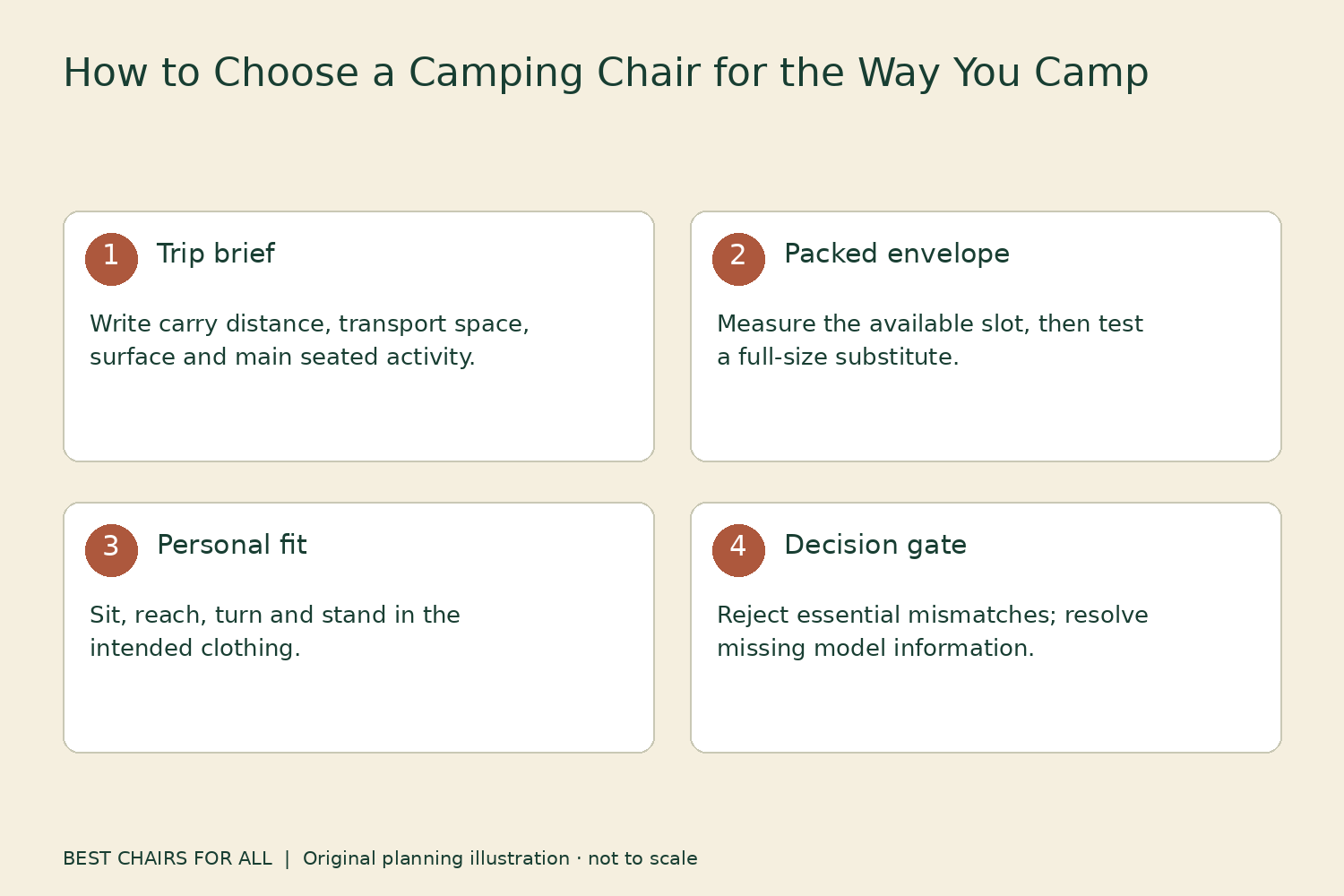
Choose a camping chair by finding the restriction that can actually spoil your trip: the walk from the vehicle, the space available for a packed chair, getting out of the seat, or the ground under its feet. Comfort matters, but it cannot rescue a chair that will not fit through the hatch or that you leave behind because carrying it is awkward. Start with your typical outing rather than the most ambitious trip you might take someday.
This is a selection method, not a claim that one chair suits every camper. The examples below use manufacturer specifications to illustrate comparisons. The measurement exercises are original planning tools; they are not results from laboratory or field testing. Try the actual chair whenever possible, wearing the shoes and layers you expect to use outside.
Write a one sentence trip brief
Write something concrete: “Two adults, a small hatchback, two nights at a drive-in campsite, chairs carried from a parking bay to a picnic area.” That brief already suggests that folded length, easy handling, and useful seating at a table deserve more attention than shaving a few ounces. Another camper walking several miles with all equipment needs a different answer, even if both people describe their trip as camping.
Add the longest routine carry, where the chairs ride, and what you do while seated. Eating from a plate, reading for an hour, watching a match, and leaning back at camp involve different positions. Separate essential requirements from nice extras. A cup holder belongs in the second group unless a particular activity makes it indispensable. Easy standing may belong in the first group. This distinction stops accessory lists from deciding the purchase.
REI’s camp chair advice similarly begins with intended use and treats packed size and weight as important backpacking considerations. Use that as the broad filter, then investigate the details that apply to your route and body.
Measure the space before comparing products
Find the real storage bottleneck. In a vehicle it may be the opening between luggage rather than the total cargo volume. On a backpack it may be the height of an external pocket or the distance between compression straps. Measure the usable length, width, and depth. Include any obstruction that prevents a rigid bundle from sliding into place. A chair bag can be narrow yet inconveniently long.
Make a simple substitute using rolled towels inside a bag or a cardboard rectangle. Match the advertised packed dimensions without squeezing the substitute unrealistically. Put it in the vehicle with the cooler and bedding already loaded. Carry it with the other items you usually take. This exercise cannot establish a product’s durability or comfort, but it can expose a size problem before money changes hands.
For an example of why labels matter, Helinox’s Chair One page distinguishes assembled weight from packed weight and supplies packed dimensions. Compare the packed figure with other packed figures. An advertised chair-only weight does not include every item you may carry. Add the bag, ground accessory, insulated seat layer, or shade attachment if you intend to use them.
Evaluate the seat as a working position
Seat height is useful only when you understand where it was measured. A sling can dip under the occupant, and a high backrest does not imply a high seat. Sit fully into the chair, with feet in a comfortable position, then check the front edge and arm contact. A narrow seat may feel acceptable in shorts yet crowd a bulky coat. A deeply reclined seat can be pleasant for reading but make eating from a high table inconvenient.
Try a normal sequence: sit down, reach for a drink, turn toward another person, and stand again. Do this without jerking the chair or treating its back as a lifting handle. If you need armrests for the movement, confirm that the design and instructions support how you use them. Soft fabric arms behave differently from firm rails. Do not assume a chair is suitable because its weight capacity exceeds your weight.
Notice whether the fabric presses against the backs of your thighs, whether the side poles touch you, and whether the back supports the position you actually want. These are personal fit observations, not medical judgments. If you cannot try a chair first, favor clear dimensions and a usable return policy over promises such as “ergonomic” or “oversized.” Neither word gives a reliable seat measurement.
Match the frame to the surface
A wide footprint and supportive feet matter on soft ground, but they do not turn uneven terrain into a level seating platform. Look at where every foot will land. Avoid slopes, holes, loose edges, and places where chair legs can drop between decking boards. Check the manufacturer’s surface restrictions. A design marketed for the outdoors may still require firm, level ground.
For sand or soft soil, investigate an accessory specifically listed for the chair model and generation. A ground sheet that joins the legs is different from a loose picnic blanket. Added feet can change the packed bulk, and their attachment must remain secure while the chair is moved. If soft ground is a common part of your trips, count the accessory in the purchase and packing comparison from the beginning.
A rocker needs additional attention to the area through which the occupant and chair move. Keep people, bags, and fragile objects out of that movement area. A small open footprint on a specification sheet does not describe every moving part or the space needed for standing. For occasional beach days and frequent hard-surface camping, consider whether one adaptable chair is worth the additional accessory management.
Distinguish a stool from a chair
A stool can be useful for a short break, birdwatching stop, or camp task where a backrest is less valuable than quick deployment. It may be simpler to position in a small area, but its smaller seating surface changes how you use it. A chair with a backrest offers somewhere to lean during a longer pause. Compare the actual products rather than assuming all stools weigh less than all chairs.
The TravelChair Original Slacker, for instance, has its own listed weight, closed dimensions, seat height, and capacity. Those are model-specific facts, not a rule for tripod stools. Its long folded shape may fit beside a vehicle seat while a shorter, wider chair bag fits a backpack better. Shape can reverse the apparent winner in a simple weight comparison.
Think about how long you sit without getting up and whether you need a free hand to support your position. If you repeatedly wish for a backrest on your present stool, saving a little packed space may be a poor trade. If you rarely use the backrest of an existing chair, a simpler perch may suit the trip. Borrowing a different style for an ordinary outing can clarify this more effectively than reading another feature list.
Use a short purchasing worksheet
Create one row per candidate, with columns for full packed weight, packed dimensions, verified seat measurements, capacity, required ground accessory, setup method, and replacement-part support. Put the source URL and model identifier in the same row. A manufacturer can sell several visually similar versions, so a product family name alone is insufficient. Record uncertainties explicitly rather than inserting a plausible value.
Then add three personal tests: fits the loaded vehicle or pack; works for sitting and standing; suits the usual surface under the manufacturer’s instructions. Mark each as pass, fail, or unresolved. A fail on an essential requirement removes the candidate. Do not average it away with attractive fabric, storage pockets, or a low price. For unresolved fit questions, identify the actual action needed: obtain a drawing, ask the manufacturer, or arrange a sit test.
Suppose your available storage slot is 28 inches long and a candidate has a 30-inch rigid bag. That is a measurable mismatch, even if the chair is lighter than every alternative. A second candidate with a shorter bag still needs enough cross-sectional space and a usable carrying method. This hypothetical example is deliberately simple: do the physical packing check instead of turning dimensions into a complicated score.
Check the ownership details
Find the manual before buying if it is available. Understand how the frame opens, what locks or joints must engage, and how the seat attaches. A chair you can deploy comfortably in a shop may be awkward with cold hands or poor light. Practice at home before the first trip. Keep the bag and any small accessories together so that a fast setup does not become a search for missing pieces.
Look for care instructions, replacement feet, seats, and frame parts. Replacement support does not make unauthorized repairs safe, but it can provide a realistic route when a consumable component wears out. Inspect new equipment for shipping damage and confirm that the manual matches the supplied chair. Store a photograph of the model label with your packing list. It is much easier to order a correct part with that information available.
Keep a separate note for event restrictions. A concert or sports venue may limit seat height, allow only particular chair styles, or prohibit attachments. The right campsite chair can therefore be the wrong event chair. Verify the venue’s current published policy for the specific event and measure the chair as that policy defines it. A backrest height, seat height, and overall height describe different things.
Finally, choose the chair that clears your essential requirements with the fewest inconvenient compromises. A heavier, easy-to-use chair can be sensible for a short vehicle-to-pitch carry. A compact chair can earn its place on a walking trip if its comfort is worth the full carried package. The useful comparison is always between complete setups on your ordinary trip, with fit, surface, and handling checked together.
Something unclear or out of date? Send a correction with this article’s title and the detail to check.
Sources, research & corrections policy ↗