A heated camping chair battery must match the chair’s documented power requirements and the manufacturer’s compatibility instructions. Matching the plug’s apparent shape or buying a larger milliamp-hour number is insufficient. Check the exact chair model, approved battery, output voltage, required current or power, connector and charging method before connecting anything.
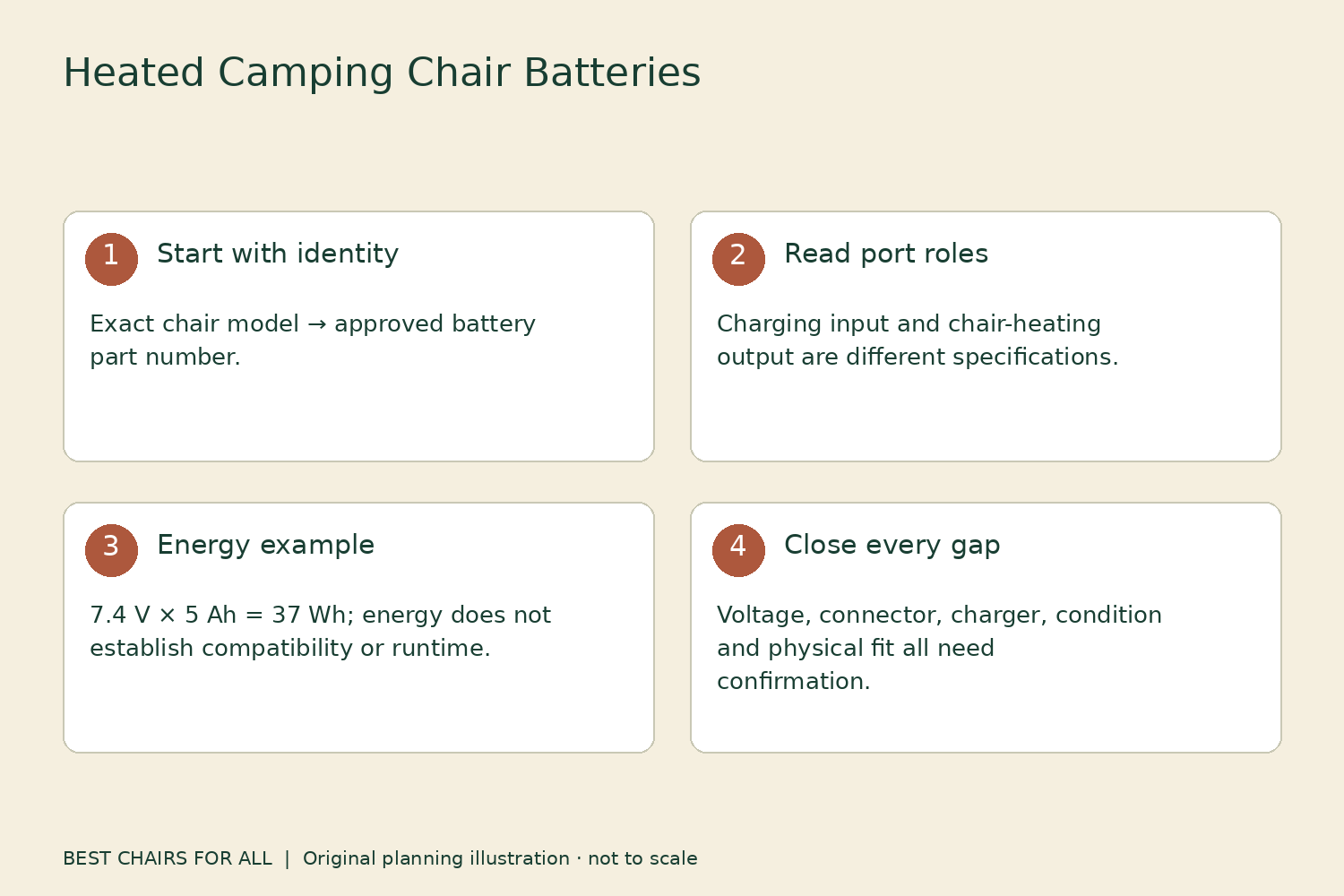
The safest purchasing shortcut is the maker’s confirmed replacement for the exact chair and generation. If the chair is designed for an ordinary USB power source, use the output profile specified in its manual. If it uses a proprietary pack, do not substitute a phone power bank through an adapter unless the manufacturer expressly supports that setup. This guide explains the labels without turning them into DIY wiring instructions.
Identify the power system you own
Find the model label on the chair and photograph the original battery label. Keep the manual and charger information beside those images. A name such as “heated folding chair” is too broad to establish a battery match. Product families may include chairs, stadium seats, covers and cushions using different electrical systems.
Look for the manufacturer’s approved replacement part number or compatibility list. Record the actual version and connector shown, not just a retailer’s abbreviated title. A battery sold under a similar name can change over time. If the maker has updated the charging port or pack design, ask whether the replacement supports your particular chair before ordering.
Do not begin by searching only for a plug adapter. An adapter changes a physical connection; it does not automatically produce the required voltage, polarity, communication or protection behavior. A plug that enters the socket can still be electrically wrong. Leave an uncertain chair disconnected while you resolve the specification with its manufacturer.
Separate charging input from heating output
A battery can have one port that accepts power for charging and another that supplies power to the chair. The labels describe different jobs. A USB-C charging input does not mean that the chair itself accepts generic USB-C power, nor does it mean that every port on the pack supplies the same voltage.
The Gobi Heat replacement jacket and chair battery page describes an updated USB-C charging input while identifying compatible products including the Terrain Heated Camping Chair. That is a useful example of why the input connector should not be mistaken for the chair’s heating connection. Use Gobi Heat’s current compatibility information for the actual pack.
Read the input and output markings separately. If a label has several voltage and current pairs, determine which pair applies to the port and operating mode required by the chair. Do not select the highest figure because it appears more capable. An unresolved label is a question for support, especially when the product page and the pack in your hand appear to use different conventions.
Voltage, current and capacity answer different questions
Voltage is part of the required electrical match. Current or power ratings indicate what an approved source can supply under specified conditions. Capacity describes stored charge or energy; it does not make an incompatible output suitable. A high-capacity battery with the wrong voltage is still the wrong battery.
As a hypothetical label-reading exercise, a source marked 5 volts at 2 amperes corresponds to 10 watts at that stated output. The calculation is volts multiplied by amperes. This arithmetic explains the relationship between labels; it does not identify a suitable heated-chair battery or authorize connecting a 5-volt pack to a chair with different requirements.
Milliamp-hours need a voltage context. A 5,000 mAh figure is 5 Ah, but multiplying it by an unrelated output voltage can produce an incorrect energy estimate. Use the battery’s marked watt-hour rating when available. If you calculate energy, use the voltage and capacity that describe the same stored-energy basis, with confirmation from the maker when the label is ambiguous.
A real nominal-voltage example
The Chaheati 7V 5000mAh battery kit is marketed with “7V” in its name while the listed battery is 7.4V and 5000mAh. This illustrates that a rounded product-family name is not always the exact nominal label. It is not permission to treat nearby voltage numbers as interchangeable across brands or chemistries.
For that stated nominal pair, 7.4 volts multiplied by 5 amp-hours equals 37 watt-hours. The calculation is an energy-label example, not a runtime promise. A chair’s operating power, control behavior and conversion losses affect how much of that energy becomes useful heating over time. The same advertised mAh number on another voltage basis can represent different stored energy.
Keep the maker’s compatibility statement in the record alongside the arithmetic. Matching a calculated watt-hour value does not establish connector compatibility, voltage suitability or an approved replacement. Two packs can contain the same nominal energy while supplying completely different outputs. The approved application is still the first purchasing gate.
One brand can use several battery systems
Chaheati’s FAQ distinguishes its 7V products from the MAXX cover’s 11.1V pack and says those systems are not interchangeable. That is the sort of explicit distinction to look for before buying a spare. Do not assume a chair cover and a complete heated chair share a battery because they have the same logo.
The Gobi Heat replacement page also cautions that its batteries are not all interchangeable and points users toward compatibility checks. A battery’s appearance, capacity number or charging port can be similar to another pack while the intended product differs. Retain the original part number when the pack is replaced so a future purchase does not start from a photograph alone.
If you own several heated items, label each compatible battery and charger pairing clearly. Use a written label on a suitable storage case rather than covering ventilation, warnings or electrical markings. Keep incompatible packs in separate identified compartments. This is particularly helpful when another household member packs equipment and sees several similar black batteries.
Use a compatibility card before purchase
| Field | Evidence to keep |
|---|---|
| Chair identity | Exact model, generation and model-label photograph |
| Approved battery | Manufacturer part number or written compatibility confirmation |
| Heating output | Required voltage and current or power from the manual |
| Connector | Documented type and any polarity or system requirements |
| Charging input | Approved charger or stated input specification |
| Stored energy | Marked watt-hours and capacity basis |
| Physical fit | Pocket fit without pinching leads or stressing the connection |
Do not fill unknown entries with values from a visually similar model. A screenshot of a seller listing is weaker evidence than the chair manual or a confirmed manufacturer replacement. If the maker’s current page contains conflicting values, ask for clarification and keep the response. Waiting for an exact match is preferable to trying several batteries as an electrical experiment.
Runtime estimates require caution
An idealized runtime estimate divides usable watt-hours by average watts. For example, a hypothetical 40 Wh source serving a constant 10 W load suggests four hours before allowing for losses and operating constraints. A real heated chair may cycle, change power with settings or stop before every nominal watt-hour is available.
Do not use that simple division to promise an evening’s heat or compare products using incompatible capacity labels. Use the manufacturer’s stated conditions for any runtime claim and allow for uncertainty when planning. If heating is important to your outing, carry appropriate ordinary clothing and shelter rather than making comfort depend entirely on an unverified calculation.
A compatible spare can extend use only if the manual permits changing packs in the intended circumstances. Switch off and follow the connection instructions. Keep connectors dry and avoid pulling on wires. Do not join packs together, splice leads or open a battery enclosure to increase runtime. Those actions are outside ordinary product setup and can defeat the designed protections.
Condition and cable routing matter
Inspect the pack, connector and cable before use. Do not connect a swollen, leaking, damaged or otherwise compromised battery. A cable trapped in a folding joint needs attention before the chair is powered. Route the lead as the manual directs, leaving the intended slack without loops that can snag a passing foot or pull the connector sideways.
Keep the chair and electrical components within the maker’s moisture restrictions. A water-resistant seat fabric does not make its connectors, controller or battery waterproof. Do not charge a wet or damaged system as a troubleshooting step. If heat becomes erratic, the controller behaves unexpectedly or a connector appears damaged, switch off and seek manufacturer support.
Use only the approved charging arrangement. The fact that two chargers have plugs of the same size does not establish a match. Keep the charger identifier in the compatibility card and retire uncertain adapters from the chair’s storage bag. Troubleshooting should start with documentation and visible condition, not opening the pack or bypassing a controller.
Pack batteries separately for travel decisions
Air travel introduces requirements separate from chair compatibility. The FAA PackSafe lithium-battery guidance says spare lithium batteries and power banks belong in carry-on baggage, with terminals protected against short circuits. Check the current airline rules as well, including watt-hour and quantity restrictions, before traveling.
Do not describe a battery as universally “airline approved” because its nominal energy falls below one threshold. Carriers and jurisdictions can impose additional limits. Keep the watt-hour marking legible and remove spare packs if a carry-on bag is gate-checked. Damaged or recalled batteries raise separate prohibitions under the FAA guidance and should not be treated as normal spares.
For ordinary vehicle trips, protect the pack from crushing and keep it within the manufacturer’s temperature and storage instructions. Store it with its identity and compatible charger recorded. A reliable heated-chair setup begins with an exact documented match, then maintains that match through charging, cable routing, packing and eventual replacement.
Something unclear or out of date? Send a correction with this article’s title and the detail to check.
Sources, research & corrections policy ↗