A gaming chair warranty usually addresses qualifying defects under stated conditions; it is not a promise that upholstery will look new for the full headline term. Read coverage by component, eligibility, exclusions, remedy, and shipping responsibility. A longer advertised warranty can still leave normal wear, accidental damage, labor, or transport outside coverage. The document that applies to your order matters more than a comparison chart’s largest number.
This guide explains how to read and organize manufacturer terms, with examples checked on November 6, 2026. It is general consumer information, not legal advice or a guarantee that a claim will be accepted. Local statutory rights may also apply. For a dispute about your specific rights, obtain advice from an appropriate consumer authority or qualified professional in your jurisdiction.
Start with the correct policy and seller
Save the invoice, order date, delivery date, exact model, upholstery, and seller’s legal identity. A marketplace listing can display a familiar brand while the actual seller is a separate business. Ask whether that seller is authorized when the manufacturer makes authorization a condition. Keep the original listing and policy in a durable format; an order confirmation alone may not preserve the terms visible at purchase.
The noblechairs U.S. limited warranty limits eligibility to the original consumer purchaser buying through its U.S. store or an authorized seller and describes a one-year period for qualifying products under those current terms. That example shows why you should not import a different region’s term or assume a used chair retains original coverage. It does not establish the policy for another country’s store or a historical order.
Secretlab’s U.S. warranty page asks for the purchase date to retrieve the applicable document and describes an extension program. A current summary is therefore only a starting point. Retrieve the document tied to your order and confirm any extension was actually completed and accepted. An available promotion is not the same as an activated extension on your chair.
Separate upholstery from structural components
Make separate lines for frame, base, gas lift, tilt or recline mechanism, armrests, casters, foam, upholstery, stitching, and accessories. A warranty can treat these differently. Do not assume a pillow or replacement arm pad has the same term as the chair frame. If the policy groups components, record the group exactly and note any separate conditions rather than inventing a more favorable category.
Razer’s U.S. warranty policy includes chair-specific entries and exclusions for cosmetic damage and ordinary wear. Read the footnotes attached to chair terms, including extension conditions, rather than extracting a number from the table alone. A listed period describes when a qualifying claim may arise, not whether every possible condition of every listed part is covered.
Upholstery questions are especially sensitive to the cause described. A seam that appears improperly joined on arrival is a different factual report from abrasion after repeated contact with a desk edge. Neither should be assigned an outcome by a generic article. Record when the condition first appeared, what you observed, and whether the manufacturer has identified a defect. Do not relabel wear as a manufacturing fault or accept a rejection without understanding the reason given.
Read exclusions as operating information
Ordinary wear, inappropriate cleaning, sharp-object damage, pets, excessive moisture, heat, misuse, and unauthorized modifications may be addressed in the terms. These are not just small-print obstacles; they help identify what maintenance and use the product expects. Match the upholstery care instructions to the material you own. A cleaner advertised for leather may be inappropriate for synthetic leatherette, and an accessory cover does not repair damaged original upholstery.
Keep claims modest when describing a problem. “Peeling appeared at the front-left edge in October” is an observation. “This proves defective material” is a conclusion the manufacturer may investigate. Include clear photographs in consistent light and a wider image showing the affected location. If there is a safety or stability concern, stop use and explain it promptly rather than continuing to gather a long wear history.
Look for any wording about substitute colors or equivalent parts, especially for limited editions. Ask whether a themed upholstery panel is guaranteed to match after a repair, and keep that answer separate from the functional coverage question. The availability of a mechanical replacement does not by itself guarantee that an older decorative finish remains in stock.
A modification does not automatically answer every legal question, but it can complicate the factual issue and may affect coverage under the terms. Do not drill, repaint, reupholster, swap unknown hardware, or open mechanisms while a claim is being assessed. Ask for permitted troubleshooting in writing. If support authorizes a component replacement, retain the instructions and the authorization with your claim record.
Understand the available remedy
Warranty service may involve a replacement part rather than a complete replacement chair. The manufacturer may decide among repair, replacement, or another remedy under its policy and applicable law. Do not assume you can demand a new chair because a caster or armrest is defective. Conversely, do not assume you must perform an unsuitable repair yourself; ask what assistance or alternative process is available for your circumstances.
A self-service part replacement creates practical questions. Who identifies the part, supplies tools, provides instructions, and handles a failed installation? Does the defective part need to be returned? Does a technician attend, or is that a separately paid service? Do not begin removal until you understand the approved procedure. In particular, a warranty approval is not permission to dismantle a pressurized gas cylinder or sealed mechanism.
Check whether a replacement restarts coverage or continues the original period. The current noblechairs U.S. terms explicitly state that service does not generally restart the original one-year term, subject to applicable law. Other policies may use different wording. Write the answer in your worksheet so a later issue with the replacement is not judged using an assumed new purchase date.
Make shipping costs a separate question
Ask who pays to send the defective part or chair to the service location, who pays to send a replacement, and whether collection or packaging is included. Those are different movements. A policy may provide a label only after approval or only for a qualifying return. Do not send a chair without the required authorization. An unsolicited shipment can create avoidable handling and tracking problems.
Distinguish warranty transport from a change-of-mind return. A retailer’s free-return promotion may have no bearing on a manufacturer warranty claim years later. Similarly, free delivery on the original order does not establish free future collection. Ask for the shipping arrangement in the approval message and preserve the tracking record. If a quote includes a charge, ask which policy provision and shipment it relates to before paying.
Bulky components also raise handling issues. Clarify whether the carrier collects from inside the home, at the threshold, or at curbside, and who prepares the package. Do not assume an owner can safely lift or dismantle a heavy chair alone. If the requested preparation is unclear or impractical, tell support before the collection date and request an approved alternative rather than improvising packaging or disassembly.
An original coverage-and-cost worksheet
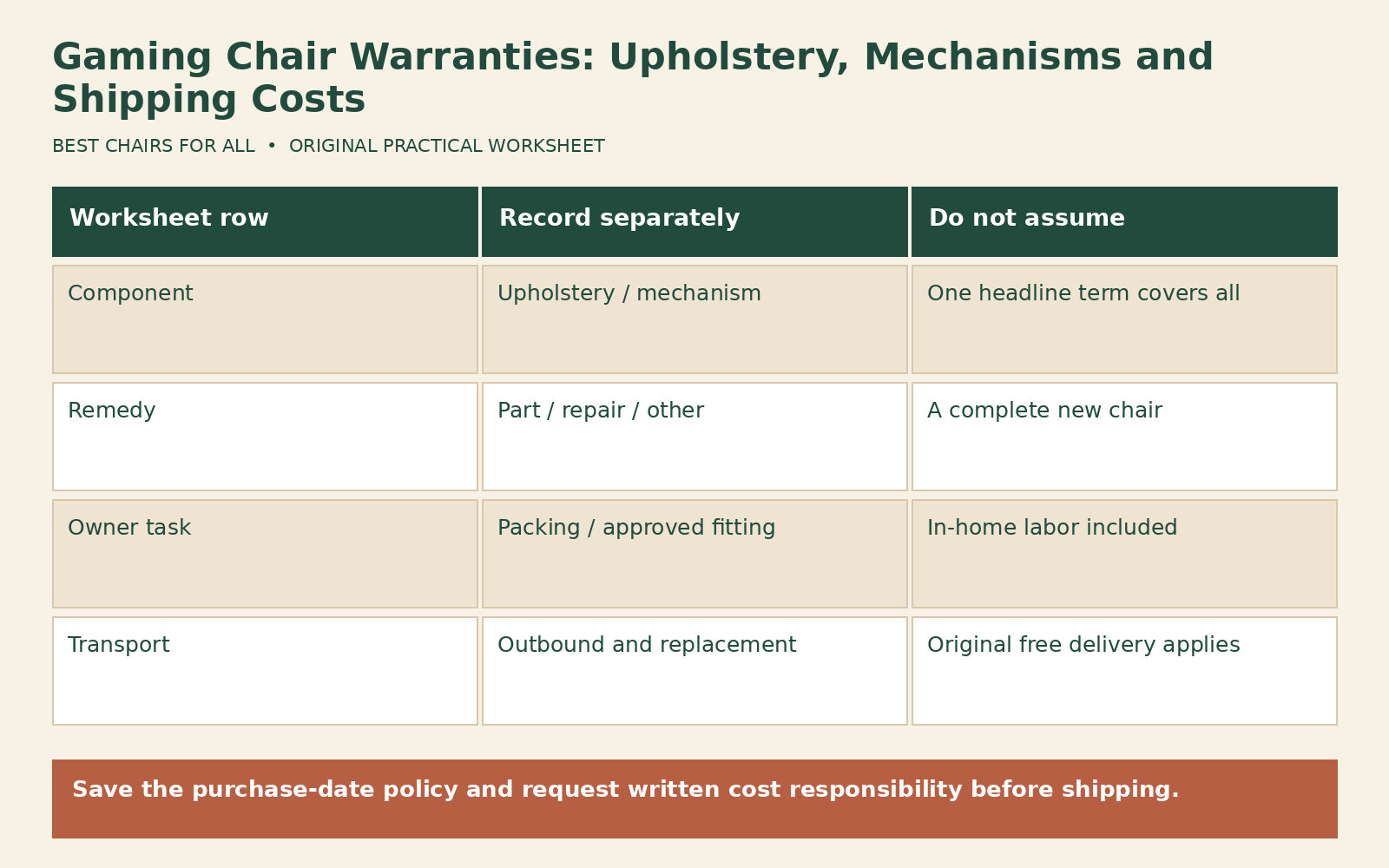
Create one row for each component and six columns: qualifying condition, period, exclusions, remedy, owner task, and transport cost. For example, a mechanism row might say “reported failure to hold; manufacturer assessment pending,” not “covered” until approved. An upholstery row might say “ordinary wear excluded; seam issue submitted with photos.” The worksheet separates what is written, what you observed, and what support has decided.
Here is a hypothetical comparison. Policy A has a longer frame term but requires owner installation of replacement parts, with shipping arrangements clarified after approval. Policy B has a shorter general term but explicitly describes a particular service process. You cannot rank them honestly using the term alone. Your ability to perform the permitted work and the clarity of the transport commitment may matter as much as duration. These are invented policy structures for illustration, not claims about named brands.
Add a final line for total confirmed out-of-pocket cost: packaging, approved outbound freight, paid labor, and any other expressly stated charge. Leave unknown amounts blank and request a written quote rather than substituting a guess. Do not treat a courtesy offer made to another customer online as a policy entitlement. A helpful exception in one case may depend on facts you do not know.
Submit a claim that can be assessed
Send the order record, model and serial identifier if requested, a concise chronology, photographs or a safe exterior video, and a description of how the issue affects normal operation. Use one claim thread so evidence stays connected. Ask for the next step, the expected remedy if approved, and any owner-paid cost before shipping or repair. Save the response outside the seller’s messaging interface where possible.
For a chair received as a gift, establish who holds the proof of purchase and whether the named purchaser must submit the claim. Do this before a problem arises if the eligibility wording is unclear. For a chair bought through an employer, ask which organization purchased it and who is responsible for communicating with the seller. An employee using a chair and the contractual purchaser may be different people. Record that relationship without assuming coverage transfers automatically when the chair changes location or ownership.
If a claim is declined, ask for the stated reason and the relevant term. Correct factual misunderstandings with evidence, such as the purchase date or the location of the damage, without exaggerating. If the disagreement remains significant, consult the appropriate consumer advice route for your jurisdiction. Do not rely on this article as a legal determination. The practical goal is a clear record of coverage, cost, and responsibility that supports a fair, informed decision.
Something unclear or out of date? Send a correction with this article’s title and the detail to check.
Sources, research & corrections policy ↗