Choose fabric or leatherette according to your room, spill habits, and willingness to follow the upholstery’s care instructions. Fabric often offers a less slick, more textile-like contact surface; coated leatherette is generally easier to wipe after a small spill. Neither label establishes how long the chair will last, how warm every person will feel, or whether its seat geometry fits. Compare the actual upholstery and chair model rather than treating either material category as a guarantee.
This guide uses manufacturer examples to explain the tradeoffs and provides a household-use worksheet. It does not report hands-on testing, measured breathability, or a durability ranking. Manufacturers use different constructions under similar marketing names, and a recommendation for one fabric or coating does not automatically apply to every competing product.
Know what the product description means
Leatherette is an imitation-leather covering, not a synonym for natural leather. Its performance depends on the coating, backing, seams, construction, and environment. A listing that says “leather” in the headline but “PU” in the specification deserves clarification before purchase. Natural leather also has its own care requirements; do not buy a conditioner intended for leather and assume it is suitable for a polyurethane-coated gaming chair.
Secretlab distinguishes its NEO Hybrid Leatherette from SoftWeave Plus fabric in its manufacturer comparison. The useful practical distinction is the manufacturer’s description of more liquid-resistant leatherette and absorbent fabric. That does not make the leatherette waterproof or the fabric uncleanable. Liquids can still reach seams and openings, and textile stains vary. Treat these as material-care differences rather than reasons to ignore spills on either surface.
Some chairs combine surfaces. The Razer Enki product page, for example, describes a dual-textured construction with different materials in the central contact areas and outer edges. A binary comparison can miss that arrangement. Inspect the seat center, backrest center, bolsters, pillow cover, and arm pads separately. The material touching your legs may be different from the decorative panel shown most prominently in the product photograph.
Heat depends on contact and room conditions
If you often feel warm in a seat, consider textile contact areas first, but keep the rest of the setup in view. Clothing, sunlight, humidity, room ventilation, session length, and foam construction all affect the experience. A fabric cover does not create active cooling, and perforated-looking upholstery does not prove air flows through the complete seat. Ask which surfaces are textile and whether the manufacturer provides useful construction details, rather than interpreting a texture photograph as a laboratory result.
A simple pre-purchase exercise is to write down when warmth becomes noticeable in your existing chair. Is it after sitting in afternoon sunlight, with shorts against the seat, or during a long session in a closed room? Compare the same conditions when trying a new chair. Otherwise a cool showroom visit in different clothing can create an unrealistic expectation of home use. If samples are available, use them to compare texture and feel, while remembering that a small swatch cannot reproduce an upholstered seat over foam.
Do not attach a numerical temperature advantage to fabric without a relevant, reproducible test. Product names such as breathable, cooling, or hybrid can help identify what to investigate but are not standardized comfort scores. A household member may prefer the smoother feel of a coated surface even in the same room where you prefer fabric. For a shared chair, record both preferences before paying for a material upgrade that addresses only one person’s priorities.
Cleaning effort is different, not absent
For fabric, the key question is what happens after liquid enters the weave. Loose debris may be easy to vacuum, while spilled coffee requires prompt attention and possibly an approved fabric cleaner. The Secretlab aftercare guide provides separate upholstery-care sections and instructions for its removable SKINS covers. Separate instructions matter: a removable accessory with a wash label is not evidence that the original sewn upholstery can go in a washing machine.
Leatherette often lets you wipe up a fresh spill before much liquid enters the surface, but that convenience comes with coating care. Abrasive scrubbing, unsuitable chemicals, heat, and repeated friction can damage a finish. A smooth surface also makes dust, skin oil, and small scuffs visible in different ways from a woven fabric. Choose it because the approved care process suits your habits, not because you expect never to maintain it.
Before buying, write down exactly what the manufacturer permits: dry vacuuming, damp wiping, named cleaner, spot testing, and drying conditions. If you cannot find care instructions for the precise upholstery, ask for them. A seller’s generic “easy clean” phrase is not enough to establish whether an extractor, steam cleaner, disinfectant, alcohol wipe, or household stain remover is suitable. The least aggressive approved method is a more useful starting point than the strongest product in your cleaning cupboard.
Compare wear patterns realistically
Fabric can catch on sharp objects, collect debris within the weave, or develop visible wear in frequently rubbed areas. Leatherette can show scratches, surface cracking, peeling, or coating wear. These are possible patterns, not predictions about when a specific chair will fail. Published manufacturer abrasion or durability claims should be read with their test conditions and comparator; they do not translate directly into a promised number of years in your room.
Look at the routes of everyday contact. A belt buckle may rub the backrest when you turn. Jeans rivets can contact the seat. A pet may jump onto an arm or scratch the same corner. A desk edge can scrape an outer panel every time the chair is pushed in. Those interactions may matter more than a generalized belief that fabric is durable or leatherette is fragile. Moving the desk obstruction or keeping pets away addresses a concrete cause that a premium material alone may not solve.
Color changes the visibility of use. Pale upholstery may show dye transfer or marks, while very dark material can make pale dust and lint obvious. A textured weave can disguise some minor visual irregularity but retain crumbs. Choose a color after considering clothing, lighting, and pets, not only the appearance in the promotional room. Check warranty exclusions for ordinary wear and accidental damage separately from claims about construction quality.
A weighted household-use worksheet
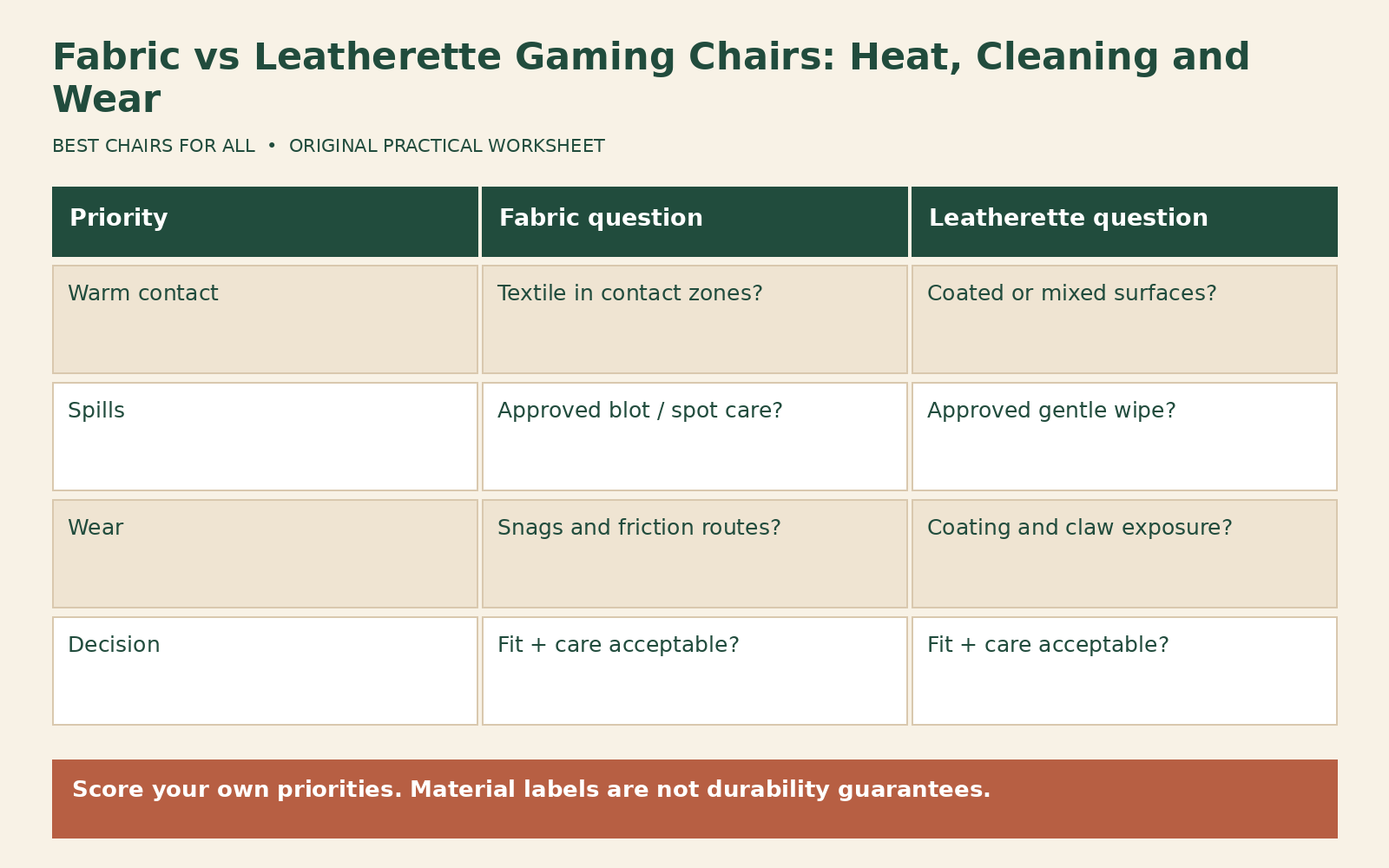
List five factors: warm-room use, drink spills, pets or sharp accessories, preferred surface feel, and approved cleaning effort. Give each factor an importance score from zero to three. Then write one sentence for each candidate explaining how its documented material addresses that factor. Keep unknowns visible. An unsupported five-star score hides uncertainty; a note saying “manufacturer does not identify the central fabric fiber or cleaner” tells you exactly what information is missing.
Here is a worked example using hypothetical priorities, not product test scores. A user gives warm-room contact three points, spill resistance one, pets zero, tactile preference two, and easy wiping one. They prefer a textile contact surface and are willing to keep drinks away. Fabric is a reasonable direction to investigate. Another user gives spill cleanup three points, warm-room contact one, and wipe-down simplicity three. A compatible leatherette model may fit that routine better, provided the coating care is acceptable.
Add a separate pass-or-fail row for chair fit. Seat width, usable depth, armrest reach, backrest shape, and height range should not be traded away for an upholstery preference. A fabric version of an unsuitable chair remains unsuitable. Where the same chair is available in two materials, comparing those versions reduces the number of changing variables. Where the models differ, acknowledge that a softer seat or wider base may explain part of the preference you attribute to the cover.
Plan an honest home comparison
If a seller permits a trial, read return conditions before assembly and retain the packaging. Compare the chair in your ordinary room, clothing, and task position. Keep food and drinks away during the evaluation rather than deliberately testing spill resistance. Do not scratch, wet, or chemically treat a sample chair to investigate durability. A returnable trial is for ordinary fit and use within the seller’s rules, not destructive material testing.
Record observations separately: “warmer against bare legs,” “less sliding when reaching,” “lint visible,” or “approved wipe routine feels manageable.” These descriptions are more useful than “premium” or “cheap.” If the cover affects how easily you change position, note that too. A grippier surface may be welcome for one person and restrictive for another, especially when the chair’s bolsters already limit lateral movement.
The purchase decision should name the tradeoff you accept. You might choose fabric and commit to keeping drinks off the desk edge, or choose leatherette and commit to regular gentle wiping and protection from heat and claws. Revisit the specific care label when buying cleaners or accessories later. The best material for your setup is the one whose everyday feel and documented maintenance match your use, on a chair that also fits your body and workspace.
Questions to settle before choosing a color
Ask whether the advertised material covers the entire chair or selected panels, whether a matching pillow uses the same cover, and whether replacement seat or backrest covers are sold for that exact generation. Replacement availability is useful information, but do not assume that a slipcover renews damaged foam or repairs a peeling original coating. Confirm whether accessories alter the warranty or require their own cleaning instructions.
Also check what happens if a special edition or discontinued color needs a warranty replacement. The policy may permit an equivalent part rather than an exact decorative match; obtain the actual terms instead of assuming a themed finish is guaranteed indefinitely. These questions matter most when appearance is a large part of the price difference. Keep a copy of the specification and care page with the order. If product names change later, your record will show which upholstery and model you actually purchased, making cleaner selection and support discussions less ambiguous.
Something unclear or out of date? Send a correction with this article’s title and the detail to check.
Sources, research & corrections policy ↗