Choose a fishing chair for supported sitting and a bedchair for a documented lying arrangement, then compare the equipment each session actually requires. The name ‘bedchair’ does not mean every model reclines into an ordinary chair, and a reclining fishing chair is not automatically intended for sleeping. Session length matters, but so do your activities, shelter floor space, access route, packed size, and the additional bedding you would carry.
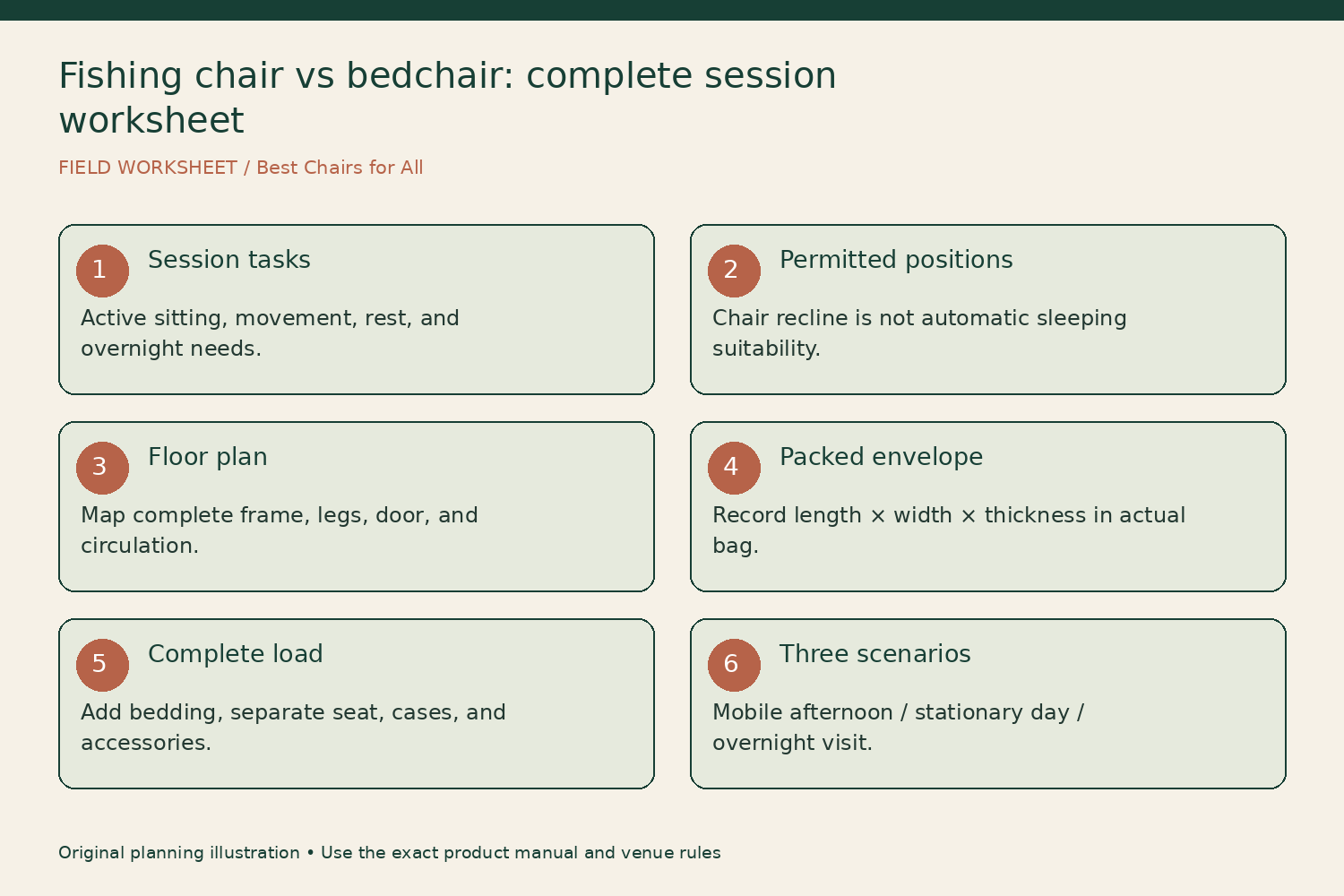
This guide uses a session plan, floor sketch, and transport inventory to compare the categories. It is not a list of current United States product recommendations. Named manufacturer examples illustrate dimensions and design differences; regional availability, version, and instructions need confirmation before purchase. Do not infer an overnight temperature rating or health benefit from padding thickness, fleece, or a product’s comfort language.
Describe the session before the furniture
Write when you expect to sit actively, move between locations, prepare tackle, rest, and leave. A short mobile session may involve little continuous sitting, while a long day can still require an upright working position throughout. An overnight session introduces a lying surface and bedding requirements that a few extra recline positions do not necessarily meet. List the activities rather than using hours alone as a buying rule.
Include the number of trips from the vehicle and whether a barrow is practical on the actual route. Record gates, steps, soft ground, and the available setup area. If a fishery has equipment or overnight-use rules, obtain them first. A large bedchair can fit in a car yet be a poor choice for a peg reached through narrow turns or a route where wheels are not allowed.
Understand the fishing-chair arrangement
A fishing chair typically provides a defined sitting surface and back, sometimes with adjustable legs, arms, a recline system, or accessory mounts. Compare usable seat width and depth, the supported back positions, and the layout of rod rests or trays. The most relaxed setting is not necessarily the position in which you can comfortably perform active tasks or stand promptly.
Nash’s Indulgence Hi-Back Auto Recline page, for example, identifies a 59-centimeter seat width, a 38-to-52-centimeter height range, and a 7.9-kilogram weight for that model. It describes a chair and its adjustment system, not a full-length sleeping platform. These figures belong to the named product and should not be treated as typical values for all fishing chairs.
Understand the bedchair arrangement
A bedchair generally provides an extended supported surface designed around lying down, but confirm whether the model is flat or has a documented adjustable head section. Some products called levelbeds are specifically flat. The frame, mattress, hinge arrangement, leg supports, and bedding attachment are part of the design. Do not assume a flat model can be converted into a conventional chair by lifting one end or changing leg lengths.
The Sonik 2024 manufacturer catalog distinguishes SK-TEK levelbeds from its lounger bedchair and lists their respective features and transport dimensions. That distinction is more useful than treating every item in a bedchair category as mechanically identical. Use the current manual for the exact SKU to establish permitted positions, setup, capacity, and whether bedding may remain in place during folding.
Draw the shelter footprint
Measure the usable floor area of the actual shelter, accounting for sloping walls, poles, door opening, and required clearances. Draw the bedchair’s complete installed outline, including legs and any projecting mechanism. Add the route from the entrance to your equipment. The mattress’s width alone is not the full floor plan, and a diagonal position can affect access even when the rectangle fits on paper.
For a hypothetical example, a 210-by-80-centimeter lying surface occupies 1.68 square meters before projecting frame parts or circulation space. A shelter with the same nominal floor area would not necessarily accommodate it. The calculation simply makes the surface scale tangible. Replace the numbers with the exact model and shelter, then check whether doors and equipment remain usable in the real arrangement.
Compare sitting and lying tasks separately
Create two columns headed active sitting and permitted resting arrangement. For a chair, record what the back and arms allow in normal use. For a bedchair, identify the permitted location and manner of sitting, if any, from its instructions. Do not assume the end frame or unsupported edge is intended as a seat. A long padded object can still have restrictions on concentrated loads.
Think through tackle preparation, footwear changes, and leaving the shelter. If the bedchair cannot provide the sitting arrangement you need, include a separate chair in the transport and floor plan. Conversely, if you only need daytime sitting, carrying a bedchair for occasional stretching may add a large package without solving a necessary task. The comparison should include the complete equipment list required by each choice.
Measure packed size in three dimensions
Record packed length, width, and thickness, plus the case and attached bedding if included in the stated configuration. A bedchair can fold into a broad flat object that occupies a different trunk shape from a chair bag. Do not compare only the longest dimension. Ask whether a manufacturer’s transport figure includes its bag, mattress, pillow, or sleeping system when the wording is unclear.
As an illustrative catalog example, Sonik lists the SK-TEK Levelbed at a transport size of 76 by 80 by 26 centimeters for the identified 2024 version. That rectangular envelope is about 158 liters by simple multiplication. It is an external bounding-box calculation, not the product’s actual material volume or a claim that it fills every liter. The shape and opening through which it must pass remain decisive.
Add bedding to the transport inventory
A bedchair frame is not the whole overnight package. List the appropriate sleeping bag, cover, pillow, and any permitted mattress accessory separately, including their packed dimensions and weights. Do not infer thermal performance from the bedchair’s fleece surface. Choose bedding using its own documented intended conditions and instructions, and consider how it attaches to the particular bed.
The Fox EOS sleeping-bag page lists multiple sizes intended to complement different EOS bed sizes and provides their packed measurements. It illustrates why bedding fit and bulk need a separate check. A sleeping bag that folds into the bed according to one manufacturer’s system does not establish permission to compress any bag between another bedchair’s hinges.
Compare total handling rather than frame weight alone
Add the chair or bedchair, its case, required accessories, and any additional seating or bedding. Record whether the load is one manageable object or several separate packages. A heavier single package can be awkward at a gate, while several lighter pieces can require extra trips. Neither arrangement is automatically better; compare it with the actual route and how you transport the rest of your fishing equipment.
If using a barrow, read its load and securing instructions and confirm where the furniture can be placed. A flat package may affect the visibility or balance of the load. Do not attach a chair to the barrow with its occupancy straps or an arbitrary frame member. Use the manufacturer’s intended transport points and secure equipment without creating projecting legs or loose webbing that can catch on the route.
Examine setup complexity
Count the documented operations: opening the frame, positioning each support, locking legs, adjusting height, fitting bedding, and arranging accessories. More steps are not inherently a problem during a planned overnight setup, but they matter for frequent moves. Compare the sequence in the manual rather than timing an imagined setup from a product photograph. A claimed quick-fold mechanism may still require separate accessory removal.
Keep folding and adjustment tasks distinct from ground assessment. A fast setup on an unsuitable surface is not an advantage. Follow the chair or bedchair’s requirements for footing and permitted adjustment. If the location cannot accommodate all supports correctly, move the arrangement or choose another permitted area. Do not use tackle boxes, stones, or unapproved leg extensions to make a large platform fit an irregular patch.
Consider moisture after the session
List the materials that may become wet: frame, mattress, fleece, sleeping bag, case, and chair cushions. Read separate care and drying instructions. A bedchair with thick padding can require more drying space at home than a simple chair, especially when bedding is stored with it as permitted. Confirm that you have somewhere appropriate to open and dry the complete system between trips.
Do not leave either type packed damp because it was marketed for outdoor use. Likewise, do not apply a generic fabric treatment to a mattress, coated seat, or sleeping bag without permission. The ownership comparison should include the tasks after fishing, not just the comfort during the session. If you cannot dry a large system properly, that is a practical limitation to address before purchase.
Use three session scenarios
Make rows for a mobile afternoon, a stationary full day, and an overnight visit. In each row, list the required sitting and lying functions, permitted floor area, total package, number of trips, and drying requirements. Mark which functions you actually need rather than assuming longer always means more recline. You may find that a chair covers two scenarios while a bedchair belongs only in the overnight plan.
Avoid averaging away a basic mismatch. A bedchair that fits the shelter but cannot pass through the vehicle opening remains a transport failure. A light chair that lacks a permitted lying arrangement does not become an overnight bed because it scores well for carrying. Use essential requirements as gates, then compare preferences among the configurations that meet the relevant session needs.
Decide what belongs on each trip
Your finished worksheet should say what to pack for each kind of session, including the accessories needed to make the choice complete. Retain exact model and version information beside the dimensions. Recheck when changing shelters, vehicles, or sleeping systems. A previously workable package can become unsuitable when one surrounding part of the plan changes.
A fishing chair and a bedchair solve overlapping but distinct tasks. Choose the documented sitting or lying arrangement you need, then account for its installed footprint, packed shape, total equipment, and drying routine. That approach makes session length useful context without turning it into a rigid rule or overlooking the extra gear required to make a long stay workable.
Something unclear or out of date? Send a correction with this article’s title and the detail to check.
Sources, research & corrections policy ↗