The easiest dining-chair upholstery to live with is the one whose care instructions match what you are willing to do after dinner. A beautiful fabric can be a poor choice if its stain routine requires equipment you do not own. A plain fabric can be excellent if crumbs release easily, the surface feels comfortable, and the cover can be serviced without replacing the chair.
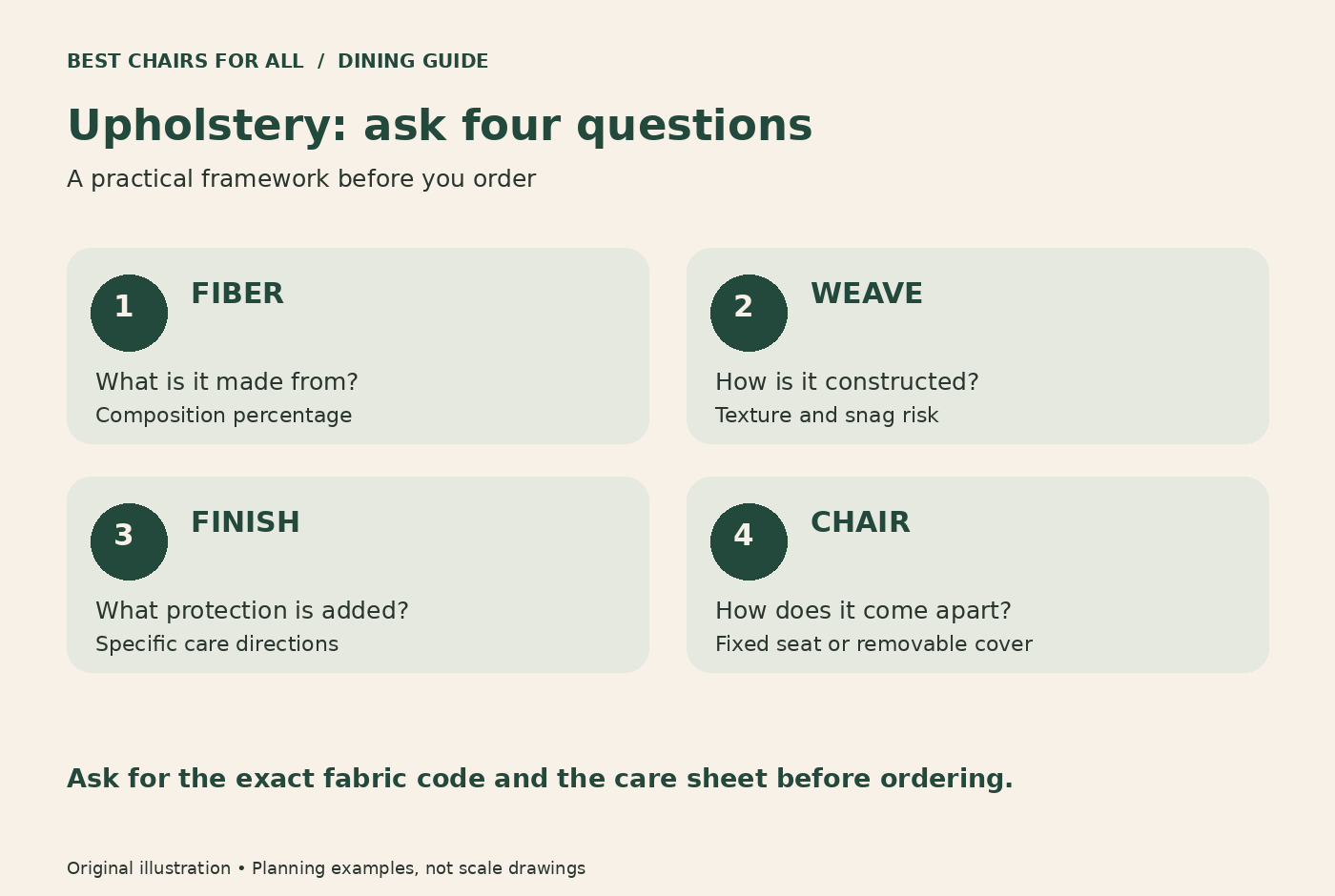
Compare the complete upholstery system: fiber, weave, finish, padding, attachment method, and cleaning instructions. “Performance,” “linen-look,” and “leather-look” describe very different things. This guide gives you a way to compare them without pretending that one material wins in every home. The comparison worksheet and household examples below are editorial planning tools; they are not laboratory test results.
Start with four questions before comparing fabrics
Write down who uses the chair, what usually lands on it, how frequently you can clean it, and whether the seat can be repaired separately. For a breakfast table, dried cereal and everyday hand marks may matter more than red wine. For a formal room used monthly, feel and appearance may deserve more weight. For a chair that doubles as a desk seat, seams and texture must remain comfortable through longer sessions.
Then ask the retailer for the exact upholstery name and code. A photograph of a cream fabric does not tell you whether it is cotton, polyester, acrylic, or a blend. Keep the fabric code with the chair model and order receipt. If you need replacement upholstery later, “the oatmeal chair” is much less useful than a specific textile identifier.
Fiber, weave, and treatment are separate decisions
Fiber is the raw material; weave or knitting describes how yarns form the surface; treatment is an additional property or process. Two fabrics containing polyester can feel entirely different because one is a smooth, close weave and another is a raised pile. Two linen blends can have different cleaning requirements. Choose from the actual swatch and care documentation rather than assigning every fabric in a category the same behavior.
A tight, fairly smooth surface is worth inspecting when crumbs, pet hair, or snagging are recurring concerns. A looped surface deserves a careful swatch examination if a cat regularly claws chairs. These are screening questions, not guarantees: the yarn, backing, construction, and specific animal all affect the result. Do not perform destructive scratching experiments on store furniture or borrowed samples.
| Option | Useful question | Tradeoff to inspect |
|---|---|---|
| Close-woven upholstery | Do crumbs brush away from the sample? | Some textures still hold fine debris |
| Velvet or other pile fabric | Are directional marks acceptable to you? | Light changes its apparent shade |
| Linen or linen blend | What exact cleaning method is permitted? | Appearance and care differ by blend |
| Protected leather | Which finish and approved cleaner apply? | Protection and patina are different goals |
| Coated faux leather | What is the coating and warranty coverage? | Care and long-term surface failure vary |
| Removable slipcover | Is machine washing expressly allowed? | A zipper alone does not mean washable |
What “performance fabric” should mean in your comparison
Treat performance as a request for evidence, not a material name. Ask which spills the manufacturer addresses, how promptly you must respond, which cleaner is approved, and whether protection depends on a particular finish. Do not assume that an outdoor fabric, stain-resistant fabric, and waterproof chair are interchangeable. The foam, seams, wood, and attachments remain separate parts of the assembly.
For example, Sunbrella’s upholstery cleaning instructions distinguish cleaning methods by application and furniture construction. The manufacturer also says to confirm with the furniture maker before washing removable casings. The practical implication is simple: a recognized textile brand does not replace the chair manufacturer’s instructions.
Crypton Home’s care sheet identifies a water-based cleaning approach, calls for a hidden-area check, and warns against over-wetting or using solvents for spot cleaning. That is useful specificity. Compare it with the actual instructions on another candidate instead of assuming both performance fabrics tolerate the same cleaner.
Leather and faux leather need different questions
Leather may appeal when you want a surface without a woven texture, but the finish matters. Ask whether the chair uses protected, aniline, semi-aniline, nubuck, or another specified leather. Ask how that finish reacts to ordinary dining spills and which cleaner is approved. If the product description only says “genuine leather,” request more detail before making a care decision.
Faux leather is also a broad category. Ask whether the visible surface is polyurethane, vinyl, or another coating, and read the warranty for peeling, cracking, and cleaning-related exclusions. Do not carry leather conditioner advice across to a synthetic coating. Room & Board’s leather care page separates its instructions by leather type, including synthetic leather, illustrating why identifying the material must come first.
For either option, inspect seams where crumbs collect, piping along the seat edge, and the underside of the chair. A surface that wipes easily is less helpful if food falls into an inaccessible gap every meal. Check whether the upholstery supplier offers a repair route and whether a single seat can be replaced. A repairable chair may suit a busy room better than a superficially simpler chair with no available parts.
Do not rank upholstery by rub count alone
Abrasion numbers can be helpful when the method and intended use are identified, but they are not years of service. Martindale cycles and Wyzenbeek double rubs are different test results; do not treat them as one interchangeable scale. A larger number also does not answer questions about staining, seam performance, pilling, or how a fabric looks after cleaning.
The Association for Contract Textiles performance guidelines cover several performance categories rather than abrasion alone. ACT’s abrasion guidance cautions that test results do not reliably predict lifespan. Use the figures to open a conversation with the supplier; do not convert them into a promised replacement date.
Use a swatch to answer the questions a screen cannot
Order the actual fabric sample if available and view it beside your table in daylight and evening lighting. Put it against the table edge as well as flat on the seat. The vertical back and horizontal seat catch light differently, especially with pile fabrics. Photographing the swatch can help compare options, but look directly at it too because cameras adjust color and brightness.
Feel the swatch against your hand and forearm. Look at it from standing height and from a seated position. Ask whether the texture is pleasant against bare legs and whether any obvious loops catch rings. A swatch cannot reproduce padding, seam placement, or the feel of a finished chair, so combine this with a sit test of the actual model whenever possible.
If a supplier explicitly permits a sample cleaning demonstration, follow its directions and let the sample dry completely before judging it. Do not improvise bleach, steam, stain removers, or abrasive scrubbing. A small swatch may respond differently from a fixed upholstered seat because the finished chair includes backing, adhesive, and padding.
A practical scoring sheet for your own household
List three candidates and mark each criterion as confirmed, unclear, or unsuitable. Use five criteria: approved cleaning method, comfortable texture, access to seams, repairability, and appearance in your room. Eliminate any candidate with an unsuitable must-have before choosing between the remaining colors. This prevents a high style score from hiding a care problem you already know will frustrate you.
For a busy family table, make care and seam access mandatory. For a quiet formal room, you might accept professional cleaning if the texture and finish are exactly what you want. For a mixed-use dining and work table, put a longer sit trial ahead of color matching. These priorities are examples; the worksheet should reflect your actual routine rather than a generic definition of durability.
Three household examples
Daily breakfast with young children: compare a documented cleanable textile with a removable-cover option. Find out how many minutes the spot routine takes, where a wet chair can dry, and whether a replacement cover is available. If the cover is washable, check temperature, drying instructions, and shrinkage guidance. Buying a spare cover may be more useful than choosing a darker color and hoping it hides every spill.
Pet-friendly dining room: inspect the actual surface for loops and the chair underside for accessible fabric. Ask how loose hair should be removed without damaging the finish. Avoid assuming that leather is claw-proof or that every smooth textile releases hair equally. If the pet uses a particular chair, a washable protector may be practical, but confirm that it stays stable and does not interfere with sitting.
Occasional hosting: compare how the fabric looks under the room’s evening lights and whether guests can sit comfortably in ordinary clothes. Ask about minimum professional cleaning charges before ordering a whole set. Six chairs with an expensive service requirement create a different ownership cost from one accent chair.
What to confirm before placing the order
Get the fabric code, care sheet, warranty, return terms, and replacement-seat or cover policy in writing. Check whether custom upholstery can be returned. If the upholstery is applied to a drop-in seat, ask who can replace it and whether doing so affects the warranty. If it is tightly integrated with the shell, request the manufacturer’s approved repair process.
Finally, choose a fabric you can maintain consistently. A documented, manageable routine is more valuable than a dramatic spill video. Keep the instructions with a photograph of the chair label and make the approved cleaning supplies easy to find. Good upholstery selection is a combination of comfortable sitting, realistic maintenance, and a repair plan that still makes sense after the first mark appears.
Compare the whole-set cost, including one damaged seat
Work through a simple ownership scenario before treating a lower purchase price as the better value. Suppose two chair designs both fit your table. One has an individually replaceable padded seat; the other requires a specialist to remove integrated upholstery. Ask for the replacement-seat price and an indicative local repair quote. Do not assume either will be cheap merely because the chair itself is inexpensive.
Then imagine a single chair needs attention while the rest remain usable. Can you keep the set in service with a spare cover, an unupholstered replacement seat, or one temporarily different chair? Can you order a matching fabric later, and will dye-lot variation be acceptable? These are questions for the seller, not reasons to stockpile parts without knowing whether they fit.
Also compare how many chairs you can realistically clean at once. A dining room with no spare seating may need a staggered routine so thoroughly dried chairs remain available. Removable covers can help, but only when removal and refitting are practical. Ask to see the process demonstrated if a showroom has the same model.
Record uncertain answers rather than filling them with optimistic assumptions. “Replacement policy not confirmed” is useful information in a comparison. It identifies a specific follow-up that could change your decision. Once those questions are answered, choose the upholstery that provides the best balance of feel, care and serviceability for your actual table.
Something unclear or out of date? Send a correction with this article’s title and the detail to check.
Sources, research & corrections policy ↗