Chenille and linen describe different things. Chenille refers to a type of textured yarn and the soft, pile-like surface it creates in a fabric. Linen refers to fiber made from flax. A chair fabric can therefore contain linen and also use chenille yarn. Before comparing comfort or cleaning, establish whether the seller is describing yarn structure, fiber content, or simply a linen-like appearance.
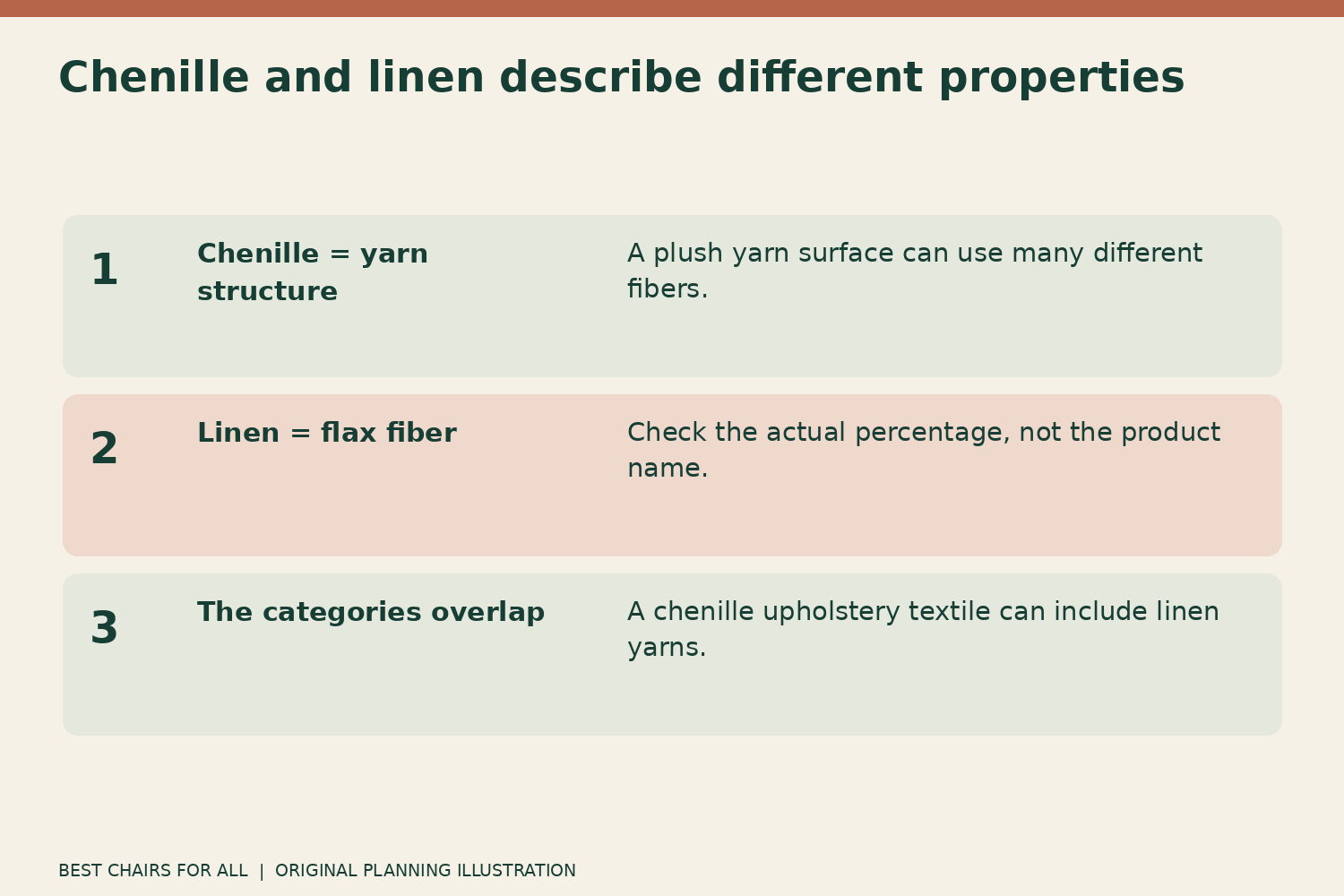
This distinction prevents a common shopping mistake: treating chenille as always synthetic and linen as always a smooth, pure natural fabric. Read the actual composition and construction. Then compare the finished chair’s feel, appearance after use, cleaning permissions, and suitability for its upholstery shape.
Translate the names into a useful specification
A chenille surface gets its character from fuzzy yarn with projecting fibers. Depending on the weave, it can look uniformly plush, subtly ribbed, or visibly textured. The underlying fibers might be cotton, viscose, polyester, acrylic, or a blend. Chenille is not a fiber percentage and does not, by itself, establish washability or resistance to stains.
Linen comes from flax. The Council of Fashion Designers of America’s flax and linen guide identifies it as a plant-stem fiber and notes that linen is sometimes incorrectly used for fabrics with a similar appearance. For furniture, a phrase such as linen-look should prompt a composition check rather than an assumption of flax content.
Ask for three separate fields: fiber percentages, yarn or weave description, and approved upholstery use. A meaningful specification might say cotton-and-linen blend in a flat weave, or polyester blend with chenille yarn. Those descriptions let you compare like with like and make it harder for a familiar texture word to conceal missing information.
A real fabric can occupy both categories
Kvadrat’s Cifrado is described as a heavyweight chenille combining chenille and twisted cotton with a double warp of twisted linen and viscose. It provides a concrete example of why “chenille versus linen” is not an exclusive choice. Linen can be one component within a chenille upholstery textile.
Another naming example is James Dunlop’s Urban Linen, whose published composition is 63% cotton and 37% linen. The name does not mean 100% linen. That blend may be exactly what a buyer wants, but the decision should be made from the composition rather than the word linen in the product title.
When requesting swatches, use the fabric code as well as its name and color. Collections can include similar names with different blends. Save the specification beside the sample so you can distinguish an actual flax-containing textile from a polyester linen-look alternative or a chenille that happens to contain some linen.
Compare surface feel during the real activity
Chenille often feels soft because its projecting fibers create a plush contact surface. A flat linen weave may feel more dry or textured, but finishing, yarn thickness, blend, and backing can change that impression substantially. Neither label guarantees a particular hand, and photographs cannot communicate how a fabric feels against bare forearms.
Place the swatch over a chair arm or cushion and handle it with clean dry hands. If possible, sit on the actual chair in clothing similar to what you wear at home. A fabric that feels pleasing when stroked with a hand may feel different against shorts, a knitted sweater, or a smooth skirt during a long reading session.
Keep cushion softness separate from upholstery feel. A plush chenille over a firm foam core remains a firm seat; a flat linen blend over a soft feather cushion can feel yielding. Compare the same cushion construction where possible, or explicitly record that you are evaluating two complete chairs rather than attributing every difference to the fabric.
Distinguish pile shading from linen creasing
Chenille can have directional effects because its surface fibers reflect light differently after handling or sitting. Examine the fabric from several angles and in the actual room’s light. Ask whether changes in shading are an expected characteristic of the exact textile. A mark that changes with viewing angle may not be ordinary soil.
Linen has limited elasticity and can retain creases. Maxwell Fabrics’ textile reference guide explains this relationship between linen’s poor elastic recovery and wrinkling. A relaxed look may be desirable, but buyers expecting an always-taut surface should examine the finished chair carefully before choosing it.
Neither appearance change should be diagnosed from the name alone. A blend, backing, upholstery tension, and cushion movement can alter the result. Ask the maker what normal appearance changes to expect and what would indicate an actual fault. Do not apply an iron or steamer to a chair merely because you know how to press a linen shirt.
Inspect the weave and seams
Look between the yarns on a swatch held against a neutral background. An open weave and a tightly constructed fabric can behave differently at seams, regardless of whether either contains linen or chenille. Check how the chosen textile is approved for the chair’s curves, buttons, piping, and tightly upholstered edges.
On a showroom chair, examine where the seat meets the arms and where fabric bends around corners. Look for the intended pattern alignment and whether the ground weave becomes more visible under tension. These observations help you understand the product, but they do not replace a professional assessment if stitching or structural fabric damage is present.
Cifrado’s specification reports seam-slippage results separately from abrasion and pilling information. That separation is useful because a fabric can resist rubbing yet still need appropriate seam design. Do not reduce upholstery quality to one large abrasion number or assume that a heavy-feeling cloth automatically resists every kind of stress.
Use a label-decoding worksheet
The following original worksheet compares the information needed for two candidates without pretending that the categories are opposites. Fill it out from the exact specifications. The example entries demonstrate how a fabric name can refer to different properties; they do not recommend one blend over another.
| Field | Chenille candidate | Linen-labeled candidate |
|---|---|---|
| Identity | Exact fabric name and color code | Exact fabric name and color code |
| Structure | Where chenille yarn appears in the weave | Flat weave, textured weave, or other construction |
| Composition | All fiber percentages, including any linen | Actual flax percentage; distinguish linen-look |
| Expected appearance | Nap shading or texture changes | Creasing and relaxed surface expectations |
| Care permission | Finished-chair instructions | Finished-chair instructions |
| Unanswered question | Test or care detail still needed | Test or care detail still needed |
For a worked naming comparison, write Cifrado under chenille structure and note that its construction includes linen. Write Urban Linen under a linen-labeled blend and enter 63% cotton, 37% linen. The exercise immediately shows why asking only “which fabric is natural?” misses the actual composition of both candidates.
Cleaning follows the exact textile and chair
A soft surface is not evidence that water is appropriate, and a natural fiber is not evidence that solvent is required. Read the chair’s cleaning label and any fabric-specific directions together. If they conflict or leave a method unclear, ask the manufacturer before applying a product. Keep the written answer with the fabric code.
Cifrado’s specific care symbols include do not wash, do not bleach, do not tumble dry, do not iron, and professional dry cleaning. That is a useful example of why chenille should not be described as generally washable. It also shows why broad household advice about cleaning all soft upholstery can be inappropriate.
A removable cushion cover creates access but does not establish permission to launder it. Shrinkage, lining, seam construction, and re-fitting can matter. Do not infer instructions from a similar fabric used for curtains or clothing. The finished upholstered chair is an assembly, and its maker may set limits beyond the fiber’s general properties.
Evaluate pilling and loose fibers carefully
Small pills, loose yarn, and a snag are different observations. Record what you see rather than assuming every irregularity is the same maintenance issue. Chenille’s fuzzy surface can make a new protruding fiber difficult to distinguish from normal texture. Linen can also show slubs or variations that belong to the yarn rather than damage.
Photograph a concern in good light and ask the supplier to identify it. Avoid pulling, cutting, or shaving an unfamiliar projection before you know what it is. A tool intended for clothing may be unsuitable for a particular upholstery surface, especially where it could catch yarn or alter the fabric’s texture.
Ask for pilling test information separately from abrasion. Cifrado, for example, publishes both categories. Their presence does not promise a flawless surface forever, but it gives you more relevant evidence than a claim that all chenille pills or that all linen remains unchanged with use.
Make sunlight and household contact specific
View both samples where the chair will stand and ask for the exact color’s lightfastness information. A linen label does not eliminate fading concerns, and a chenille label does not predict how its dyes will perform. Keep the intended location, exposure, and manufacturer guidance together rather than ranking the fibers by appearance alone.
Consider routine contact with dark clothing, throws, pet claws, and jewelry. The weave and surface structure influence what can catch or transfer, while the cleaning instructions determine what response is available. A pale flat weave and a pale chenille can each be demanding for different reasons. Choose based on your household’s actual contacts.
Choose with a complete fabric description
Favor the chenille candidate when its particular soft texture, expected shading, and care requirements suit the chair’s use. Favor the linen-containing candidate when its actual blend, weave, and creasing behavior match the appearance you want. If one fabric belongs to both descriptions, compare it on those properties rather than forcing it into a single category.
Keep the swatch, composition, care instructions, and appearance notes together. That record will be useful when ordering a matching cushion, assessing a later mark, or speaking to an upholstery cleaner. The best decision comes from the exact textile and the finished chair, not from a false contest between a yarn type and a plant fiber.
Something unclear or out of date? Send a correction with this article’s title and the detail to check.
Sources, research & corrections policy ↗