A cantilever dining chair carries the seat on a frame that extends from a supported base without rear legs directly beneath the back of the seat. A four-leg chair has separate legs near its corners. That difference changes the feel, floor contact, and space beneath the table, but it does not establish which chair is safer, stronger, or more comfortable. Compare the actual construction and intended use, then try it on the floor and at the table you will use.
Recognize the structure before judging the feel
The familiar tubular-steel cantilever often has a continuous-looking frame running down at the front and back along the floor. Some versions have arms; others do not. The visible outline can look light even when the chair occupies substantial depth. Do not confuse the absence of rear legs with an absence of furniture behind or beneath the seat.
Knoll describes the Cesca Chair’s cantilevered form as using the material’s possibilities to provide flexibility. That is a statement about a particular design. It does not mean every chair with a similar silhouette should flex by the same amount, or that looseness in any chair is an intended feature.
A four-leg dining chair can use timber, metal, molded components, or a combination. Its seat can be rigid, upholstered, or suspended in another way. The number of legs does not reveal its joint quality or its weight rating. Check the exact model rather than treating “four legs” as a construction specification.
Separate designed flex from damage
A cantilever may yield slightly as you sit, depending on the design and material. Try that movement gently in normal use and ask the seller what is expected. Do not bounce, rock, or deliberately overload it to assess strength. A shopping trial is not a structural test and should not be described as one.
Unexpected clicking, a visibly separating connection, a damaged weld, or a frame that remains distorted after unloading deserves investigation. Stop using a chair with suspected structural damage and contact the manufacturer or a qualified repairer. A familiar springy feel is not a reason to ignore a new change, especially in a secondhand chair of uncertain history.
For a four-leg chair, distinguish an uneven floor from loose construction. A slight rock that changes when the empty chair moves to a known level area may reflect floor contact; visible joint movement points to a different concern. Do not fix an unexplained wobble by simply tightening every fastener as hard as possible or adding pads until the symptom disappears.
Compare the actual floor footprint
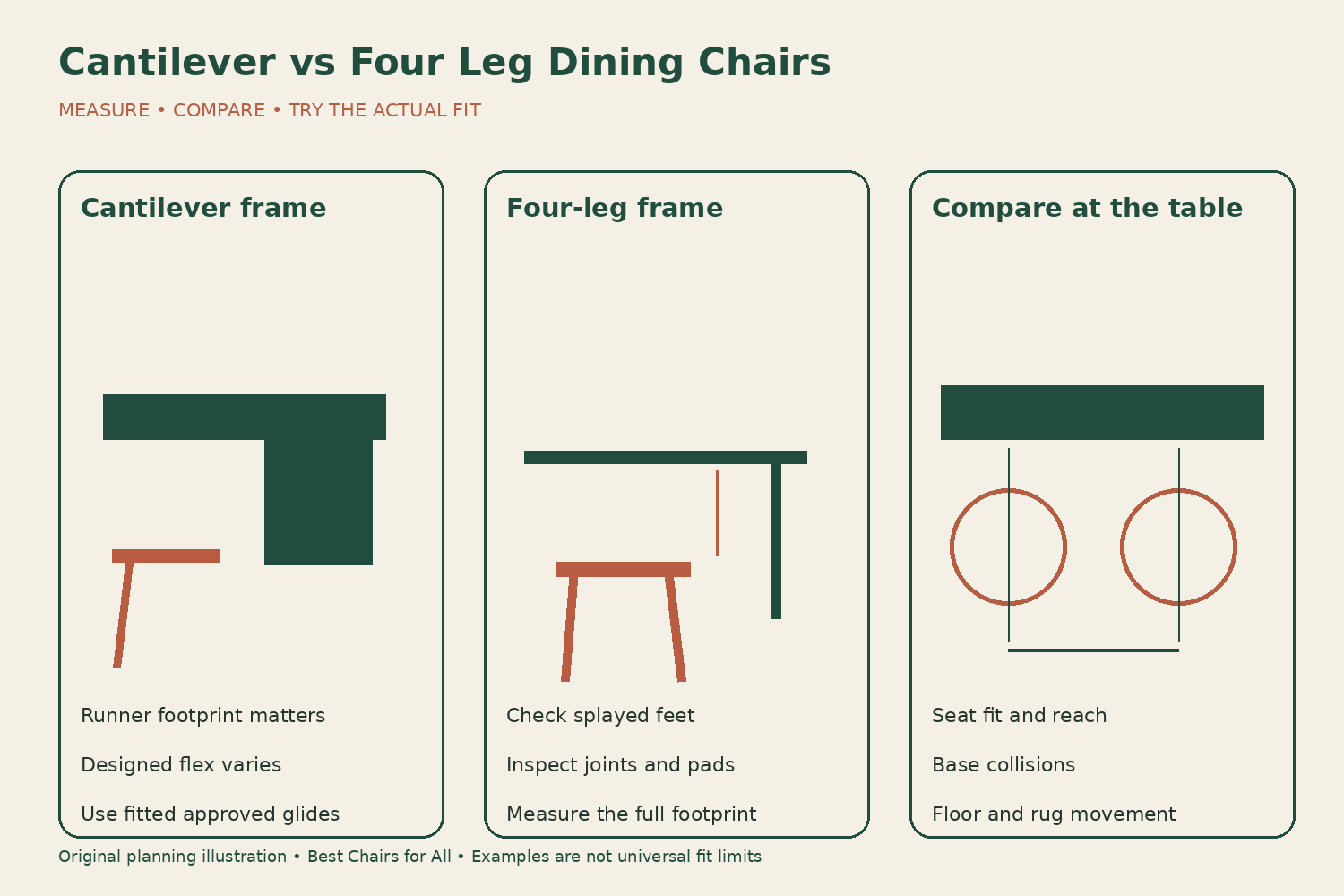
Measure the base at its widest and deepest points. A cantilever’s horizontal runners may extend farther back than you expect from the seat outline. Four legs may splay outward beyond the seat or angle into a neighboring person’s foot area. Include the entire frame when drawing the chair beneath your table.
At a pedestal table, check where the feet and base want to occupy the same space. At a four-leg table, check the opening between the table legs. A chair that looks slim above the floor may be awkward below it. Test the stored position, the occupied position, and the path between them rather than stopping when the chair can be pushed under the top.
Use a paper plan with the chair footprint and table base drawn to the same scale. Mark the seat center so you can see where the person sits relative to the frame. This helps explain why shifting a chair a few inches can resolve one collision yet put the sitter off-center from the place setting.
Match protectors to the frame and floor
Four-leg chairs commonly use individual pads or glides under each foot. Tubular cantilevers may use fitted glides along the runners. The appropriate component depends on the chair and floor; a generic adhesive circle may not fit a curved tube or stay in the intended position. Ask about the exact manufacturer-approved replacement part.
Thonet’s care resources distinguish care by material and product family. Follow the instructions relevant to the frame and seat you own. A tubular frame, caned panel, leather covering, and wood trim can require different treatment on the same chair, so one all-purpose cleaning instruction is not enough.
Inspect the floor-contact areas before a trial on a delicate floor. Missing or damaged glides can expose hard edges. Remove grit from the floor and protectors using approved care methods, and lift furniture when the chair or flooring instructions call for it. A protector is a maintenance item, not a lifetime assurance that no scratch can occur.
Consider rugs, seams, and edges
A continuous runner and four separate feet interact differently with rug edges, grout lines, and textured surfaces. Neither interaction is universally better. Test on a representative surface, especially if the dining chairs regularly move between a rug and hard floor. A smooth showroom floor may conceal the conditions that matter in your room.
Observe entry and exit without forcing the chair across an obstruction. If a runner catches or a foot lands partly off the rug, review the rug size and chair placement. Do not remove glides or change the frame to make it cross an edge. Address the setup with the manufacturer or flooring guidance in mind.
Check the empty chair and the occupied position separately. A chair may slide easily when empty but resist movement under load, or move in a way the sitter does not expect. Avoid relying on a seated person to drag the furniture into place. Try the normal sequence of pulling out, sitting down, approaching the table, and leaving again.
Evaluate dining comfort independently of the base
The frame is only one part of the sitting experience. Seat height, usable depth, width, back contour, and upholstery still determine how you relate to the table. Room & Board’s dining-chair guide considers chair materials and table-leg spacing together, a useful reminder that the whole chair-table combination matters.
Sit with feet supported and your normal place setting in front of you. Check whether you can use the back without pressure behind the knees and whether the table’s underside leaves suitable room for your thighs. Compare a cantilever and a four-leg candidate at the same surface height so a different table does not confuse the comparison.
Notice whether the chair’s movement suits your preference. Some people enjoy a little yielding; others prefer a firmer, more stationary sensation. Record the preference plainly without presenting it as a medical conclusion. If a user needs particular transfer support or has concerns about moving seating, involve an appropriate professional rather than assuming one base style meets those needs.
Think about moving and handling the chairs
Weight and convenient handholds affect everyday use. A visually delicate metal chair may be heavier than it appears; a wood chair may be easy or awkward to lift depending on its frame. Ask for the product weight and try an approved lifting point. Do not lift a chair by delicate cane, upholstery, or a component not intended as a handle.
Consider cleaning under the table and rearranging chairs for guests. A frame that fits between table legs while facing forward may be awkward to turn sideways during removal. Test that route before buying several. Protect both furniture pieces and avoid dragging frames against table bases simply to achieve a tighter stored arrangement.
Do not assume either design stacks. Stacking requires an explicit manufacturer statement and instructions for that model, including limits where applicable. A continuous steel frame may look robust but can still damage another chair’s seat or finish if piled without the intended contact points.
A comparison worksheet with separate decisions
For each candidate, record the model, intended setting, stated capacity if provided, overall footprint, seat dimensions, arms, and floor-protector type. Add a column for replacement glides and service support. If a weight rating or test statement is absent, ask for it rather than substituting your judgment from the thickness of a tube or leg.
Next record normal-use observations: floor contact, expected movement, table-base clearance, access to the seat, and the route when pulling the chair away. Use separate yes/no or descriptive entries. A single score such as “stability: eight out of ten” would imply a level of testing you have not performed and would hide the reason a chair suits or fails your room.
Finally, write a care plan. Identify the frame finish, seat material, approved routine cleaner or method, and the inspection points the manufacturer specifies. Keep any assembly instructions and part numbers with the receipt. A chair selected partly for repairability should have a documented route to the parts that made that benefit plausible.
Check secondhand chairs more carefully
For a used cantilever, ask about the maker, model, age, repairs, and missing glides. Inspect visible tube bends, welds, connections, and seat attachments without disassembling the frame. For a four-leg chair, inspect joints, stretchers, hardware, and any cracked or altered pieces. Surface patina does not tell you whether the structure is sound.
Avoid home structural alterations such as bending a metal frame, welding an unidentified tube, or shortening legs to change the fit. A qualified repairer can advise whether repair is appropriate. If you cannot establish the condition or obtain necessary guidance, choose another chair rather than relying on an attractive design history.
The useful comparison ends with two independent answers: does the chair’s structure and condition suit its stated use, and does the complete chair fit your floor, table, and sitter? A cantilever can provide a distinctive feel and open outline; a four-leg design offers many other forms and materials. The better option is the specific chair whose fit and ownership requirements you can actually verify.
Something unclear or out of date? Send a correction with this article’s title and the detail to check.
Sources, research & corrections policy ↗