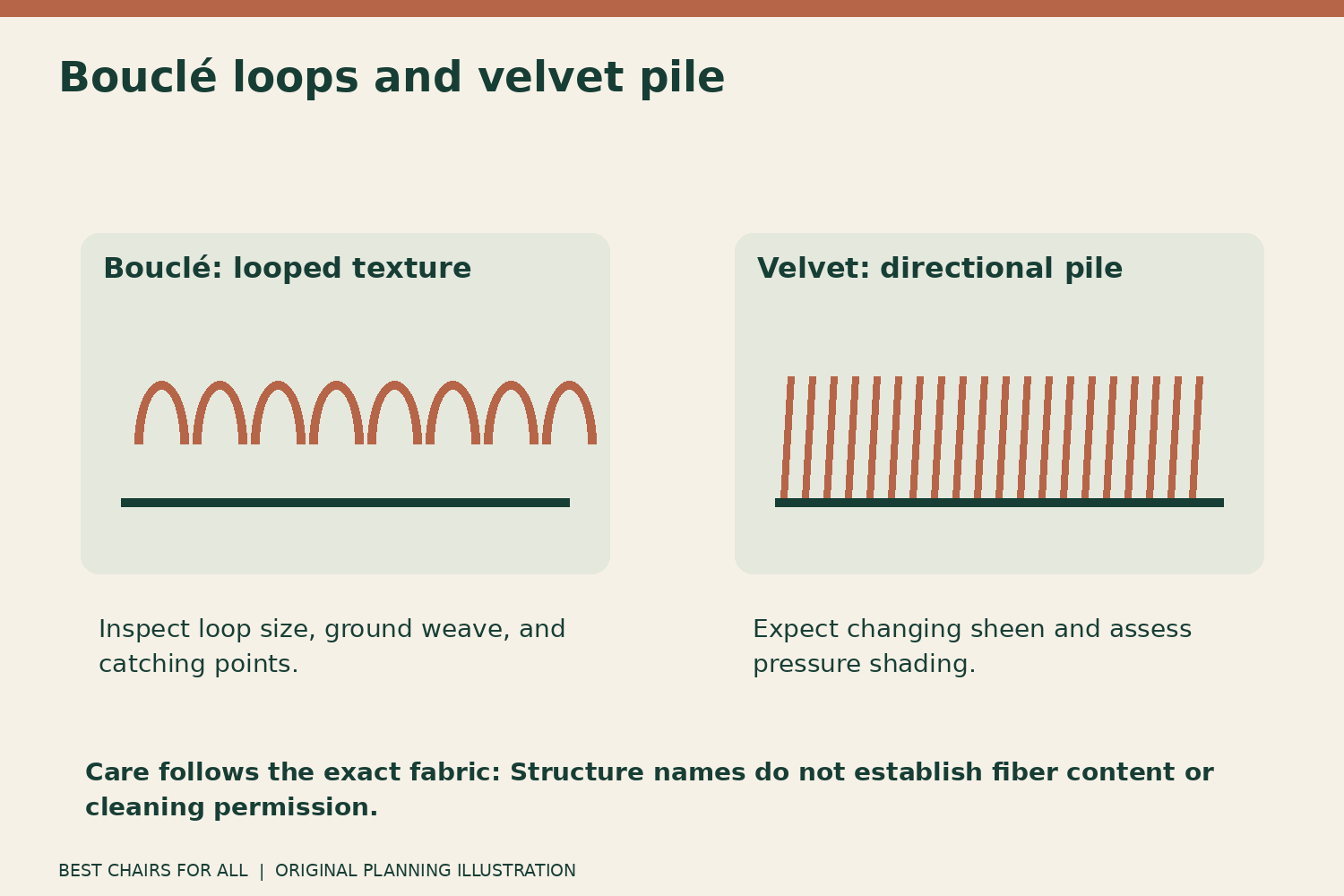
Bouclé gives a chair a curled or nubby surface; velvet gives it a pile whose direction affects how light reflects. Both names describe textile structure rather than one particular fiber or cleaning method. A wool-rich bouclé, an acrylic blend bouclé, and a polyester bouclé can have different care requirements. The same is true of cotton, viscose, mohair, and synthetic velvets.
The useful comparison is therefore between two exact upholstery options. Obtain their composition, construction, care directions, and performance information, then examine swatches at home. Choose the surface whose ordinary appearance and maintenance you can live with, including the possibility of loops catching or velvet showing pressure shading.
What creates the visible texture
Bouclé uses textured yarn that creates loops or curls in the finished surface. Loop size, yarn thickness, and how closely the fabric is woven affect the result. Some bouclés are finely nubby, while others have large irregular curls. A photograph can make both look like the same soft cream fabric even though they feel and behave differently.
James Dunlop Textiles’ discussion of bouclé explains that the term can refer to the yarn and the resulting fabric, with a range of natural and synthetic fibers used. That is why bouclé should not be treated as a synonym for wool or as a complete specification.
Velvet has a raised pile that creates a soft surface and directional sheen. The pile may appear lighter or darker as you change viewing angle or move a hand across it. Some textiles combine cut and loop effects or patterned pile. Ask for the exact fabric description rather than assuming every fabric sold as velvet has the same density or surface finish.
Compare snagging risk without calling either pet-proof
Exposed loops provide places where a sharp object can catch. The practical questions are how prominent the loops are, how securely they sit in the weave, and what contacts the chair in your household. Rings, buckles, zippers, and claws deserve consideration. A smooth-looking velvet lacks the same obvious loop structure but can still be scratched, torn, or otherwise damaged.
Warwick Fabrics’ upholstery tips warn that sharp objects, including rings, buckles, and pets’ claws, can snag or tear fabric. Apply that warning to the actual sample rather than declaring an entire textile family safe or unsuitable. No ordinary upholstery label establishes immunity to deliberate scratching.
Do not test snag resistance by dragging a key or claw over a showroom sample. Ask for a swatch and permission for any destructive test, or request the supplier’s relevant test information. At home, inspect the swatch closely and consider whether your clothing or accessories routinely present catching points. This is a household-risk comparison, not a substitute for laboratory testing.
Understand velvet shading and pressure marks
Velvet can show a sitting impression because pressure changes the orientation of its pile. That can produce a lighter or darker area without the fabric necessarily being dirty. Look from different directions and gently observe the nap before deciding that a mark is a stain. Repeated scrubbing can make a surface problem worse.
Fritz Hansen’s velvet care guidance describes pressure marks as a characteristic of velvet and recommends care in the nap direction. Its cleaning and steam permissions are tied to specified products. Do not turn those instructions into a universal steam-cleaning method for every velvet chair.
If you want a surface that looks completely uniform after every sitting, velvet’s directional appearance may bother you even when the textile is functioning normally. Test that preference with a swatch in your room. Bouclé’s uneven texture creates a different kind of light and shadow, but it can still flatten, pill, soil, or change with wear.
Fiber composition changes the comparison
A fabric’s name does not reveal whether it contains wool, cotton, viscose, polyester, acrylic, or a blend. Composition affects the care instructions and can influence feel and response to moisture. Read the percentages rather than relying on phrases such as natural texture, performance velvet, or luxurious bouclé.
For a specific example, James Dunlop’s Koa 8090 by Romo specification identifies a bouclé textile made from 57% acrylic, 36% polyester, and 7% wool. That example demonstrates why the boucle label alone cannot establish a wool-dominant composition or a particular maintenance routine.
Also ask whether the fabric has a backing, finish, or treatment that changes its care. A chair manufacturer may impose additional limits because of the cushion, adhesive, lining, or upholstery construction. When textile-supplier guidance and the finished chair’s instructions differ, ask the chair manufacturer for clarification before cleaning or commissioning upholstery work.
Use a non-destructive swatch comparison
Order the actual color and fabric code for each candidate. Place the swatches in the room where the chair will sit, first in daylight and then under the evening lamp. Lay them over a rounded cushion to see how their surfaces behave on curves. A flat sample under bright retail lighting can misrepresent both texture and sheen.
Move the velvet swatch through several orientations and note which direction looks darkest. Examine the bouclé from the side to see the loop height and whether the ground weave is easily visible. Handle both with clean dry hands, following any sample instructions. Do not apply water, solvent, heat, or stain products unless the supplier has explicitly authorized a test.
| Observation | Bouclé record | Velvet record |
|---|---|---|
| Surface structure | Small or large loops; open or dense ground | Pile length, density, and directional sheen |
| Appearance after gentle handling | Any visible flattening or displaced yarn | Nap shading and hand impressions |
| Household contacts | Likely catching points | Likely pressure or abrasion points |
| Exact care permission | Record label and fabric code | Record label and fabric code |
| Cleaning uncertainty | Questions for chair maker | Questions for chair maker |
This original worksheet is a selection aid. It does not produce a durability score or prove how many years either fabric will last. Its value is in exposing the differences you can actually see and the care questions you still need answered before ordering a chair.
Compare maintenance workload before choosing a color
Textured surfaces can retain loose debris in their recesses, while velvet can show lint and directional marks strongly against certain colors. Ask how the exact fabric should be vacuumed and which attachment is appropriate. A rotating brush or aggressive suction can be unsuitable for delicate upholstery, so use the manufacturer’s permitted method.
For velvet, pay attention to the nap direction and pressure sensitivity described in the instructions. For bouclé, avoid pulling a loose loop or clipping it without advice: it may be part of the yarn structure rather than a harmless stray fiber. Photograph a snag and ask the manufacturer or an upholsterer how to assess it.
For spills, first consult the finished chair’s care instructions. Blotting an excess liquid with a clean absorbent cloth may be appropriate where permitted, but choosing a cleaning solution requires the exact fabric’s guidance. Do not assume bouclé tolerates water or that velvet requires solvent solely because of the surface name.
A pale chair also creates a color-maintenance decision independent of texture. Dark clothing transfer, skin oils, and ordinary soil can show clearly on light upholstery. A darker velvet may disguise some soil yet display pale lint or strong nap contrast. View samples alongside the clothing, throws, and surrounding materials the chair will regularly contact.
Read durability results in context
Abrasion results describe performance in a particular test. They do not directly measure resistance to claws, loop pulling, staining, or the appearance of pressure marks. If two fabrics have different test methods, do not rank them by the larger number without understanding the methods. Ask for pilling, colorfastness, and seam information where relevant to your use.
A tightly constructed bouclé may outperform a loosely constructed one, and different velvets may behave differently under wear. Marketing terms such as family-friendly or performance need supporting details. Look for the actual fabric code, test method, cleaning permission, and warranty terms. Avoid converting a high abrasion figure into a promised service life.
The upholstery layout matters too. A curved chair can place stress at seams and edges, and a loose cushion behaves differently from a tightly upholstered shell. Ask whether the chosen fabric is approved for the exact chair model. A swatch suitable for one application should not be assumed appropriate for every shape or upholstery technique.
Make a decision that fits ordinary use
Choose bouclé when you like its looped texture, accept the potential catching points, and can follow the exact care routine. Choose velvet when you like its pile and changing sheen, accept ordinary shading, and have clear maintenance directions. Neither choice should depend on a blanket claim that one is always tougher or easier to clean.
For a heavily used reading chair, prioritize a comfortable surface and a maintenance routine you will actually perform. For an occasional accent, appearance may carry more weight, but sunlight, pets, and clothing contact still matter. Keep the fabric code and swatch with the chair’s documentation so future cleaning advice refers to the real textile rather than its broad texture name.
Check the whole upholstered chair for visual consistency
Velvet on a seat, arm, and back can appear to be several shades because each panel faces a different direction. Ask how the maker handles pile orientation across the chair and look at photographs from more than one angle. A replacement cushion upholstered later may also look different if the fabric direction or dye batch differs.
Bouclé raises a different visual question on rounded edges: does the texture remain evenly distributed, or does stretching expose more of the ground weave? Inspect the actual chair near seams, buttons, and tight curves. These observations do not diagnose poor manufacture by themselves, but they help establish what the finished product should look like before delivery.
Something unclear or out of date? Send a correction with this article’s title and the detail to check.
Sources, research & corrections policy ↗