Bonded leather is a composite made with leather-derived material and a binder. Faux leather is an imitation leather surface that may use a polyurethane, vinyl, or other coated construction. A bonded material can also have a synthetic-looking or synthetic contact surface, so the two labels do not tell the whole story of what your skin touches or what supports it underneath.
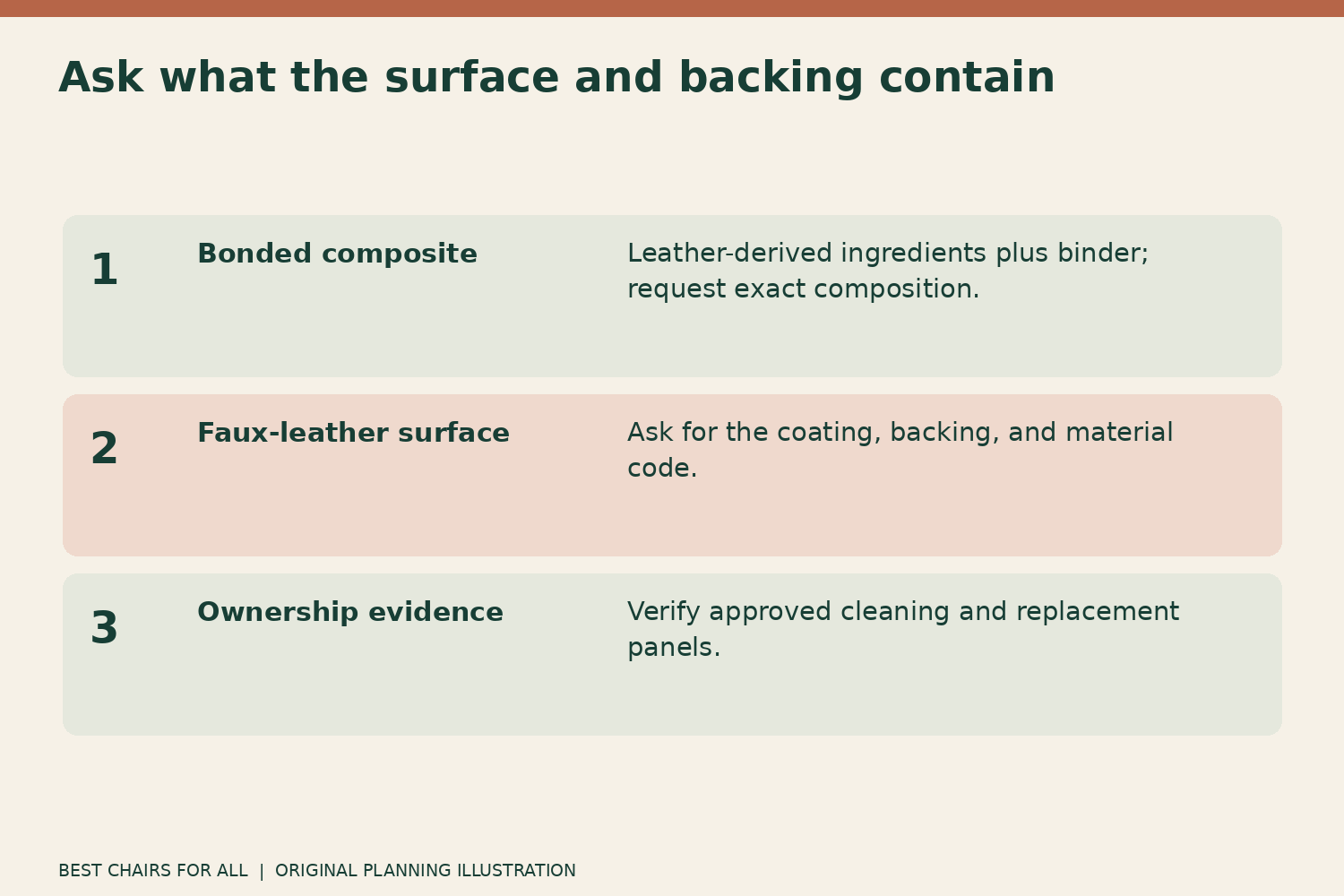
Compare the complete upholstery construction: surface coating, middle layers, backing, exact composition, and finished-chair care instructions. Neither a leather-related name nor a soft hand establishes durability. A useful buying decision needs the actual specification and the consequences of ordinary wear, cleaning, and possible repair.
What bonded describes
Leather Naturally’s terminology guide describes bonded material as leather dust, clippings, and shavings held together with a base substance, usually synthetic. It differs from a continuous grain-side or split layer of hide. The leather-derived ingredients have been reconstituted into a manufactured material.
The label does not establish one universal percentage of leather. Ask for the composition of the actual upholstery rather than copying a percentage from another brand. Also ask what forms the visible surface. A composite can contain leather-derived fibers beneath a separate coating, so leather content and contact-surface identity are different questions.
For a chair, the panel coverage matters too. The seat, inside back, outer back, and arms might use the same material or different materials selected to match visually. Request a written panel description. A specification applying to seating areas should not be silently extended to the whole chair.
What faux leather leaves unspecified
Faux leather identifies an imitation appearance rather than one fixed recipe. Upholstery marketed this way can vary in coating chemistry, backing, thickness, texture, and performance. A product description that says only faux leather provides less useful information than one naming the exact material and its published specification.
For a documented example of a detailed faux-leather specification, Haworth’s Brisa material page identifies a polyurethane surface and a backing containing polyester and rayon. The page treats surface and backing as separate fields. That is a useful model for questions to ask about another chair, not a composition that should be attributed to all faux leather.
Do not assume animal-free status from appearance alone. If avoiding animal-derived materials is important, ask about the complete upholstery and any relevant construction materials in writing. Bonded material contains leather-derived ingredients by definition, while a broad faux-leather description may still leave backing, adhesives, or other components unexplained.
Think in layers rather than names
Imagine the upholstery as a stack. The top layer provides the visible color, grain pattern, and contact surface. Layers underneath contribute body, cushioning, or attachment, and the backing provides a foundation for upholstering. Not every material uses the same stack, and not every seller publishes a cross section.
Ask the seller to identify each layer that is relevant to the chair. If the answer is simply “premium bonded leather,” request the material code and manufacturer data sheet. If it is “PU,” ask whether that identifies the surface only or the whole material. These follow-ups turn a vague label into a specification you can compare.
A coating can influence the cleaning response regardless of what lies beneath it. Applying a traditional leather conditioner to a polymer surface does not become appropriate because the backing contains leather fibers. Follow the finished chair’s directions and the exact coating supplier’s guidance where the chair maker refers to it.
Compare wear mechanisms without promising a lifespan
For both constructions, inspect how the upholstery is stretched around arms, seat edges, piping, and seams. Repeated flexing at a cushion edge creates a different demand from a flat outside-back panel. A high abrasion result alone does not describe coating adhesion, repeated bending, or how the material responds to moisture and cleaning chemicals.
Polyurethane upholstery specifications may include hydrolysis or accelerated-aging information. Such results apply to a stated test and specimen, not a direct conversion into years in your living room. Ask for the method and conditions rather than accepting a bare number as a service-life guarantee.
Likewise, do not assign all bonded upholstery a fixed failure date. Composition, finish, use, environment, and care differ. It is reasonable to investigate peeling and replacement limitations, but a claim that every chair will fail after a particular number of months is not established by the category name.
Distinguish soil, a scratch, and delamination
A surface stain changes appearance without necessarily separating the material. A scratch damages the surface locally. Delamination means layers are separating, which may produce lifting edges, bubbles, flakes, or exposed backing. Those observations call for different responses, and a cleaner cannot rebuild a failing layered structure.
If a coating begins lifting, stop rubbing the area and photograph it. Find the model number, material code, purchase record, and care history. Ask the manufacturer whether the condition is covered and whether a replacement panel or cushion is available. Avoid using adhesive or dye before a warranty assessment, because it can obscure the original condition.
A cosmetic repair compound may change the look of a small damaged area but should not be described as restoring original upholstery performance. Ask a qualified upholsterer about the substrate’s condition and the size of the affected area. If deterioration is widespread, compare a proper reupholstery quote with replacement rather than budgeting only for a small patch kit.
Read cleaning instructions at product scope
Coated upholstery can be damaged by an unsuitable cleaner even when it initially appears to wipe clean. Product-specific directions may differ on alcohol, bleach, solvents, conditioners, and abrasive tools. A cleaning method approved for one commercial vinyl should not be transferred to an unidentified bonded or polyurethane chair.
Spradling’s PERMAGUARD cleaning guide names prohibited tools and chemicals for that finish and discusses dye transfer from clothing. It illustrates the level of specificity needed: the finish name and its instructions matter more than the general word faux leather.
For your chair, record the exact routine cleaner, dilution if specified, application method, rinsing requirement, and drying instructions. If any field is absent, ask before applying a substitute. A cleaner advertised for leather and vinyl is not automatically compatible with every coated upholstery material.
Do not use heat, an abrasive sponge, or a household solvent to remove a stubborn mark without explicit permission. Also avoid covering a damaged surface with a tight adhesive film. The apparent success of removing a stain does not prove the coating has retained its original condition.
A construction-and-ownership comparison sheet
Use this original worksheet before judging two chairs by price. Fill it out with written answers and leave unknowns visible. It is designed to expose whether you are comparing complete materials or merely marketing names. No field should be supplied from a different model that happens to look similar.
| Field | Bonded candidate | Faux-leather candidate |
|---|---|---|
| Material identity | Composite name and exact code | Coating family and exact code |
| Composition | Leather-derived content, binder, backing | Surface and backing listed separately |
| Panel coverage | Seat, arms, inside and outside back | Seat, arms, inside and outside back |
| Wear evidence | Relevant tests and warranty terms | Relevant tests and warranty terms |
| Care permission | Named approved method | Named approved method |
| Repair route | Replacement panel or cushion availability | Replacement panel or cushion availability |
For a hypothetical example, Candidate A supplies only a bonded label and a general wipe-clean claim. Candidate B names its polyurethane material, backing, care guide, and replacement cushion procedure. Candidate B currently provides more usable evidence, but that is an information advantage rather than proof that every polyurethane chair outlasts every bonded chair.
Check comfort and appearance on the finished chair
Coating texture, gloss, thickness, and the cushion underneath all influence feel. Sit in the chair long enough to notice whether the surface is agreeable against your normal clothing and whether it allows comfortable position changes. Do not attribute a firm or soft seat entirely to the upholstery; foam and suspension remain important.
View the actual color under the room’s daylight and evening lighting. Embossed grain can hide some minor visual variation, while a glossy finish may emphasize creases or reflections. Compare the sample with the upholstered arms and seat if possible, because stretching and shaping can affect how the material looks on a finished object.
For a secondhand chair, inspect high-flex areas and hidden edges without dismantling the upholstery. A pristine outside back does not tell you the condition of the seat front or inside arms. Ask about previous cleaners, repairs, and storage conditions. If the material cannot be identified, treat its care and future repair options as unresolved.
Make environmental and value claims specific
Bonded material can use leather-derived scraps, but that fact alone does not establish the environmental impact of a complete chair. Similarly, a synthetic surface’s animal-free description does not establish recyclability, renewable content, or low emissions. Ask for the exact claim, scope, and supporting documentation rather than treating one ingredient as a complete sustainability verdict.
Compare total ownership questions you can verify: what is included, what can be replaced, what care is required, and what the warranty actually covers. Choose the chair whose documented construction and maintenance fit your priorities. The strongest decision rests on the surface, backing, panel coverage, and repair route together, rather than a contest between two incomplete labels.
Do not confuse bonded with coated split leather
A coated split uses a continuous lower layer of hide beneath its finish. Bonded material instead uses reconstituted leather-derived ingredients. Leather Naturally distinguishes these constructions in its terminology guide. If a seller uses bicast, coated leather, and bonded interchangeably, ask for clarification before proceeding. The visible surface can look similar, but the substrate and appropriate repair assessment may differ. A clear material description is more useful than guessing from the grain pattern.
Something unclear or out of date? Send a correction with this article’s title and the detail to check.
Sources, research & corrections policy ↗