As an Amazon Associate, we earn from qualifying purchases. Read our affiliate disclosure. Amazon buttons below search for matching listings; they do not confirm stock, an exact seller, or a current price.
The best wheelchair is the one whose propulsion, seating, dimensions, and support arrangements match the person using it. For a first manual-chair shortlist, compare the Drive Medical Cruiser III for conventional adjustable seating, Karman S-ERGO 115 for a lighter folding package, and QUICKIE 2 for a substantially broader configuration discussion. These are three different buying routes. A clinician or qualified seating professional should help determine whether any is appropriate for daily mobility.
This guide compares manufacturer documents checked on November 6, 2026. We have not tested these chairs, measured their rolling resistance, or assessed an individual user. There is no universal winner here, and advertised capacity does not establish whether a seat fits. Prices, insurance eligibility, and retailer availability are not verified; request a written quotation for the exact configuration.
First decide what the chair must do
Write a one-sentence description before considering models: “I need to propel myself around my apartment and use a family car twice a week,” or “A companion will push me during short outings.” Those sentences produce different requirements. A conventional manual wheelchair has large rear wheels with handrims. A transport chair primarily depends on a companion. A power wheelchair adds different control, charging, transportation, and assessment questions. This article focuses on manual wheelchairs, rather than treating those categories as interchangeable.
Next separate occasional mobility from prolonged seating. A chair used for a brief appointment still needs appropriate fit, but a chair used throughout the day deserves a detailed seating assessment. Pain, reduced sensation, posture difficulties, or difficulty operating handrims cannot be resolved by choosing the highest customer rating. Ask the professional evaluating you to document the support required, the intended propulsion method, and any compatible cushion or back support. The resulting specification should guide the order.
Three manufacturer-verified starting points
| Model | Documented feature | Best reason to investigate | Decision to resolve |
|---|---|---|---|
| Drive Cruiser III | Seat depth extends from 16 to 18 inches | Conventional folding chair with removable flip-back arms | Exact width, rigging, and model weight |
| Karman S-ERGO 115 | 25 pounds without riggings; 17-inch seat depth | Lighter folding chair for a compatible user | Fixed arm configuration and seat fit |
| QUICKIE 2 | 12–24-inch seat-width range on the US page | Individual configuration with a supplier | Compatibility of the selected options |
Drive Medical Cruiser III: start with straightforward adjustability
The Cruiser III manufacturer page describes an extending seat depth, removable flip-back arms, and a dual axle offering a 17.5–19.5-inch seat-to-floor range. Its specification table lists multiple weights and capacities across variants, so “Cruiser III” alone is not an adequate order description. Front riggings also affect the package being handled.
This is worth discussing when a conventional folding manual chair meets the assessed need and arm access matters. Its limitation is that a broad retail model family can conceal differences between configurations. Ask the seller to put the seat width, arm type, footrest or elevating-legrest choice, assembled weight, and capacity of the exact stock number in writing. An adjustable depth does not make every other dimension adjustable, and a steel-frame chair should be physically evaluated by whoever will load it.
Check matching Drive Medical Cruiser III wheelchair listings on Amazon (paid link)
Karman S-ERGO 115: examine the lighter package without overselling the seat
Karman’s S-ERGO 115 specification sheet lists 16-, 18-, and 20-inch seat variants, a 17-inch seat depth, a 250-pound capacity, and a 25-pound weight without riggings. The same sheet distinguishes overall widths of 23, 25, and 27 inches. The named seating shape is a manufacturer design feature, not a promise that a particular person will avoid pressure injury or sit comfortably all day.
Investigate it when the documented seat dimensions fit and lifting a conventional heavier chair is a concern. Its fixed-arm arrangement deserves attention if your assessed access method requires arms to move away. The useful comparison is the complete chair you will actually handle, including footrests and prescribed seating. Do not compare the Karman figure without riggings directly with another chair’s fully equipped weight and declare a measured advantage.
Check matching Karman S ERGO 115 wheelchair listings on Amazon (paid link)
QUICKIE 2: prioritize configuration over quick checkout
Sunrise Medical’s QUICKIE 2 US specifications list seat widths from 12 to 24 inches and depths from 12 to 22 inches, with standard and heavy-duty configurations distinguished. The page also warns that available options are not necessarily compatible with every configuration. That is a strong reason to involve a knowledgeable supplier rather than copy several attractive options into a cart.
This is the most relevant shortlist entry when the evaluation calls for a carefully configured folding manual chair. It is less attractive when a buyer expects an off-the-shelf order with no fitting decisions. Obtain the completed order form, seating specification, and delivered dimensions before agreeing. The breadth of a product range is valuable only when the actual combination is appropriate; it does not mean a random QUICKIE 2 listed online will fit your needs.
Check matching QUICKIE 2 wheelchair listings on Amazon (paid link)
A fit record that distinguishes body size from doorway size
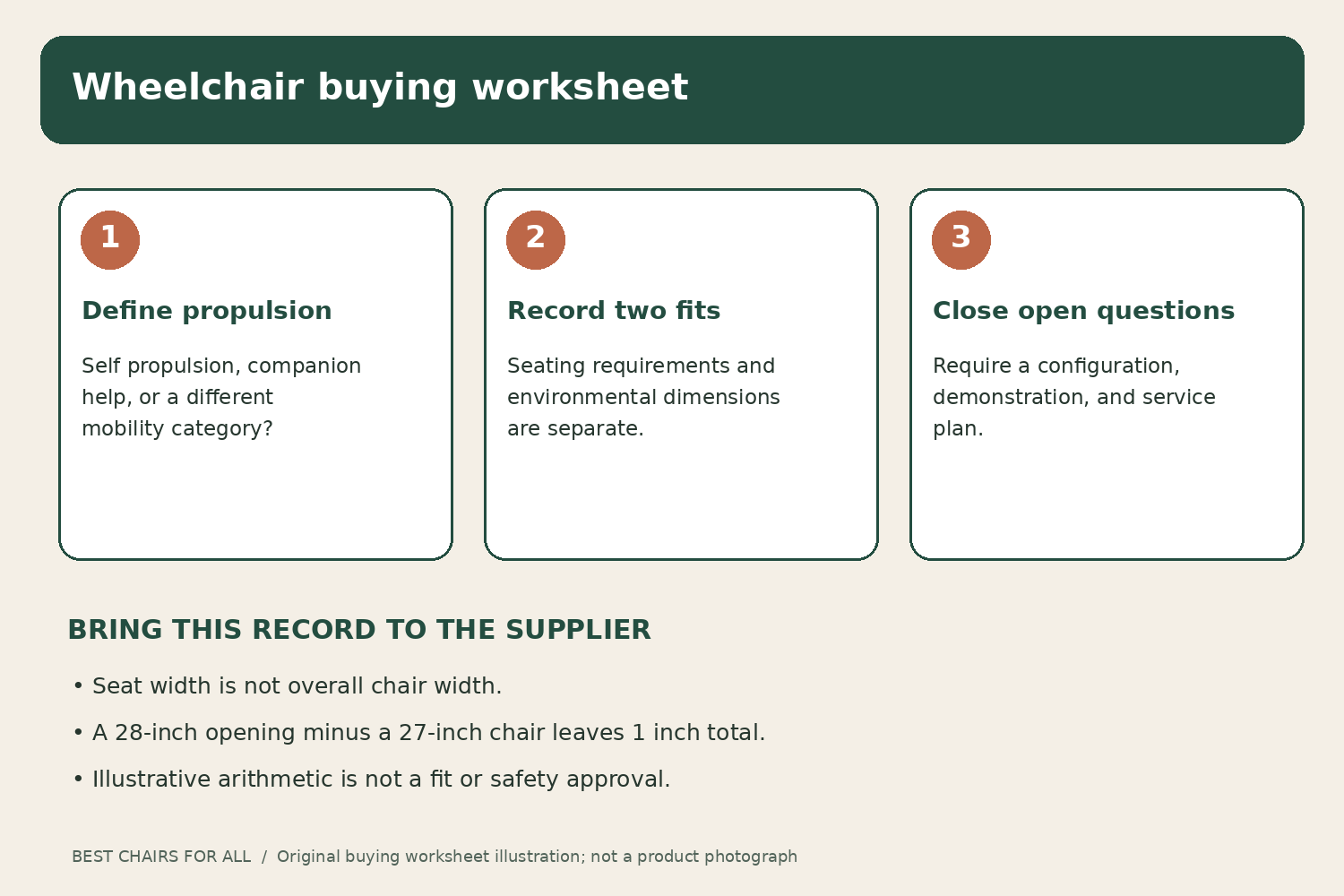
Use a sheet with two separate columns headed “seating prescription” and “environment.” The first is completed with the seating professional: seat width and depth, cushion details, back support, foot support, and the required arm arrangement. The second records the places the finished chair must go. Keeping them separate prevents the common mistake of choosing a narrow seat solely because a bathroom door is narrow.
Use wheelchair seat-width measurements as a discussion aid with the intended user and a qualified seating professional when comparing the published sizes.
For the environment column, record the narrowest clear opening with the door in its normal open position. Include protruding hardware and the approach angle. Then record the manufacturer’s actual overall chair width for the selected configuration. For example, an opening measured at 28 inches and a chair specified at 27 inches leave one inch of total nominal clearance. That arithmetic is not a usability approval: hands, alignment, turning approach, and measurement error still matter. Arrange a demonstration in the real environment if possible.
Depth matters as well. A chair that fits through the doorway may have insufficient room to turn toward the toilet, bed, or desk. Draw the approach on graph paper, marking the door swing and any furniture that cannot move. Show that drawing to the supplier and ask which dimensions they need to confirm maneuvering. A hallway measurement alone is an incomplete access assessment.
The cushion belongs in this discussion from the beginning. Its thickness and shape change the occupied seating arrangement and the relationship to tables and foot supports. Avoid buying an unrelated thick cushion after final fitting and assuming the geometry remains equivalent. Have the professional identify compatible seating and record the final occupied setup, rather than trying to prescribe dimensions from a generic online formula.
Worked purchase worksheet: one apartment, two different failures
Imagine a buyer whose assessment identifies an appropriate 18-inch-wide seat. Their apartment has a straight entrance but an awkward bathroom turn, and a family member loads the empty chair into a hatchback. Start with the assessed seat requirement, then ask each supplier for overall width, overall length with the chosen rigging, folded dimensions, and the empty lifting configuration. Do not narrow the seat to solve the bathroom problem.
In the worksheet, use rows for the apartment entrance, bathroom approach, dining position, and vehicle. Use columns for the measured space, the exact chair dimension, the demonstration result, and unresolved questions. “Fits entrance” is one result; “bathroom turn not demonstrated” is another. A single successful doorway pass cannot cancel the unresolved bathroom problem. Likewise, passing the access demonstration does not establish that the family member can comfortably manage the empty chair at the hatchback.
The final row should read “ready to order only when unresolved questions are closed.” Possible solutions may include a different configuration, environmental changes, or another mobility approach recommended by the assessment team. The worksheet does not choose among those clinical or building decisions. It makes the unanswered questions visible before money is committed.
Compare ownership, service, and transportation
Ask who will assemble and fit the chair, who can adjust it afterward, and which parts are available locally. A low purchase price can be less useful if a worn caster or damaged upholstery leaves the user without mobility for weeks. Request the service provider’s procedure for reporting a problem and ask about loan equipment. Those practical arrangements deserve a place beside the product specifications.
For car loading, distinguish an empty wheelchair carried as cargo from a wheelchair occupied during transportation. Neither a folding frame nor a seat belt supplied with a chair establishes crash protection. If remaining in the chair during vehicle travel is necessary, have the supplier identify the exact approved transit configuration, documentation, securement arrangement, and compatibility with the vehicle. Do not improvise using a general retail description.
A realistic total quotation includes the selected chair, prescribed seating, accessories, fitting, shipping, and any return or cancellation terms. Ask whether a configured chair can be returned and who pays transport charges. A billing code printed on a product page is not an insurance promise. Obtain coverage information from the relevant insurer or benefits administrator and the supplying provider before relying on reimbursement.
Recall and delivery checks
The FDA medical-device recall database is an official starting point for checking classified device recalls. Check the manufacturer name, exact model, and identifying numbers before purchase and again when accepting used equipment. A general search is not a serial-number clearance, and this guide does not certify any individual chair as recall-free. Ask the supplier about current notices and keep the manufacturer contact details with the receipt.
At delivery, compare the chair and paperwork with the agreed order. Have the supplier demonstrate ordinary controls, folding, and any user-removable components according to the model’s instructions. Confirm that the provided manual matches the chair. If damage, unexpected movement, missing components, or a mismatch appears, resolve it with the supplier before use. Avoid changing axle position or other stability-related settings based on a video.
Which one belongs on your shortlist?
Choose the Cruiser III discussion when a conventional adjustable folding chair appears consistent with the assessment and the exact variant is clear. Investigate the S-ERGO 115 when its documented seat and arm layout fit and a lighter lifting package is relevant. Start the QUICKIE 2 ordering discussion when individual configuration is a central requirement. If prolonged seating, propulsion, or access remains unresolved, the next useful purchase is a proper assessment and demonstration, followed by an exact written chair specification.
Before accepting the order
Ask the supplier to mark each selected option on a copy of the order form and explain any substitution. If the delivered arm style differs from the one assessed, an otherwise correct seat width does not settle the problem. Keep a photograph of the model label and a copy of the final specification with the receipt. That record also helps another service provider identify parts later without guessing from the chair’s appearance. A family member helping with shopping should use this same document, so a superficially similar sale listing does not quietly replace the agreed configuration.
Something unclear or out of date? Send a correction with this article’s title and the detail to check.
Sources, research & corrections policy ↗