As an Amazon Associate, we earn from qualifying purchases. Read our affiliate disclosure. Amazon buttons below search for matching listings; they do not confirm stock, an exact seller, or a current price.
The best tattoo artist chair is the one that supports the artist’s actual working relationship with the client chair, independent armrest, tray, light, and floor. Our researched starting comparison covers TATSoul 270, Mako Studio, and Oros Artist Chair. These three models from one manufacturer provide a documented comparison of height ranges and support layouts; this is not a claim that the entire market has been tested or ranked.
Check tattoo artist stool height adjustment against the client position and working height you actually use.
We checked the current manufacturer pages on November 6, 2026. We have not sat on, rolled, or tattooed from these chairs. No model is presented as treating back pain or guaranteeing comfortable long sessions. Current prices, stock, and individual suitability require direct confirmation. A professional ergonomic assessment may be appropriate where an artist has symptoms or cannot find a workable relationship between the equipment and the task.
Buy for the artist, not for a generic studio photograph
A client chair supports the person receiving a tattoo. An artist chair positions the professional doing the work. Their requirements overlap only partly, and a product promoted as versatile should still be evaluated for its specific intended use. For this guide, the purchasing brief is the artist’s own seat, not a substitute client bed or a decorative stool for consultation.
Start by writing down where the current setup fails. Perhaps the stool cannot reach a useful low position, its back support blocks access, a lever is difficult to find, or its base collides with the client chair. Each complaint suggests a concrete demonstration question. “I need something ergonomic” is too broad to distinguish between three adjustable products.
Then record which client chair and independent support equipment will remain. The same artist chair can produce different results at another station. A higher stool is not necessarily an improvement if the work surface remains too low; a narrower seat does not solve a collision caused by a wide wheelbase. Compare the whole station before attributing the problem to the cushion alone.
Three verified model distinctions
| Model | Documented manufacturer feature | Best reason to investigate | Tradeoff to evaluate |
|---|---|---|---|
| TATSoul 270 | 18–24-inch seat-height range; adjustable back and seat tilt | A familiar multi-adjustment artist-chair format | Support shape and access at the actual station |
| Mako Studio | 17–22-inch height range; six listed adjustments | Lower starting height and split-back arrangement | Additional settings and support geometry |
| Oros Artist Chair | 18.5–23.5-inch height range; full front adjustment bar | Control access and pronounced seat-pan format | Whether the seat shape and control suit the individual |
TATSoul 270: investigate its support relationship at the work
The 270 manufacturer page lists pneumatic height adjustment, back and seat tilt, adjustable backrest height, a five-wheel base, and an 18–24-inch seat-height range. It states a 250-pound capacity and describes both forward-facing and straddling arrangements. Those are design descriptions, not proof of a clinical benefit.
Consider it when that adjustable support format suits the artist and the documented operating limits work for the individual. Its limitation is that a wide adjustment list cannot establish whether the backrest or base interferes with a particular task. Demonstrate the relevant manufacturer-permitted positions with the actual client chair. Ask the supplier to explain the controls and compatible wheels rather than adapting a generic office-chair component.
Check matching TATSoul 270 artist chair listings on Amazon (paid link)
Mako Studio: the lower minimum and split back are the comparison points
The Mako Studio manufacturer page lists six adjustment areas covering seat height and pitch and several backrest settings. Its height range is 17–22 inches, and it includes nonmarking lockable wheels. The page also contains travel-armrest descriptions, which should not be mistaken for specifications of the artist chair.
This is worth investigating when a lower seat setting or its split-support format addresses an identified task problem. Its limitation is the setup work needed to find an appropriate configuration and confirm it at the station. More adjustments are useful only when the operator understands their purpose and the approved secured state. Ask for the applicable manual and a demonstration rather than assigning the chair an automatic ergonomic advantage.
Check matching TATSoul Mako Studio artist chair listings on Amazon (paid link)
Oros Artist Chair: control access can matter as much as cushion shape
The Oros Artist Chair product specification identifies model AC680-B with a front-bar height control, a pronounced seat-pan shape, roller-blade-style wheels, and an 18.5–23.5-inch height range. Its product specification gives 40 pounds and a 250-pound capacity. An unrelated small shipping-dimensions block on the page should not be used as the assembled chair’s footprint.
Investigate it when the front control and seat form provide a demonstrated improvement for the work. It is less relevant if the minimum height or shaped cushion is unsuitable for the artist. Ask for the complete base dimensions and compatible wheel information. The Oros Artist Chair is different from the Oros client chair; retain the AC680-B identity so accessories or dimensions from the other product do not enter the order.
Check matching TATSoul Oros Artist Chair AC680 listings on Amazon (paid link)
Original artifact: the station relationship log
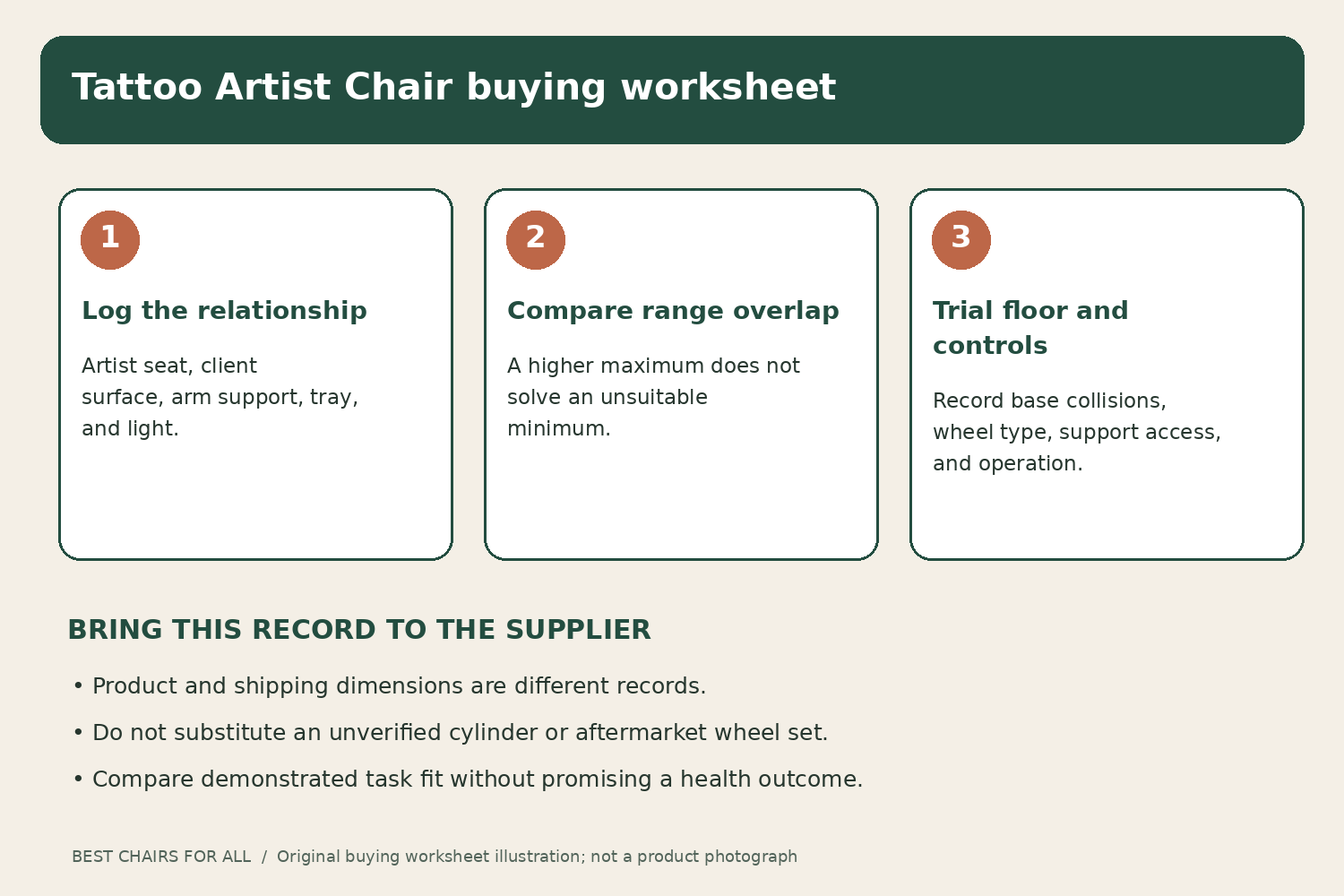
Create a log with one row for each frequent working arrangement and columns for artist-chair setting, client-chair setting, independent arm support, tray position, light, foot position, and interference. Record actual demonstrated configurations and practical observations. The log is a purchasing tool, not a clinical posture prescription. Avoid filling it with promises such as pain-free or perfect alignment.
For an invented example, an artist may find that their current seat adjusts from 20 to 25 inches while one regular task requires a workable position below that minimum. The correct demonstration question is whether a candidate with a lower published range improves the complete arrangement. The Mako’s 17-inch starting specification suggests a model to investigate, but it does not determine the correct personal setting or establish that every task should be done lower.
Another row may reveal that the artist’s wheelbase touches the client chair before the working area can be reached comfortably. Changing seat height may not resolve that collision. Ask the supplier to help evaluate the actual base shapes, permitted chair positions, and independent support arrangement. An overhead sketch can show what is colliding more clearly than a list of seat dimensions.
Keep an “unknown” column for essential measurements that the product page omits. For Oros, request the actual assembled base footprint rather than copying the anomalous shipping block. For every chair, distinguish a supplier’s measured demonstration result from a manufacturer’s nominal specification. If the ordered configuration differs, confirm which observations still apply.
Height ranges are an intersection problem
The artist chair, client chair, and independent support all have operating ranges. Their useful overlap depends on the task and user. A seat with a high maximum can still be unsuitable if its minimum is too high for a frequent working arrangement. Likewise, a low stool can be impractical for another service position. The published range narrows the shortlist; it does not prescribe a universal setting.
Have the artist try the relevant tasks using ordinary controls in a supervised demonstration. Include the equipment that actually remains at the studio. Record whether the chair’s supports obstruct reach, whether the user can access the controls, and whether the required arrangement stays within manufacturer instructions. If symptoms or persistent difficulties arise, take that record to an appropriate occupational or ergonomic professional.
Do not extend the operating range by replacing a gas lift with an unverified cylinder or adding a homemade platform. A component that seems dimensionally compatible is not an approved complete chair. Ask the manufacturer about supported configurations and use authorized service where required. A purchase that needs an improvised modification to work has not yet met the brief.
Wheels and floor behavior deserve a separate trial
The chair’s movement needs to suit the actual floor and task. Manufacturer descriptions such as lockable or nonmarking should be retained as product features rather than turned into guarantees about every surface. Ask how the exact wheels are intended to operate and whether the floor finish or mat arrangement is compatible. Test the approved ordinary setup instead of evaluating a chair on an unrelated showroom rug.
Do not assume that replacing wheels with a popular aftermarket style preserves the correct seat height, load specification, or intended behavior. The 270 and Mako pages identify compatible manufacturer wheel options; confirm exact applicability with the supplier. Record what wheels are on the quote and on the demonstration chair. Small component substitutions can undermine a carefully documented station comparison.
Floor clutter can also produce an apparent chair problem. Cables, mats, foot controls, and equipment legs should be planned as part of the station. A new wheeled base cannot fix an obstructed route by itself. Draw the ordinary work area, then have the relevant personnel resolve any electrical or facility questions according to the equipment instructions and applicable requirements.
Support options should remain operator-controlled and understood
An adjustable back or chest-support arrangement may be relevant for some artists and tasks, but it is not a universal prescription. Have the supplier explain the intended positions and controls and allow the artist to compare the approved configurations. Ask whether the support can be adjusted without interfering with the required professional work and whether its secured state is clear.
Do not interpret manufacturer pressure-relief or comfort language as evidence that the chair will prevent a musculoskeletal problem. If the artist needs medical advice, the chair comparison can provide useful equipment information to the appropriate professional. It cannot replace that assessment. The purchase decision should describe observed task fit and documented specifications, with uncertainty preserved where a demonstration has not answered the question.
Hygiene must fit the studio’s actual process
The artist’s chair can be part of a professional environment with occupational blood exposure. OSHA’s bloodborne-pathogens quick reference describes the role of exposure-control planning, work practices, housekeeping, and training where the standard applies. Consult current applicable requirements and the relevant local authority for the studio rather than assuming a particular vinyl chair makes the workplace compliant.
Request written material-compatibility guidance for the actual upholstery, controls, and wheels. The studio’s required disinfection process and the furniture care instructions must be compatible. If a conflict appears, resolve it with the supplier and responsible professional before buying; do not shorten a disinfectant’s required contact time or substitute an unverified chemical to protect the finish. Barrier arrangements also belong in the documented professional process.
Ask about cleaning access around adjustment levers, support brackets, cushion seams, and wheel assemblies. A removable part should be removed only as the manufacturer permits. Damaged surfaces or mechanisms need the correct repair or replacement route. Keep model identification and current instructions available so the person responsible for cleaning is not forced to infer the process from appearance.
Order the configuration you actually evaluated
Obtain an itemized quotation for the exact chair, upholstery, wheels, approved accessories, delivery, and setup. Ask how a return or exchange works if an unused chair proves unsuitable and whether special colors have different terms. Prices and stock are not verified in this comparison; the final total needs current confirmation. A sale price does not compensate for an unresolved operating-height or station-access problem.
Request component warranty and local service information. A failed pneumatic lift, damaged support, or unexplained movement should be referred to the authorized provider without opening pressurized components. Record the final settings and model on the station log, and revisit it when the client chair or work arrangement changes. The strongest choice among 270, Mako, and Oros is the one that solves the documented task problem in an approved configuration.
Something unclear or out of date? Send a correction with this article’s title and the detail to check.
Sources, research & corrections policy ↗