As an Amazon Associate, we earn from qualifying purchases. Read our affiliate disclosure. Amazon buttons search for matching model listings. IKEA also sells its named products directly; compare the exact item, seller, delivery, and return terms.
The best stackable chair depends on the room and the place where the stack will live. My research-based shortlist is IKEA TEODORES for straightforward indoor dining, the specific walnut-veneer SKÅLSTA combination for a chair that stays on display, and Safco’s Vy 4292BL for a meeting-room workflow that may include a cart. These recommendations come from current manufacturer documentation, not hands-on testing.
All three are considered here for indoor seating. They are not backpacking chairs, and they do not become a compact flat package like a folding chair. Their portability comes from moving individual chairs or using a documented handling system. If you need patio seating, begin with a chair specifically approved for that exposure rather than extending this indoor shortlist outdoors.
The shortlist and the figures that matter
The product details below come from IKEA’s TEODORES page, the exact SKÅLSTA combination, and Safco’s current Vy 4292BL page, checked November 6, 2026. IKEA’s wording is “tested for,” which is preserved instead of relabeling it as a different kind of capacity statement. No retailer star ratings or unverified budget promise determine these picks.
1. IKEA TEODORES Chair White 304.861.56
Best for: a straightforward home dining chair that stacks.
TEODORES is my research-based first comparison for a home that needs usable dining seats plus occasional compact storage. The armless form makes it worth measuring against a small table. Its main appeal is that the ordinary chair you sit on can also be the spare chair you put away.
The seat measurements matter more than the visual impression of a slim frame. Try the chair if possible, especially if long meals are the intended use. A compact seat can be a practical match for one person and feel restrictive to another. Stackability should not decide that comfort question.
Product Details
| Brand | IKEA |
|---|---|
| Overall size | 18 1/8 W × 21 1/4 D × 31 1/2 H in |
| Seat size | 15 3/4 W × 14 5/8 D in |
| Seat height | 17 3/4 in |
| Manufacturer test figure | 243 lb; manufacturer wording: tested for |
| Maximum stack | 6 chairs |
| Use | Indoor only |
Pros
- A clear published stacking limit makes storage planning possible.
- Plastic seat and back suit buyers who prefer a simple wipeable surface.
Cons
- Not an outdoor chair.
- Assembly and later fastener checks add ownership work.
Choose it when the seated fit and table clearance work. If you need only two extra chairs for rare guests, compare its assembled storage shape against folding alternatives before committing to a matching set.
2. IKEA SKÅLSTA Chair Walnut Veneer Tubular Metal Black-Gray 496.087.56
Best for: a home dining setup that favors a wood-veneer shell.
This specific SKÅLSTA combination is the appearance-led alternative in the shortlist. I would consider it when the chairs remain visible around a dining table most of the time, but the room occasionally needs to open up. Its different seat dimensions also make it worth a personal fit comparison with TEODORES.
The range allows different shells and frames, so the exact combination matters. This recommendation applies to the walnut-veneer shell with the tubular metal base named here. Do not assume a different underframe preserves the same stackability or dimensions. Confirm both components in the basket.
Product Details
| Brand | IKEA |
|---|---|
| Overall size | 20 1/2 W × 19 5/8 D × 32 1/4 H in |
| Seat size | 17 3/4 W × 17 3/4 D in |
| Seat height | 17 3/8 in |
| Manufacturer test figure | 243 lb; manufacturer wording: tested for |
| Maximum stack | 4 chairs |
| Components | Walnut-veneer shell 906.116.71; tubular frame 506.118.14 |
Pros
- A useful choice when the chair must contribute to the room’s everyday appearance.
- The wider listed seat provides a different fitting option.
Cons
- Lower stack count means more separate stacks for the same quantity.
- A finished veneer surface deserves careful handling at contact points.
Choose the specified combination after checking actual stack contact and table fit. If hidden storage is the dominant goal, the decorative finish may be less valuable than a chair with a more suitable storage arrangement.
3. Safco Vy Sled Base Chair 4292BL
Best for: meeting rooms with a planned cart and storage route.
The Vy 4292BL is my shortlist choice for someone planning repeat room changes rather than simply buying two dining spares. Its sled base and optional cart arrangement deserve attention as a system. That means assessing the storage room, the people moving the chairs, and the route between rooms before ordering quantity.
The current manufacturer page gives separate floor and cart counts. Follow those current instructions even if an older catalog or reseller describes a taller stack. A useful quantity purchase depends on consistent models and compatible handling equipment; a generic cart description should not override the chair’s own limit.
Product Details
| Brand | Safco |
|---|---|
| Overall size | 22.5 W × 19.5 D × 32.5 H in |
| Seat size | 18.5 W × 17 D in |
| Seat height | 18 in |
| Manufacturer capacity | 350 lb |
| Current floor stack limit | 5 chairs |
| Current cart stack limit | 15 chairs; confirm compatible cart and instructions |
Pros
- A documented capacity and floor-versus-cart distinction support planning.
- No assembly is listed for the chair.
Cons
- The overall width requires a real room-layout check.
- A cart adds cost and occupies storage space of its own.
Choose the Vy when its seating fit and repeated setup workflow justify the system. For a small household closet, buy a sample and measure the actual nested shape before assuming the office-oriented option saves more space.
A twelve-chair storage plan you can adapt
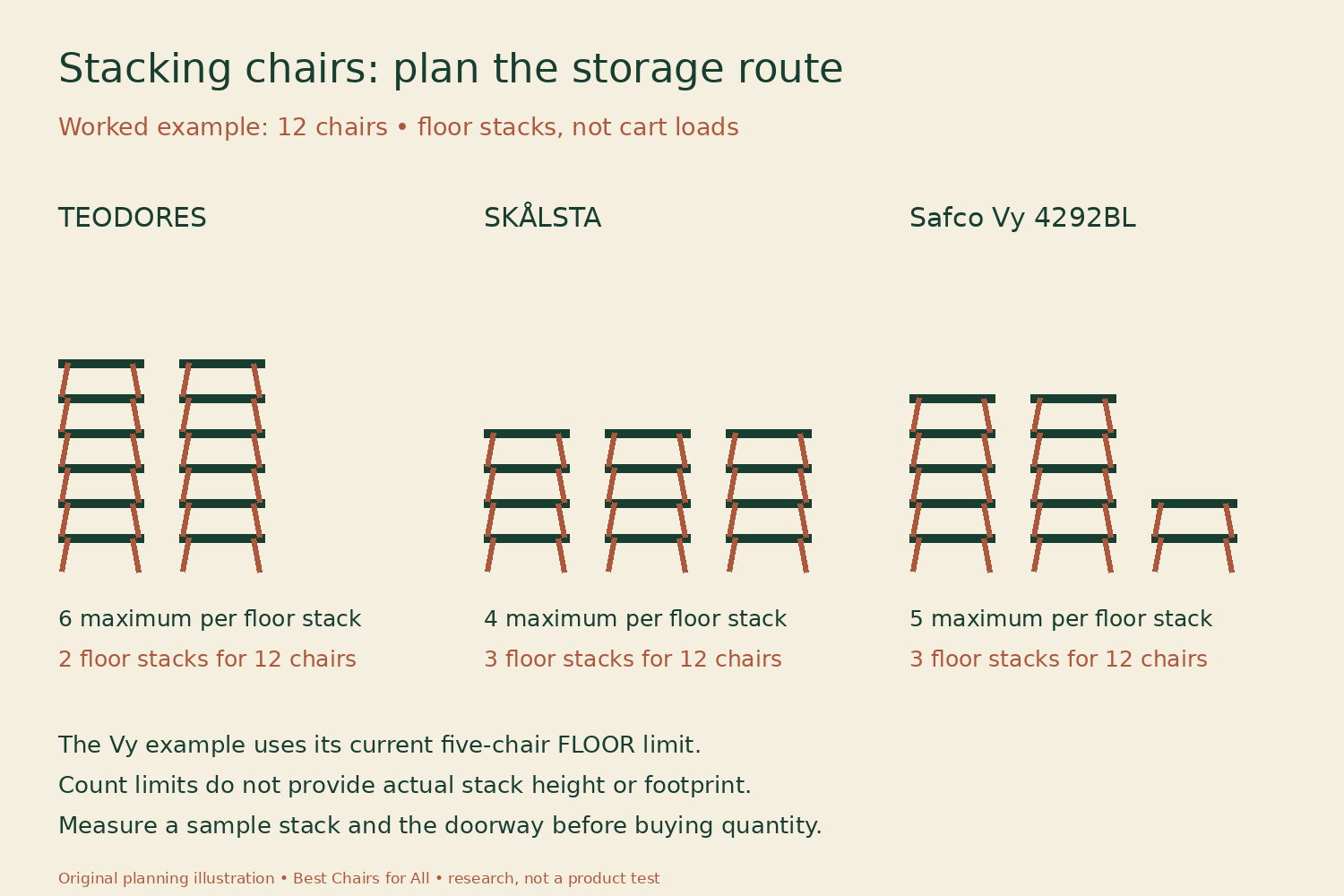
Suppose you need twelve identical chairs and want to store them in floor stacks. Divide the chair quantity by the permitted floor-stack count and round upward. Using the published limits in this shortlist, TEODORES needs two stacks of six. SKÅLSTA needs three stacks of four. Vy needs three stacks: five, five, and two. These are count calculations, not measured predictions of floor area or stack stability.
Write each arrangement on a simple sketch of the actual storage room. Draw the door swing, shelves, light switches, and other stored equipment before adding chair stacks. A corner that appears empty on a room plan can become unusable if the open door occupies it. You also need room to remove a chair without lifting over another stack or scraping the seat against a shelf.
The worksheet should contain six fields: total chair count; permitted floor-stack count; number of stacks; measured footprint of a real stack; measured height of that stack; and the access space needed to retrieve chairs. Only the first three can be completed from a count limit. Do not multiply single-chair dimensions by the stack count: nesting changes the geometry, and some stacks lean or grow backward.
For a quantity purchase, ask the supplier for a measured stack drawing or obtain a sample before finalizing the storage layout. Measure from the furthest protruding point rather than only the seat. Record whether the manufacturer’s claimed count includes any accessories. Your objective is a repeatable storage position with clear access, not squeezing the maximum possible number into an unmeasured corner.
Why floor counts and cart counts cannot be swapped
Safco’s current Vy product page specifies five high on the floor and fifteen high on a cart. Older material and reseller pages can show different counts. This guide uses the current chair page. The distinction matters because a cart supports the chairs in a particular arrangement and introduces wheels, a different base, and its own handling requirements. A floor stack is not automatically approved to grow taller because a cart exists somewhere in the range.
The Safco 4190SL cart page describes a cart that can hold up to twenty units depending on the chair and lists a 500 lb product weight capacity. That general cart statement does not increase the Vy chair page’s fifteen-chair cart limit. Both the exact chair’s count and the compatible cart’s loading instructions must be satisfied. Confirm the pairing and current directions with Safco when ordering a system.
Also measure the empty cart and the loaded stack separately. A cart may fit through a door while its highest chair catches an overhead obstruction, or its loaded outline may be wider than the wheels. Ask for the complete loaded dimensions rather than adding guessed increments. If those dimensions are unavailable, keep that field unresolved until you can inspect a sample.
A cart is most useful when the route can actually accommodate it. Look at thresholds, tight turns, carpet changes, and the place where the cart waits during seating setup. Do not assume that having casters makes a loaded stack suitable for stairs or a slope. The cart should solve a recurring movement problem, not create a new obstacle in a corridor.
Check the table before comparing the storage closet
A stackable chair still has to work as a chair. Measure the clear distance between table legs and compare it with the chair’s overall width, not just its seat width. Then consider whether the chair can be pulled out far enough for the user to sit. Two chairs may fit side by side when empty but interfere when people angle them to enter or leave.
A practical home test uses painter’s tape to mark the proposed chair outline on the floor. Place an existing chair at the intended position and rehearse getting in and out with the table set normally. The tape does not reproduce the new chair’s comfort or frame shape; it helps expose a layout conflict early. Check drawers and cabinet doors that may open behind seated guests.
For the sitting trial, bring the activity into the test. A chair used for a brief announcement has a different demand from one used through dinner and conversation. Notice the front edge, the width available to change position, and how the back meets your body. An attractive finish or large load figure cannot establish how those contact points will feel to you.
If a loose seat cushion is part of the plan, treat it as an additional item. Ask whether it must be removed before stacking, where all cushions will be stored, and whether it shifts on the seat. A cushion can change the seated position and table relationship. Its thickness should not be ignored when you are buying chairs to fit beneath a particular table.
Handling and surface protection affect daily usefulness
IKEA’s current TEODORES page recommends lifting and moving stackable furniture one chair at a time. That is a useful reminder that a storage count is not a carrying allowance. Plan the number of individual trips from dining room to closet, especially when the route includes narrow doorways. Do not evaluate a chair by imagining that you will carry an entire permitted stack by hand.
When stacking, align the chair in the intended orientation and lower it into the designed contact points. If it catches or rocks unexpectedly, stop and check the arrangement instead of adding another chair. Mixed models that look similar should remain separate unless the manufacturer explicitly approves them for interstacking. A different shell, base, or foot can alter where the load lands.
Inspect the feet and contact areas as part of ordinary setup. Grit trapped under a glide can damage a floor even when the glide itself appears intact. A missing foot can also change the chair’s contact with the ground. Ask the manufacturer for the correct replacement rather than fitting an arbitrary cap that changes the height of one corner.
For the wood-veneer SKÅLSTA, avoid turning stacking into a sliding motion across decorative surfaces. Place and lift carefully, and keep the contact areas clean. The general principle is simple: the storage feature should not require accepting new scratches every time the room changes. Inspect a sample stack so you understand where parts meet before ordering a finish you want to preserve.
A care and purchasing record for the exact configuration
TEODORES calls for mild soapy cleaning, drying with a clean cloth, and checking the screws about two weeks after assembly and when needed. SKÅLSTA specifies a damp cloth with mild cleaner, drying, and retightening when necessary. Keep the relevant instructions with the purchase record. Do not infer approval for harsh disinfectants or pressure washing from the fact that a seat is easy to wipe.
For a shared room, record the exact brand, model, color, shell, and frame combination on a storage label or inventory sheet. Keep the floor and cart limits beside that information. This is particularly useful when a later purchase must match the first batch: a similar name or appearance can hide a changed component or revised instruction. Staff should not have to reconstruct the permissible stack count from an old shopping receipt.
Compare delivered cost per usable chair rather than carton price alone. Check the quantity in the carton, whether assembly is required, the cost of a compatible cart, and how returns work for a multi-chair order. No price threshold is assumed here. If one candidate requires extra storage equipment and another uses an existing closet arrangement, include that difference in the decision.
For a small home, begin with TEODORES or the exact SKÅLSTA combination according to seated fit and appearance. For repeated meeting-room changes, consider the Vy together with its documented handling system. Buy quantity after the chair, stack, table, and movement route have all been checked. That sequence gives stackability a concrete purpose: clearing the room in a way the people using it can repeat.
Something unclear or out of date? Send a correction with this article’s title and the detail to check.
Sources, research & corrections policy ↗