As an Amazon Associate, we earn from qualifying purchases. Read our affiliate disclosure. Amazon buttons open matching-model searches; verify the seller, exact version and checkout total.
Choose for the person, not an age category
The best recliner chair for seniors is the chair its intended user can enter, adjust and leave comfortably in the actual home. Age alone does not determine whether someone needs a lift mechanism. Some people will prefer a simple stationary manual chair; others need independent powered positioning or professionally assessed stand assistance. Begin with ability, fit and room layout rather than a label aimed at older adults.
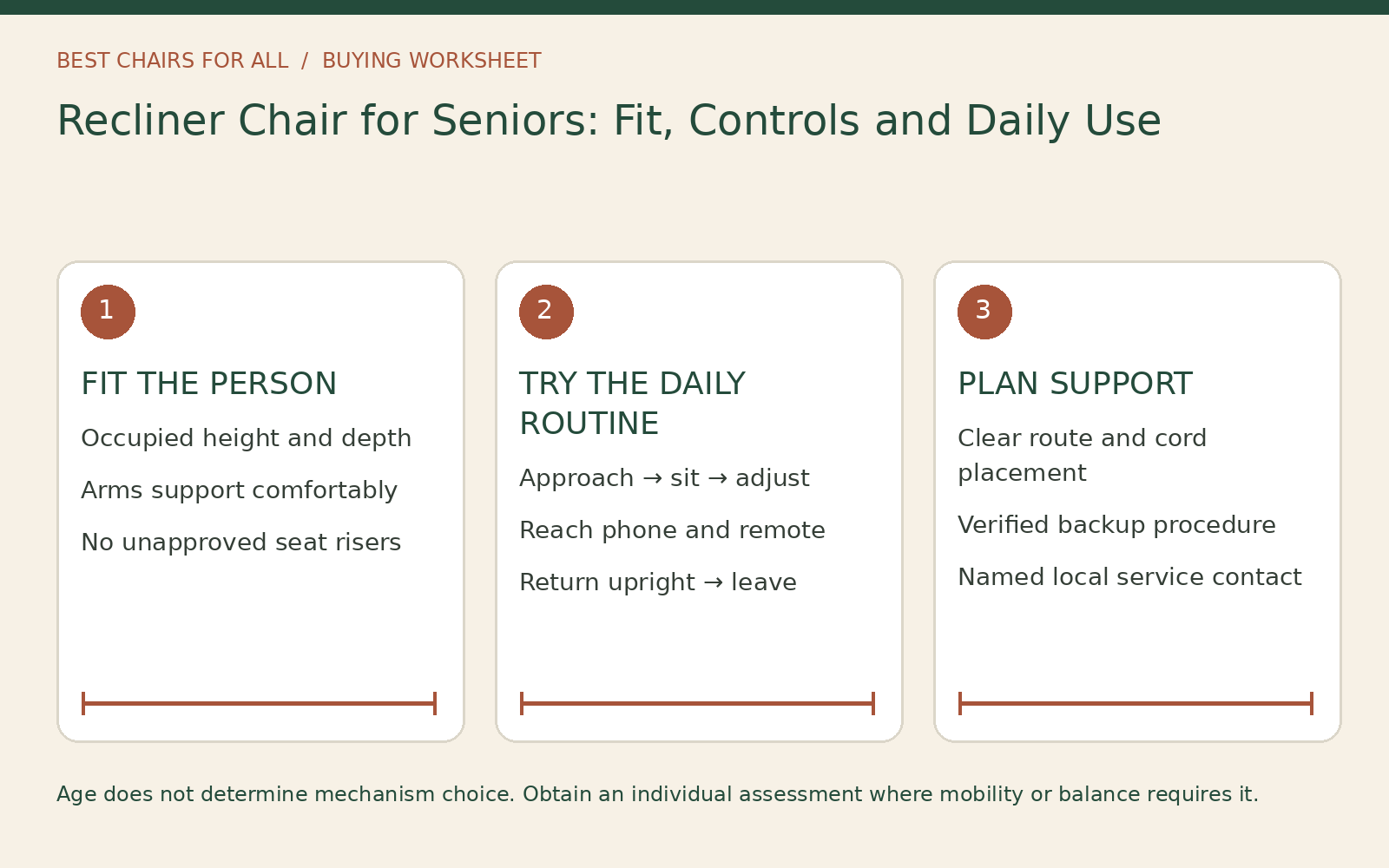
Our three candidates are La-Z-Boy Pinnacle Wall for a conventional stationary manual option, Golden MaxiComforter PR535-MED for a narrow-bodied lift chair with two main adjustment zones, and Pride VivaLift Ultra Medium for more detailed powered positioning. The practical tool below is a daily-routine checklist that includes controls, outage behavior, walking space and service responsibility. It is a buying aid, not a fall-prevention guarantee.
This is a research-based buying guide, not a hands-on test. We compared the linked manufacturer specifications and current product documentation on November 6, 2026. Recommendations reflect the fit and ownership tradeoffs below; published dimensions do not establish personal comfort, long-term durability or a medical outcome.
Chairs worth comparing for this use
1. La-Z-Boy Pinnacle Wall Recliner 016512
Best for: For independent users who prefer a manual chair.
Pinnacle Wall is worth comparing when the user does not need lift assistance and can operate a side handle. Its base does not rock, and its relatively modest 33-inch width can be easier to integrate beside existing furniture.
The manual Pinnacle Wall Recliner has a side handle and an independently reclining back. Its base does not rock. The maker lists three locking legrest positions; this is a different chair from the Pinnacle rocker, swivel glider and powered versions. The 18.5-inch seat height must be judged under the person’s weight. A lower seat can help feet settle yet be harder to stand from. The 19-inch seat width is also a real limitation; padded arms should not squeeze the user simply because the overall chair fits the room. See the model-specific source linked below.
Product Details
| Brand | La-Z-Boy |
|---|---|
| Overall dimensions | 33 W × 38.5 D × 41 H inches |
| Seat dimensions | 19 W × 21.5 D inches |
| Seat height | 18.5 inches |
| Fully extended | 66 inches |
| Wall clearance | Approximately 7 inches |
Pros
- Stationary base avoids unrequested rocking motion
- No power supply needed for normal manual recline
Cons
- Handle reach and legrest-closing effort can rule it out
- No stand-assist function
Choose this only after the intended user completes the ordinary sit, recline, close and stand sequence comfortably. Simpler controls are helpful when the underlying movement is also suitable.
La-Z-Boy Pinnacle Wall Recliner 016512 specifications and source details
2. Golden MaxiComforter PR535-MED
Best for: For a compact-width lift-chair comparison.
Golden PR535-MED offers a lift mechanism and two independently adjustable zones in a 32-inch-wide body. It provides a useful alternative to broad lift chairs when the room width is constrained.
The current PR535 medium sell sheet specifies two independently adjustable comfort zones, pocketed-coil seating and a 9-volt battery backup arrangement. Heat and vibration massage are optional. This model does not provide power-adjustable lumbar or an articulating headrest. The nominal 20-inch seat height and 19-inch depth do not automatically make it suitable for a short user. Compare the petite/small and medium dimensions with the dealer rather than ordering the medium by habit. This model needs 23 inches from the wall, which can dominate a small room. See the model-specific source linked below.
Product Details
| Brand | Golden Technologies |
|---|---|
| Capacity | 400 pounds |
| Seat dimensions | 21 W × 19 D inches |
| Seat height | 20 inches |
| Overall width | 32 inches |
| Rear clearance | 23 inches |
Pros
- Two main zones offer independent upper- and lower-body adjustment
- Published medium dimensions support a careful fitting
Cons
- No powered lumbar or articulating headrest
- Standard medium backup arrangement requires the specified batteries and maintenance
Choose this when the seat geometry and controller work for the user and the local dealer can explain installation, backup operation and service. Do not assume every PR535 size shares the same specifications.
Golden MaxiComforter PR535-MED specifications and source details
3. Pride VivaLift Ultra PLR-4955M
Best for: For users who can use detailed powered adjustments.
Ultra Medium includes more independent adjustment than the other candidates. Power headrest and lumbar may be useful when one fixed back shape does not suit the user’s preferred reading and television positions.
The medium Ultra has independent back and footrest movement, power headrest and lumbar, tilt, lift assistance, lithium battery backup, three heating pads and lower-back air massage. Small and large versions have different seat and clearance dimensions. The toggle remote, memory function and additional comfort controls need an actual learning trial. More functions can improve choice while making an unfamiliar controller harder to manage. Ask the user to demonstrate the actions rather than judging ease of use from the size of the buttons. See the model-specific source linked below.
Product Details
| Brand | Pride Mobility |
|---|---|
| Capacity | 400 pounds |
| Seat dimensions | 22.5 W × 21 D inches |
| Seat height | 19.5 inches |
| Overall width | 39 inches |
| Rear clearance | 15 inches |
Pros
- Independent posture adjustments and lift function
- Included lithium battery backup
Cons
- 39-inch overall width needs more room than the other candidates
- Multiple functions may be unnecessary or confusing for some users
Choose Ultra when the user can locate and operate its needed controls and its fit passes the same basic checks as a simpler chair. Leave optional sensations off until ordinary movement is understood.
Pride VivaLift Ultra PLR-4955M specifications and source details
The daily-routine checklist
Create six rows: approach, sit, adjust, reach essentials, return upright and leave. For each row, write who performs the action and whether anything needs moving first. A chair that works only after someone removes a table, retrieves the remote and shifts a walker has a different independence profile from a chair that supports the user’s normal routine without that help.
Check the occupied seat height and depth. The user should be able to settle back in an appropriate sitting position without the edge pressing uncomfortably behind the knees or the arms forcing the shoulders upward. If the chair needs an added cushion, evaluate the whole position again because raising the seat also changes foot support and arm height. Do not use furniture blocks or other unapproved height modifications.
For someone with balance difficulty, recent surgery or significant mobility limitations, ask an occupational therapist, physical therapist or other qualified professional to assess the transfer arrangement. The purchase should follow the person’s abilities and advice already received. This article does not teach a universal way to stand from a lift chair or position a walking aid.
Manual, coupled power and independent power solve different problems
A manual recliner is not automatically harder to use, and a powered chair is not automatically easier. A user may find a familiar handle intuitive but be unable to press the footrest closed comfortably. Another person may use a large powered toggle easily while struggling with smaller separate controls. Test both directions of movement and the ability to stop where desired.
A coupled powered mechanism commonly moves the back and leg support in a linked sequence. Independent zones allow more combinations, but the controller must make those choices understandable. Identify the movements the user actually needs. If the chair will mainly be used upright for television, a long list of deep-recline settings may add little practical value.
For lift assistance, clarify whether the person needs occasional help standing or a more comprehensive mobility arrangement. A chair that tips upward cannot guarantee balance once the user is standing. Appropriate professional assessment matters when there is a risk of falling, and the dealer should explain the mechanism without promising that it makes every transfer safe.
A controls trial without coaching
After the dealer explains the controller, let the intended user try a short routine without prompting at every step. Ask them to raise the feet, change to their preferred television angle, return upright and place the controller in its normal storage position. Watch for accidental button presses, difficulty reading symbols or trouble reaching the remote after it slips beside the cushion.
A memory setting can be useful, but confirm exactly what it stores and how the person recalls it. Do not assume it records every motor or that pressing it once returns the chair to the same place on every model. Record the explanation in a simple note if the user wants one, and keep the full manual accessible for troubleshooting.
Heat and massage are secondary choices. If they are not needed, a model without them can reduce the controller burden. If they are desired, check whether each can be stopped independently and ask about warnings relevant to the user’s sensation and health. Do not leave heating active for sleep or treat a timer on another function as a universal automatic shutoff.
Room layout: a lift chair needs an approach zone
Measure the full movement envelope, then separately mark the space the user needs to approach and leave. A rear clearance number only describes part of that plan. Golden Medium’s 23-inch rear requirement may be more limiting than its narrow overall body, while Ultra Medium needs 15 inches behind its 39-inch-wide body. Neither should be pushed against the wall by visual guesswork.
The National Institute on Aging recommends keeping cords near walls, arranging furniture away from walking paths, placing frequently used objects within reach and choosing suitable chair heights. Apply that guidance to the entire corner: lamp, rug, charging cable, side table and route to the bathroom. Check the setup with the lighting normally used in the evening.
Leave the power supply accessible as the manual requires, and keep walking aids out of moving linkages. Children and pets should not be underneath or behind the chair during operation. If the user cannot readily check that space, the household needs a workable routine rather than assuming a quiet motor is harmless.
The outage and service worksheet
Ask three specific questions: what powers the chair during an outage, what movements that backup supports, and how its batteries are checked or replaced. Ultra includes lithium backup; the current Golden medium sheet lists a 9-volt arrangement, while some wide Golden variants use lithium. This distinction is why a family-level model name cannot settle the backup plan.
Ask the dealer to show the manufacturer-approved procedure and provide the relevant manual. Do not promise yourself a particular number of return cycles without written documentation for the exact unit. If a person depends on powered movement, discuss the outage arrangement with the people involved in their care and choose service support accordingly.
Check recall information for the precise model and production label, particularly for used or clearance chairs. The 2026 CPSC Joy Furniture notice identifies certain powered Talan and Royce models with overheating switches; it is not a recall of the three candidates in this guide. Save model labels and the service contact at delivery. A dependable ownership arrangement includes an understandable controller, a clear walking route and someone accountable for repair—not merely a long warranty heading.
Make the handover understandable
At installation, ask the intended user to repeat the agreed daily routine while the installer is still present. Identify the remote’s storage position, the approved power connection and the service telephone number. Have the dealer explain the exact backup procedure to the people who will need it, rather than leaving an unopened manual in another room. If the user cannot complete a movement that worked in the showroom, check the installed floor, layout and configuration before accepting the result. The goal is a usable chair in this home, with clear responsibility for any correction it needs.
Research sources
Sources were checked November 6, 2026. Configuration, stock and prices may change. La-Z-Boy Pinnacle Wall specifications; Golden PR535 current manufacturer sell sheet; Pride Ultra specifications and functions; National Institute on Aging: preventing falls at home; CPSC May 2026 powered-furniture recall.
Something unclear or out of date? Send a correction with this article’s title and the detail to check.
Sources, research & corrections policy ↗