As an Amazon Associate, we earn from qualifying purchases. Read our affiliate disclosure. Amazon buttons open matching-model searches; verify the seller, exact version and checkout total.
Evaluate the powered system as a whole
The best power lift recliner makes the required movements understandable and available in the home where it will operate. A long list of motorized functions is not enough. The controller, ordinary power connection, backup behavior, approved servicing and actual seat fit determine whether those functions are useful. A powered lift also does not establish that an individual can stand or transfer independently.
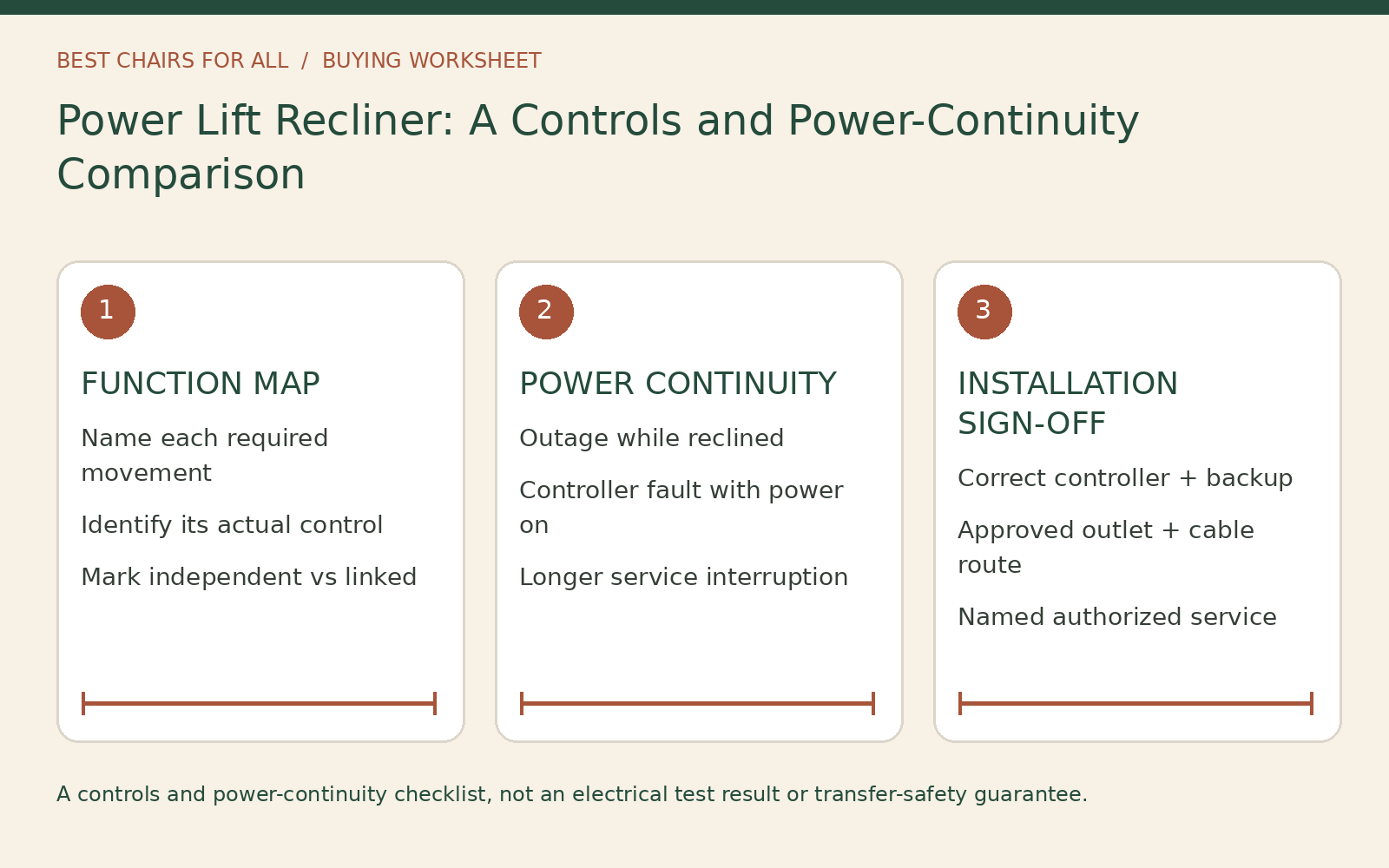
Pride VivaLift Ultra Medium is the detailed-control candidate, Golden MaxiComforter PR535-MED is the two-zone candidate in a narrower body, and MCombo 7890 Medium is the independently moving back-and-footrest alternative. This guide uses a function map and a power-continuity checklist, with no claim of hands-on electrical testing, medical benefit or guaranteed independent use.
This is a research-based buying guide, not a hands-on test. We compared the linked manufacturer specifications and current product documentation on November 6, 2026. Recommendations reflect the fit and ownership tradeoffs below; published dimensions do not establish personal comfort, long-term durability or a medical outcome.
Model specification links: Pride VivaLift Ultra PLR-4955M; Golden MaxiComforter PR535-MED; MCombo 7890 Series Dual Motor Fabric Lift Recliner.
Chairs worth comparing for this use
1. Pride VivaLift Ultra PLR-4955M
Best for: For a broad set of independent powered functions.
Ultra Medium is the most relevant comparison when one linked motion cannot produce the position the user wants. Headrest, lumbar, back and leg support can be investigated separately, with tilt and lift adding other movements.
The medium Ultra has independent back and footrest movement, power headrest and lumbar, tilt, lift assistance, lithium battery backup, three heating pads and lower-back air massage. Small and large versions have different seat and clearance dimensions. Its memory feature may reduce repetitive adjustment after it is correctly programmed, but the user still needs to understand how to stop and return to the ordinary sitting position. The documented lithium backup is useful evidence for an outage discussion; it is not a promise of unlimited operation without mains power. The model-specific specification source is linked in this guide.
Product Details
| Brand | Pride Mobility |
|---|---|
| Capacity | 400 pounds |
| Seat dimensions | 22.5 W × 21 D inches |
| Seat height | 19.5 inches |
| Overall width | 39 inches |
| Rear clearance | 15 inches |
Pros
- Separate positioning functions and programmable memory
- Lithium backup included in the documented system
Cons
- More functions create a larger control-learning task
- Medium fit and 400-pound rating remain independent screening requirements
Choose Ultra for an identified adjustment need, then test the controller as seriously as the cushion. Do not let charging, heat or massage features distract from a difficult basic movement sequence.
2. Golden MaxiComforter PR535-MED
Best for: For a focused two-zone powered comparison.
PR535-MED provides two independently adjustable comfort zones in a 32-inch-wide chair body. It is worth comparing when a user wants separate upper- and lower-body control without the full set of powered head and lumbar adjustments.
The current PR535 medium sell sheet specifies two independently adjustable comfort zones, pocketed-coil seating and a 9-volt battery backup arrangement. Heat and vibration massage are optional. This model does not provide power-adjustable lumbar or an articulating headrest. Its fixed head and lumbar contours need to fit from the start. The current medium sheet lists 9-volt backup, while wide variants use a different arrangement. Ask the provider for the exact supplied configuration and procedure rather than interpreting the entirePR535 range as one electrical system. The model-specific specification source is linked in this guide.
Product Details
| Brand | Golden Technologies |
|---|---|
| Capacity | 400 pounds |
| Seat dimensions | 21 W × 19 D inches |
| Seat height | 20 inches |
| Overall width | 32 inches |
| Rear clearance | 23 inches |
Pros
- Two main positioning zones keep the comparison focused
- Narrower overall body than Ultra Medium
Cons
- No articulating headrest or powered lumbar in the current sheet
- Backup specifications vary across sizes
Choose the medium Golden when its controller and body fit solve the task. RecordMEDon the order so a larger, wider or differently powered variant is not treated as a straightforward substitute.
3. MCombo 7890 Series Dual Motor Fabric Lift Recliner
Best for: For independent back and leg movement with fewer posture extras.
The current 7890 Medium Coffee Brown configuration lists a 350-pound capacity, separate back and footrest movement and a 165-degree maximum recline. Those are useful facts for a function comparison, regardless of the sleeping terminology in some listings.
MCombo’s fabric 7890 series provides separately controlled back and leg support, cupholders, side pockets and USB charging. The collection page includes several size codes; identify the exact size and load rating before placing an order. The series page combines multiple sizes, so obtain the exact dimensions, controller and outage instructions for the selected SKU. The known independent movement does not establish powered headrest, powered lumbar or a supplied backup battery. Leave those worksheet entries unconfirmed unless the seller supplies matching documentation. The model-specific specification source is linked in this guide.
Product Details
| Brand | MCombo |
|---|---|
| Maximum recline | 165 degrees |
| Movement | Independent powered back and footrest; lift |
| Footrest extension | 4.7 inches |
| Comfort extras | 8 vibration points; lumbar heat |
| Capacity | 350 pounds on the current Medium configuration |
Pros
- Independent back and footrest adjustment
- Specific Medium configuration and capacity can be identified
Cons
- Grouped family listings can hide differences between variants
- Backup behavior is a required seller question
Choose 7890 when its documented functions match the requirement and the missing installation details are resolved. Do not add an assumed capability merely because another MCombo chair offers it.
Draw a function map, not a motor-count ranking
Write each required body movement on a separate line: feet, back, head, lumbar contact and lift. Then mark the actual control beside it. Use another column for whether movement is independent or part of a sequence. This map captures what a motor count omits: which part moves, how the user chooses it and what other parts move at the same time.
For Ultra, the map contains separate head and lumbar functions as well as independent back and footrest movement. For Golden Medium, it contains two main comfort zones and a fixed head-and-lumbar shape. For 7890 Medium, it contains independent back and footrest control; other functions require exact documentation. The models should be compared on these differences rather than placed in a simple more-motors-is-better order.
Keep optional sensations outside the core map. Heat and vibration can be preferred comfort extras, but they do not make a controller easier to understand or establish an appropriate lift movement. If a user only needs a supported television position and an assessed lift function, additional adjustments should earn their place by solving a concrete problem.
The controller acceptance sequence
Have the dealer explain the exact supplied controller, then ask the intended user to demonstrate the functions they need. Record whether the labels are readable, the buttons require manageable pressure and the cable or storage position keeps the handset accessible. The test should include stopping movement at an intermediate position and returning to ordinary sitting, not only reaching full recline.
A useful memory setting is not a replacement for understanding the basic controls. Confirm what the memory stores, how it is recalled and whether the user can stop it according to the manual. Do not apply a programming sequence from a different handset in the same brand. A family can include different control generations and feature packages.
If the user needs help, record that openly in the purchase plan. A chair that works with agreed assistance can still be appropriate; a chair advertised as easy is not proof of independent operation. Where cognitive, hand-function or mobility concerns are relevant, involve a qualified professional and authorized provider in choosing and explaining the system.
Three power-continuity scenarios to resolve
Scenario one is an ordinary local outage while the chair is reclined. Ask which approved backup or return procedure applies to the exact unit and which motions remain available. Scenario two is a controller that stops responding while mains electricity remains on. Ask who diagnoses it and what the household should do. Scenario three is a longer interruption or service delay. Ask how the user’s needs will be met without depending on an unverified promise about battery endurance.
Ultra’s documented lithium backup answers the first hardware question but not every practical question. Golden Medium’s 9-volt listing requires its own procedure and maintenance explanation. For 7890, obtain written backup information instead of assuming a battery is included. Different electrical arrangements deserve different answers.
Do not force a powered legrest, bypass a switch or open a loaded chair’s electrical components to improvise a return. Demonstrations and troubleshooting should follow the supplied manual and provider guidance. If the person relies on powered movement, the contingency arrangement should be discussed before purchase, when changing models or support plans remains possible.
Power installation is a physical room decision
Mark the outlet, transformer location and full cable route on a room drawing. The chair needs to move through its approved range without pulling a connector, trapping a lead or crossing a walking path. A convenient socket behind a sofa may be unsuitable if reaching it requires hiding a transformer in an enclosed or inaccessible location.
Follow the specific manual’s connection requirements. Pride’s current owner’s manual prohibits an extension cord for the documented installation and describes an accessible, ventilated transformer location. Do not generalize another chair’s electrical instructions or use an unapproved replacement supply because the plug appears to fit. If the room needs electrical changes, arrange appropriate professional work.
A USB charging port is a secondary device feature, not evidence of a suitable mains installation or backup system. Route phone leads away from the mechanism too. Remove unnecessary accessories from the movement area, and check that the controller remains reachable when a table, lamp and normal household belongings are placed around the chair.
Separate battery maintenance from component repair
Ask the provider what routine battery checks the household is expected to perform and what requires service. Keep the correct instructions accessible. Do not invent a replacement interval or substitute a battery chemistry based on a generic online recommendation. A manufacturer-approved backup component is part of a specific system.
Ask how the seller distinguishes a handset issue, a power-supply issue and a mechanism issue, and whether diagnosis happens remotely or in the home. That is a service question rather than an invitation for the buyer to dismantle powered equipment. Record the supplied model and serial information where it can be shared without moving an occupied chair.
Warranty years do not reveal every responsibility. A plan covering a component may exclude a visit, labor or transport. Clarify those items and the process for obtaining help. The practical value of powered features depends partly on a provider who can identify the right component and restore the intended operation through approved service.
A final system sign-off
At installation, match the chair, controller and backup arrangement with the order and demonstration. Have the installer explain the approved stopping and return functions, where the handset belongs and whom to contact if operation changes. Keep optional heat off during the basic acceptance check; Pride’s manual also prohibits using its heat function during sleep.
Check current recall information against the exact production labels when buying used or clearance powered seating. The CPSC’s specific 2026Joy Furniture recall illustrates why a powered-furniture headline must be matched to models rather than treated as a statement about the whole category.
Choose Ultra when its added independent adjustments and controller are useful, Golden Medium when its focused two-zone system and fit suit the user, or 7890Medium when its documented independent back and leg movement meets the task. Approve the system only after the function map, power-continuity answers and installed cable plan are complete.
Research sources
Sources were checked November 6, 2026. Configuration, stock and prices may change. Pride Ultra Medium functions and lithium backup; Golden currentPR535-MED control and backup matrix; MCombo 7890 Medium independent positioning; Pride current power connection and operation instructions; CPSC specified 2026 powered-furniture recall.
Something unclear or out of date? Send a correction with this article’s title and the detail to check.
Sources, research & corrections policy ↗