Affiliate disclosure: As an Amazon Associate, Best Chairs for All earns from qualifying purchases. Read our disclosure. Amazon links below open matching US search listings; check the exact model, seller, configuration, availability, and checkout terms.
The best office chair is the one that lets you use your desk without fighting the seat. For a typical home office, I would begin with an appropriately configured Haworth Soji, compare Steelcase Series 1 if you need a shorter functional seat, and consider Herman Miller Aeron when suspension seating is a deliberate preference. Those are three different fit strategies, not a universal comfort ranking.
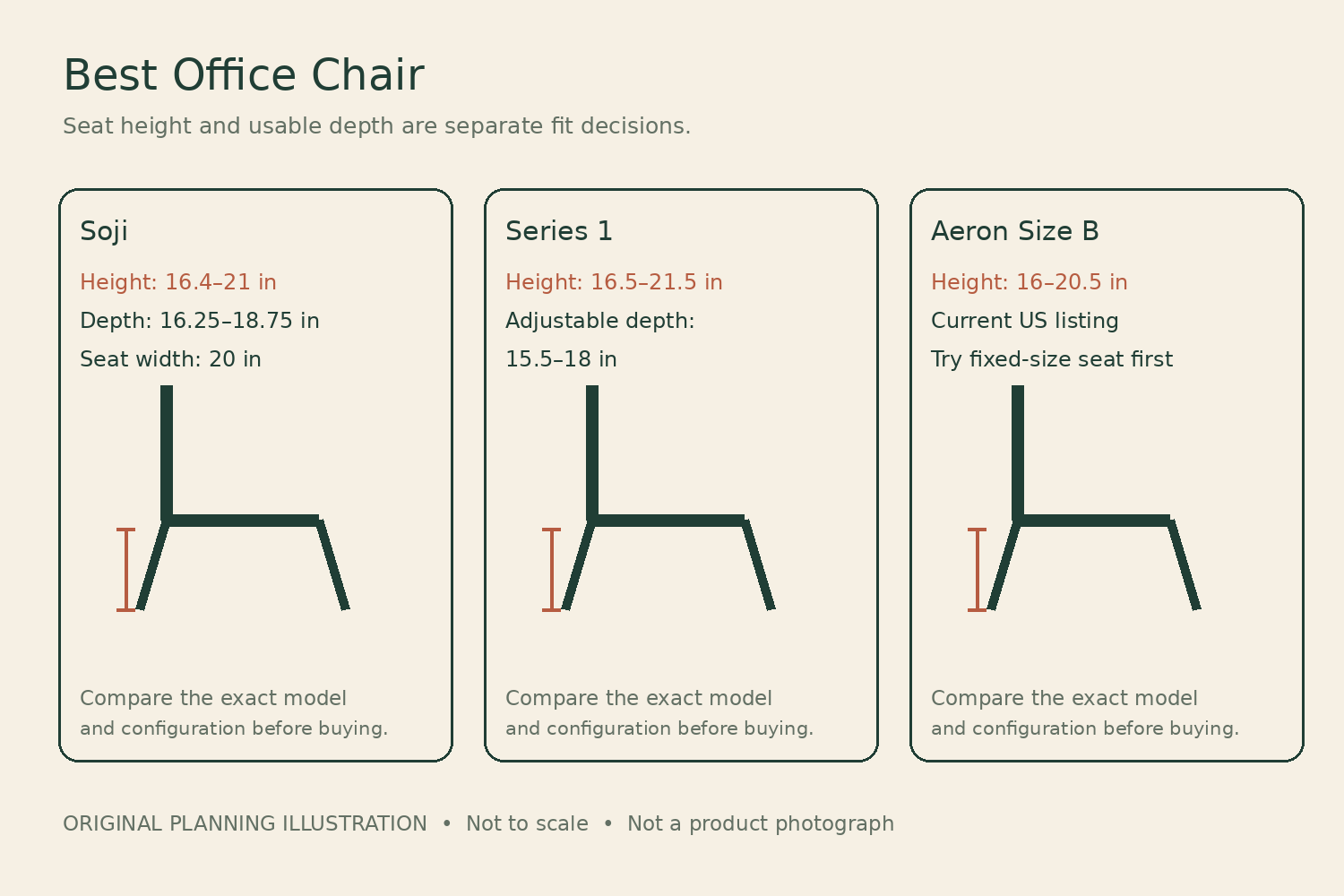
This guide compares manufacturer specifications and current US product listings checked November 6, 2026. It is research, not a report of hands-on testing. We do not invent comfort scores, durability results, discount prices, or claims that a chair will treat pain. Availability statements describe the sources checked; Amazon search results can include different models and third-party sellers.
Start with the fit problem you actually have
Write one sentence about your current chair before shopping. “My feet hang when my elbows reach the keyboard” points toward a workstation-height problem. “The front cushion presses into the back of my knees” points toward excessive usable seat depth. “The armrests push me away from the desk” may mean the arms are too tall, too wide, or blocked by a desk apron. Buying a more expensive version of the same geometry rarely resolves these conflicts.
Separate body fit from room fit. Seat width describes where you sit; overall width determines whether the chair can turn beside a cabinet. Seat height determines the leg position; arm height above the floor determines whether you can roll under the desk. A chair can succeed at one and fail at another. Record both sets of numbers before deciding how much adjustment you need.
Quick comparison: three defensible starting points
| Chair | Primary reason to shortlist | Published seat measurements | Main compromise |
|---|---|---|---|
| Haworth Soji | Adjustable padded-seat fit | 16.4–21 in height; 16.25–18.75 in depth | Arms and support options vary |
| Steelcase Series 1 | Shorter usable depth | 16.5–21.5 in standard height; 15.5–18 in adjustable depth | Compact seat and configuration differences |
| Aeron Size B, current US listing | Suspension seating | 16–20.5 in height; 16.75 in listed depth | Fixed-size seat perimeter |
These figures come from Haworth’s Soji listing, the Steelcase Series 1 guide, and the current US Aeron listing. The depth labels are not perfectly interchangeable: Steelcase distinguishes the adjustment range from the physical pan. Use a sit or a seller’s dimension drawing to settle a close fit decision.
1. Haworth Soji Office Chair
Best for: Best starting point for adjustable fit.
Soji is my first shortlist choice for a conventional home office because its seat moves in both height and depth. That makes it possible to compare the chair with your legs rather than guessing from your overall height. Haworth publishes a 20-inch seat width, a 16.4–21-inch height range, and 2.5 inches of depth travel. These are useful dimensions for someone moving from an inexpensive chair whose only meaningful adjustment was a height lever.
The attraction is the combination of a padded seat and configurable support. Order carefully: Haworth describes the 4D arms, adjustable lumbar support, and forward tilt as options. An Amazon listing with the same model name may not contain the configuration pictured elsewhere. A 28-inch overall width also means this is not automatically the neatest choice for a narrow desk alcove. The manufacturer's current US store has an orderable listing, but retailer lead times and colors need a separate check.
Product Details
| Brand | Haworth |
|---|---|
| Seat height | 16.4–21 inches |
| Seat width | 20 inches |
| Seat depth | 16.25–18.75 inches |
| Overall width | 28 inches |
| Rated user weight | 350 lb |
| Warranty | 12-year limited; terms apply |
Pros
- Seat depth can be fitted to thigh length
- Padded seat with a mesh-back option
- Published dimensions make comparison straightforward
Cons
- Important controls depend on configuration
- Overall width needs a real desk-clearance check
Choose Soji if you want to establish a sensible baseline before paying for a premium specialty design. Skip a stripped-down listing when adjustable arms or lumbar support are central to your plan. Haworth advertises a 12-year warranty; confirm that your seller and exact chair qualify, since a direct-store trial should not be assumed to follow a marketplace purchase.
2. Steelcase Series 1 Office Chair
Best for: Best for a shorter seat and compact frame.
Series 1 deserves attention when front-edge pressure is the reason your present chair fails. Its US specification guide describes adjustable seat depth, 15.5–18 inches, separately from the physical seat pan. That distinction matters: the visible cushion is not the same as the supported distance available to your thighs. The standard cylinder gives a 16.5–21.5-inch seat-height range. Specialty cylinders exist, so use the listing's actual part configuration rather than assuming every Series 1 sits equally low.
Its adjustable-width arms can reduce the overall width to a published 23.5 inches, rising to 27 inches as they move outward. This makes the chair interesting for a small workstation, provided the arm position that fits your body also fits the desk. The compact frame is a tradeoff for someone who wants a broad lounge seat. We found a current US Steelcase store listing, but did not independently confirm every upholstery combination or Amazon seller's inventory.
Product Details
| Brand | Steelcase |
|---|---|
| Standard seat height | 16.5–21.5 inches |
| Adjustable seat depth | 15.5–18 inches |
| Seat width | 19.5 inches |
| Overall width | 23.5–27 inches |
| Warranty | Limited lifetime framework; component terms vary |
Pros
- Short functional seat-depth setting
- Width-adjustable arms help align elbows
- Detailed US specification drawing
Cons
- Compact seat will not suit every body
- Cylinder and arm options must be verified
Buy Series 1 for a fit requirement, not simply because it is a Steelcase. Ask the seller to identify the standard or optional cylinder, and check the warranty against your purchase route. Steelcase's limited lifetime wording is a framework with component-specific periods, not a promise that fabric and every moving part receive identical lifetime coverage.
3. Herman Miller Aeron Chair Size B
Best for: Best premium choice for suspension seating.
Aeron is the specialist option here for people who prefer a suspension seat to upholstery. Its three-size system is also useful when one adjustable seat cannot deliver the relationship you want between the backrest and front edge. For the current US Size B listing checked, Herman Miller publishes a 16–20.5-inch seat-height range, 27-inch width, and 350-pound capacity. Older Aeron sheets show different ranges, so do not merge classic, remastered, and current specifications into one imaginary chair.
The firm perimeter around the suspension seat makes accurate sizing particularly important. Someone who likes sitting sideways or folding a leg under themselves should try that posture before committing. The current direct listing was orderable with a lead time; that does not establish immediate Amazon availability. Back support, tilt options, arm adjustment, and casters also vary. A bargain listing may describe a used or refurbished chair rather than the current model used for this comparison.
Product Details
| Brand | Herman Miller |
|---|---|
| Current Size B seat height | 16–20.5 inches |
| Current Size B width | 27 inches |
| Current Size B listed depth | 16.75 inches |
| Current Size B weight capacity | 350 lb |
| Warranty | 12-year limited; terms apply |
Pros
- Suspension seat and back instead of a foam cushion
- Three sizes allow a different approach to fit
- Current direct listing includes 12-year warranty terms
Cons
- Rigid perimeter makes size choice consequential
- Used and current versions are easily confused
Choose Aeron after a real sit if you value ventilation and enjoy the seat's particular feel. Its price buys a design and service proposition, not a guaranteed personal comfort result. For marketplace purchases, have the seller identify model generation, size, condition, and warranty eligibility in writing before comparing the total cost.
Your office-chair measurement worksheet
Use a firm chair, your normal work shoes, a tape measure, and a helper if possible. The worksheet is a way to narrow the shortlist; soft upholstery compresses, bodies move, and manufacturers measure differently. If a result sits on the boundary of a product range, treat that as a reason to try the chair rather than round the number in its favor.
- Lower-leg fit: measure from the floor to the underside of your thigh near the knee while your foot rests comfortably. Compare that starting point with the chair’s seat-height range. Account for cushion compression during an actual sit.
- Usable depth: measure from the back of your buttocks to the knee crease. The seat needs to support your thighs while leaving comfortable clearance behind the knees. Check whether the published depth includes a back cushion or means functional seat depth.
- Seated width: measure the space occupied by your hips in ordinary clothing. Compare it with the usable seat and space between the arms. Overall frame width is a separate number.
- Desk opening: measure width, height under any apron, and available depth. Include the base, turning room, and armrests at the height you intend to use.
- Work position: sit at the actual keyboard and mouse. Record whether your shoulders relax, your elbows remain near your body, and your feet have support at the required desk height.
Before comparing the three fit strategies, use the office-chair measurement worksheet and keep your usable seat depth and desk working height beside the shortlist.
For a shared chair, repeat the worksheet for each person. A range that overlaps both sets of numbers is more useful than a feature that only one person can reach. Photograph the successful settings or write them on a small setup card. A highly adjustable chair that gets reset randomly can be less useful than a simpler chair everyone understands.
Which adjustments deserve your money?
Seat depth is especially valuable when people of different proportions share a desk. Arm adjustment matters when you use a mouse heavily or need to get close to a narrow keyboard. Back support needs to meet your body where you actually sit, without requiring you to perch on the seat edge. More aggressive lumbar shaping is not automatically better; the useful setting is one you can tolerate through ordinary tasks.
Recline is a separate decision from seat fit. Test whether you can lean back without bracing your feet, and whether returning upright feels controlled. A tilt limiter is not always an angle lock. Ask what the control actually does rather than accepting an adjustment count. Ten controls are not ten benefits if several duplicate movements you never use.
Choose casters for your floor and the manufacturer’s compatibility guidance. A rug can change both rolling effort and the effective stability of a light base. Keep enough free space to move away from the desk without catching a wheel. A chair’s attractive measurements on an empty floor do not describe the same chair squeezed between a printer stand and a filing cabinet.
Warranty, trial, and the real purchase decision
Keep warranty coverage and return permission separate. A warranty normally addresses qualifying defects; it does not promise that the chair will feel right. A return policy is where discomfort, fit, packaging, fees, and deadlines are decided. Check whether you must dismantle the base, keep the carton, pay return freight, or use a specific carrier. Large-chair return costs can erase an apparently attractive discount.
The Steelcase warranty page separates regional and purchase-route documents. Haworth’s direct-store trial and Herman Miller’s direct return terms should likewise be checked against the actual seller. Save the order confirmation, model label, configuration list, and written warranty terms. “Manufacturer warranty” in a listing is a starting question, not complete evidence of eligibility.
Questions buyers should settle before ordering
Is mesh better than a padded seat?
It depends on the feel and geometry you want. Suspension seating avoids a thick foam cushion, but it introduces a defined supporting surface and often a firm perimeter. Upholstery can offer a more forgiving edge, while also changing as the cushion compresses. Try your normal clothing and sitting positions. Material preference cannot compensate for an unsuitable seat depth.
Can a footrest fix a chair that sits too high?
It can support the feet when desk height requires a higher sitting position, provided the rest is stable and fits the available space. It cannot shorten a seat that is too deep or move armrests that are too wide. Treat the desk, chair, keyboard, and foot support as a system, then check that you can enter and leave the position easily.
What should happen during the return window?
Keep the packaging and use the chair for your ordinary mix of typing, calls, reading, and leaning back. Change one setting at a time and make brief notes about the result. If the fit remains wrong after a reasonable adjustment process, act before the return deadline. Do not keep a costly mismatch solely because a prestigious brand was supposed to work.
My purchase order would therefore be simple: measure, choose the configuration, verify the seller’s terms, and test the chair in your own workstation. Soji is the broad adjustable starting point, Series 1 is the compact-depth alternative, and Aeron is the suspension option to choose deliberately after checking its size.
Something unclear or out of date? Send a correction with this article’s title and the detail to check.
Sources, research & corrections policy ↗