As an Amazon Associate, we earn from qualifying purchases. Read our affiliate disclosure. Amazon buttons open searches for matching listings; they do not confirm seller, configuration, price or stock.
Buy the right caster configuration, then protect the floor system
The best office chair for hardwood floors is an appropriately fitted chair ordered with casters specifically intended for hard surfaces, used on a clean rolling path and with any protection required by the flooring maker. The chair brand alone cannot promise a scratch-free floor. Our shortlist is Herman Miller Aeron with the appropriate hard-floor caster option, Steelcase Series 1 with soft dual-wheel roll-control casters, and Humanscale Freedom configured with soft casters for hard surfaces.
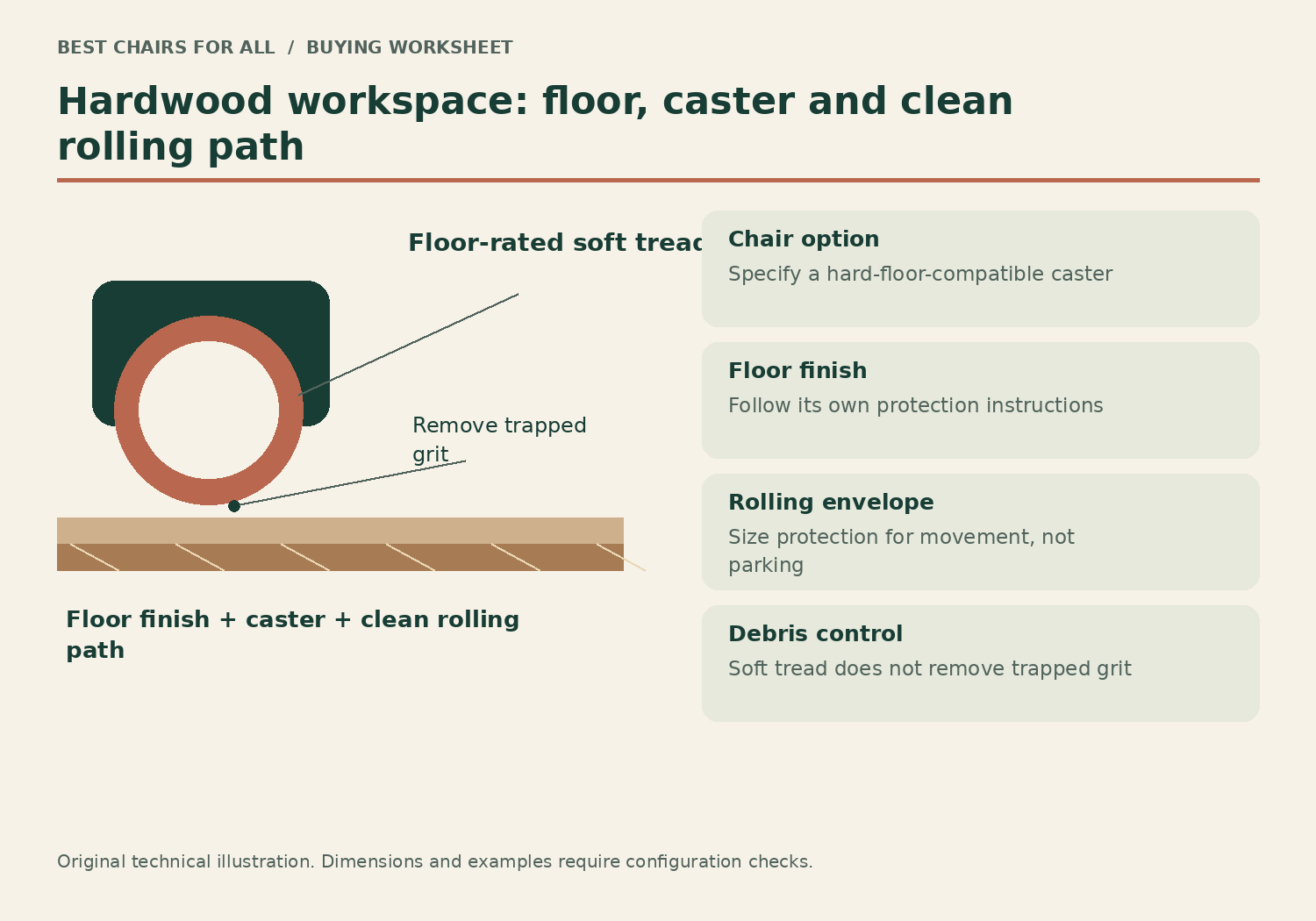
These selections are based on manufacturer option documentation and flooring care guidance checked November 6, 2026. We have not rolled these chairs across test panels, measured noise or tested resistance to scratching. Hardwood species, finish, debris, occupant load and mat compatibility all affect the outcome. Treat floor protection as a configuration and maintenance decision rather than a special property implied by a chair’s upholstery.
| Chair configuration | Manufacturer evidence | Purchase gate |
|---|---|---|
| Aeron with hard-floor-compatible casters | Herman Miller caster and floor-type documentation | Confirm selected caster, exact chair generation |
| Series 1 with soft roll-control casters | Steelcase specifies soft option for hard floors | Standard hard carpet casters are not the chosen build |
| Freedom with soft hard-surface casters | Humanscale configurator lists that selection | Save the full configured order |
Three configurable chairs, rather than universal floor-safe claims
Each candidate can be a good office chair for the right person, but this shortlist is about its documented caster option. A seller shipping the standard carpet wheel has not supplied the configuration described here. Read the option text in the cart and retain it on the invoice; product photography may not show the difference reliably.
Model specifications and ordering details were checked against Herman Miller Aeron US product and options, Herman Miller 2026 caster and flooring specification book, Steelcase Series 1 US product and options, Steelcase Series 1 dimensional specification guide, Humanscale Freedom Headrest official configurator, Brentwood Hills hardwood floor care and caster requirements, Bruce hardwood flooring care and protection. These manufacturer documents support the configuration notes in this comparison; retrieved November 6, 2026.
1. Herman Miller Aeron with hard-floor-compatible caster option
Best for: a sized mesh chair ordered with a documented hard-floor caster.
Aeron offers several size and configuration choices, including caster options for different floor conditions. Herman Miller's documentation describes hard-floor-compatible designs with soft tread; select the option appropriate to the specific Aeron chair rather than assuming every standard wheel is the same.
The all-mesh seat and back are personal fitting choices unrelated to floor protection. Select the A, B or C frame first, then verify the current caster code and intended surfaces in the order. A carpet-only listing or an unspecified used-chair wheel does not satisfy the floor configuration described in this guide.
Product Details
| Brand | Herman Miller |
|---|---|
| Caster requirement | Select current hard-floor-compatible option |
| Seat | Mesh; A/B/C sizing |
| Verification | Confirm exact caster code and floor description |
Pros
- Documented floor-specific caster choices
- Multiple frame sizes
Cons
- Exact generation and caster must match
- No guarantee against grit or finish damage
Choose the complete hard-floor-compatible configuration only after the frame fits and the flooring guidance is understood.
2. Steelcase Series 1 with soft roll-control casters
Best for: a sliding-seat chair with an explicit soft-caster option.
Series 1's official specification distinguishes standard hard carpet casters from optional soft dual-wheel roll-control casters for hard floors or chair mats. That is unusually useful wording for a buyer trying to avoid ambiguous universal-wheel claims.
Before choosing the rolling setup, check how to protect hardwood floors from office chairs, including cleaning grit and confirming wheel or mat compatibility with the floor finish.
Its seat-depth adjustment and cylinder options still need fitting to the user. Save the soft-caster choice on the order, especially when comparing quick-ship marketplace builds. Roll control is a specific mechanism feature rather than proof that the chair cannot move unexpectedly on every sloped or slippery surface.
Product Details
| Brand | Steelcase |
|---|---|
| Caster requirement | Optional soft dual-wheel roll-control |
| Intended surfaces | Hard floors or chair mats per cited guide |
| Standard caster | Hard carpet wheel is a different selection |
Pros
- Clear manufacturer caster distinction
- Seat and cylinder fitting options
Cons
- Standard build may ship different wheels
- Floor mat requirements still come from the floor maker
A strong comparison when both short-seat adjustment and an explicitly specified hard-floor wheel are priorities.
3. Humanscale Freedom with soft hard-surface casters
Best for: an upholstered chair configured with soft hard-surface casters.
Humanscale's Freedom configurator includes a Soft Casters for Hard Surfaces selection. Its movement-linked headrest and back-mounted arms offer a different task-chair experience from the mesh Aeron or the more compact Series 1. The caster choice should be retained in the complete order specification.
Do not let the attractive support mechanism distract from usable seat height, depth and room clearance. A configured chair can have different return terms from an in-stock standard product. This is a recommendation to investigate the appropriate caster build, not a claim that its wheels have been independently tested by us on your hardwood finish.
Product Details
| Brand | Humanscale |
|---|---|
| Caster requirement | Soft Casters for Hard Surfaces |
| Configuration | Save complete selected build |
| Floor requirement | Follow actual flooring care plan |
Pros
- Official soft hard-surface selection
- Coordinated chair support approach
Cons
- Configured return terms need checking
- Chair fit and floor care remain separate requirements
Consider it when the whole chair suits your tasks and the selected caster meets the actual floor policy.
Understand the confusing hard-floor terminology
Hard-floor casters are usually described by the surface they are intended for, while soft casters describes a wheel tread characteristic. Those phrases can point to the same intended use. A hard wheel is not automatically the right wheel for a hard floor. Steelcase’s Series 1 documentation explicitly describes hard dual wheels for carpet and the soft roll-control option for hard floors or chair mats.
Herman Miller’s caster documentation similarly distinguishes carpet-only choices from hard-floor-compatible designs with softer tread. Its option codes and availability vary by chair, so do not buy a caster solely because an unrelated Herman Miller model uses a similarly named wheel. Match the chair, selected caster code and floor description together.
The size and material of a replacement wheel are not the whole compatibility question. Stem fit, approved load, rolling resistance, clearance and effect on seat height all matter. An aftermarket wheel advertised as universal may not be appropriate for every base or floor finish. Ask the chair manufacturer about a supported replacement instead of assuming a soft-looking wheel is an upgrade in every respect.
The floor-and-caster purchase worksheet
Start by identifying the floor rather than guessing from its appearance. Is it solid hardwood, engineered hardwood, laminate or another wood-look surface? What finish and care policy apply? Obtain the flooring maker’s current instructions or ask the installer when uncertain. A cleaner or mat approved for one surface is not automatically approved for another.
Next record the exact chair caster option and whether the flooring guidance requires a protective mat. Brentwood Hills’ cited care plan specifies a wide barrel-type roller made of non-marking hard rubber, with additional dimensions and material restrictions. That can be stricter than a chair maker’s general hard-floor description. None of these shortlisted caster builds is automatically approved for that particular floor; ask the flooring maker to confirm the actual tread and geometry. Follow the policy for your installed product.
Finally draw the rolling envelope: the area covered by all wheels while you approach the desk, turn and roll back to stand. A mat sized only for the parked chair can leave wheels crossing its edge during normal use. Include transitions, nearby thresholds and the path to storage if you routinely move the chair between tasks.
| System part | Question to resolve | Evidence |
|---|---|---|
| Floor | Which product and finish are installed? | Flooring care instructions |
| Caster | Which exact hard-floor option ships? | Configured chair order or part number |
| Protection | Is a compatible mat required? | Floor-maker and mat-maker compatibility |
| Rolling envelope | Where do the wheels travel during use? | Measured normal movement at the desk |
| Cleaning | How will grit be removed without finish damage? | Material-specific care plan |
A worked mat-sizing example
Suppose a chair’s wheelbase occupies roughly 28 inches across when parked. During normal exit the user rolls back another 18 inches and turns toward a cabinet. A small square mat that barely surrounds the parked base will not contain that movement. The relevant measurement is the full wheel path in both the forward work position and the backward exit position.
Mark those outer wheel positions using paper or another floor-approved temporary method, then measure the resulting area. Check where a proposed mat edge would land relative to the user’s feet and room route. Do not select an arbitrary standard mat size just because its nominal width exceeds the chair’s base. Actual movement may need a longer shape or a different desk arrangement.
If one wheel repeatedly drops from mat to floor, investigate whether the mat is undersized, moving or unsuitable for the surface. A larger compatible protector may be appropriate, but get the floor maker’s advice on the material and backing. A mat can introduce its own issues when it traps debris or moisture, shifts under the chair or has a backing unsuitable for the finish.
Why no wheel can promise zero scratches
A soft tread does not make trapped grit disappear. Small hard particles can lodge in a wheel or accumulate in the rolling area. Keeping the path and caster surfaces clean is therefore part of the purchase plan, not an optional finishing touch. Bruce’s hardwood guidance emphasizes removing loose soil and debris and using appropriate floor protection.
The floor’s own resistance to dents and abrasion also matters. A wheel suitable for a hard surface is not evidence that every wood species and finish will tolerate every repeated rolling load without marking. Do not treat a chair durability standard as a finish warranty. Where the floor has special restrictions, those restrictions take priority in choosing the protection system.
Likewise, quieter rolling and less scratching are different claims. Softer tread may change sound, but we have not measured any of these chairs for noise. A quiet wheel can still carry debris, and a caster marketed as non-marking can still be used with an incompatible floor treatment. Keep each claim tied to evidence rather than turning one favorable property into a universal floor-safe label.
A practical care routine for a rolling workspace
Before first use, inspect the wheels and floor for packaging debris and grit. Follow the chair maker’s instructions for the caster and the flooring maker’s cleaning method. Do not roll the chair through an outdoor gritty route on the way to its final location; contaminants can arrive with the chair before office use even starts.
During routine cleaning, clear the chair’s path and inspect accessible wheel surfaces for hair, debris or damage. Use only the methods and products suitable for the chair and floor. Do not spray oily lubricant onto tread as a floor-protection strategy, and do not use a harsh solvent simply because a visible mark is stubborn. A damaged caster should be handled through the manufacturer’s supported replacement process.
Check beneath a removable mat at intervals appropriate to the floor’s instructions, keeping the area clean and dry. Investigate new marks early rather than rolling over them for weeks. Photograph the caster configuration and the affected area if you need advice from the chair seller or floor installer; knowing the exact materials helps them identify the issue.
Do you need a new chair or just the right supported wheels?
If your existing chair fits well and operates correctly, a manufacturer-approved caster change may be the more direct solution. Confirm compatibility with its model and production version, including whether a taller wheel changes the lowest usable seat height. Do not replace an entire otherwise suitable chair solely because the original seller shipped carpet casters.
If you are buying a new chair anyway, choose seat fit first among builds with appropriate floor options. Aeron requires correct frame sizing; Series 1 provides a shorter adjustable seat and optional low cylinder; Freedom offers its movement-linked support and soft-caster configuration. None of those ergonomic differences is resolved by the floor type.
Order the exact hard-floor build, establish any mat requirement from your flooring source and plan a clean rolling envelope. That combined decision is more defensible than calling one chair the best for every hardwood floor. The right purchase is a documented chair-and-floor combination that suits the person, the finish and the way the workspace is used.
Something unclear or out of date? Send a correction with this article’s title and the detail to check.
Sources, research & corrections policy ↗