As an Amazon Associate, we earn from qualifying purchases. Read our affiliate disclosure.
The best massage chair for the money is the least expensive complete purchase that gives you the fit, coverage, controls, and support you actually need. On the current evidence, investigate Real Relax Favor-06 3D for lower-cost SL-track coverage, Ogawa Refresh 3D for a different brand’s track-and-control package, and Human Touch WholeBody 7.1 when an open chair and warm-air comfort are more valuable to you than an enclosed system.
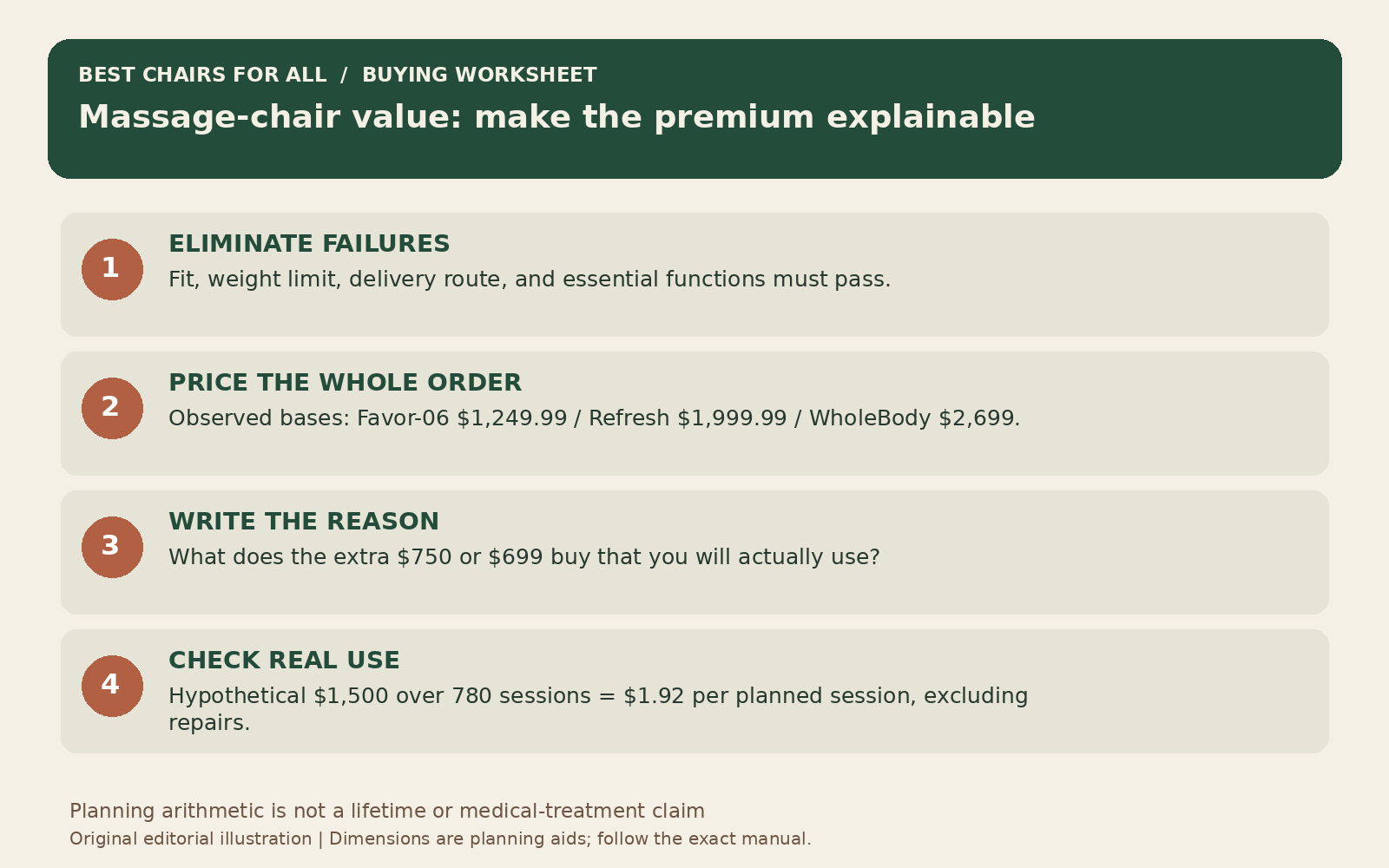
This is a value analysis rather than a declaration of the most reliable chair. We checked current manufacturer specifications and prices on November 6, 2026, and have not performed durability testing or measured service response. The guide uses a weighted-feature worksheet and illustrative cost-per-use calculation to separate real priorities from large discount claims and program-count marketing.
Three value propositions, three different compromises
| Model | Observed base price | Primary value proposition | Main compromise |
|---|---|---|---|
| Real Relax Favor-06 3D Black | $1,249.99 | Moving SL-track at a lower current price | Confirm exact generation and personal fit |
| Ogawa Refresh 3D | $1,999.99 | 3D mechanism, flexible-track description, custom controls | Official comparison and current model page differ |
| Human Touch WholeBody 7.1 | $2,699 | Open chair form, warm air, shorter operating length | Not an enclosed SL-track equivalent |
Favor-06 3D: value when the basic moving-track package is enough
The Favor-06 3D Black page showed $1,249.99 and an active cart. It lists an SL-track, a 3D massage mechanism, six automatic programs, adjustable massage and air pressure, 20 air cells, lumbar heating, foot rollers, and an extendable footrest. A buyer who needs those functions may have little reason to pay more solely for additional preset names or lighting.
Published dimensions are 59.06 by 28.74 by 41.73 inches upright and 68.50 by 28.74 by 33.07 inches reclined, with a 147.6-pound net weight. Confirm the current exact generation, body-fit limits, delivery route, and supplied manual. Favor-06 and Favor-06 2026 are not names we would interchange without checking the model identifier. A cheaper listing for a different generation does not establish a discount on the one you intended to buy.
This is the first candidate to investigate when preserving cash matters and a demonstration or acceptable return policy confirms suitable fit. It is less compelling if a must-have control, approved fit range, or service arrangement is missing. We do not assign it a fabricated durability score or assume that more affordable furniture has the same support as a more expensive brand. Its strongest documented value is the observed base price for the listed moving-track functions.
Ogawa Refresh 3D: compare the current version carefully
The Refresh 3D current page showed $1,999.99, in-stock language, and an estimated dispatch time. It describes a 3D Vario Motion mechanism, Li Flex track, zero-gravity recline, lumbar heating, foot rollers, and manual or custom programming. That makes it a useful different-brand comparison for someone who wants to assess whether its controls and configuration are worth more than the Favor-06 package.
The current page gives dimensions of 58 by 29.9 by 44.5 inches upright and 70.9 by 29.9 by 33.5 inches reclined, a 21.3-inch seat width, 20.1-inch seat height, 162-pound net weight, and a 320-pound capacity. However, Ogawa’s general comparison chart lists different Refresh dimensions and weight. Confirm the current model identifier and written specification with the seller; do not mix the chart’s measurements with the new product page or treat all Refresh listings as identical.
This is worth investigating when the current version’s fit and custom controls make a demonstrable difference for you. It is less persuasive if the only apparent benefit is a large crossed-out list price. The headline five-year warranty is also divided by coverage type; inspect the actual model warranty terms for labor, parts, and framework. A five-year label is not the same as five years of every possible service expense.
WholeBody 7.1: value can mean a chair form you prefer
The WholeBody 7.1 was listed at $2,699 with an active purchase option. It publishes a 44-by-28-by-40-inch upright size and a 66-by-28-by-29-inch reclined size, a 114-pound chair weight, 285-pound maximum load, and nine inches of rear clearance. Its open arms, swivel base, five automatic programs, warm-air feature, and retractable foot-and-calf unit differ meaningfully from a deep enclosed capsule.
The reason to pay more here is a preference for that form and control arrangement, not the expectation of automatically receiving more roller coverage everywhere. Its 21-inch-wide, 18-inch-deep, 19-inch-high seat may fit a particular living-room routine better than another model’s larger shell. Try the actual chair and the foot-and-calf unit before deciding the open design is easier for you to use. We cannot establish entry comfort or quietness from dimensions alone.
Choose this candidate when its form solves a real household need and the complete cost is acceptable. Pass if continuous SL-track coverage into the seat, enclosed arm compression, or zero-gravity positioning is on your required list. The paid white-glove service listed on the checked page adds $349, so the actual value calculation should use the delivery you need rather than the bare price. Avoid comparing different feature types as though the only variable were brand prestige.
Build a weighted value sheet without inventing scores
Write five criteria: personal fit, required massage coverage, usable controls, room fit, and complete transaction terms. Give each a weight that reflects your own priorities. A household sharing the chair between very different adults might weight fit most heavily; someone with a tight living room might give the operating footprint more weight. The weights belong to the buyer, not to an unsupported universal ranking.
Mark each product pass, fail, or unverified for the essential criteria before considering preferences. A chair that fails a required weight limit or cannot be delivered into the room should leave the shortlist. Unverified fit is not a neutral score that speakers or an app can offset. Obtain the missing evidence through the maker, a demonstration, or an acceptable purchase-and-return arrangement.
For nonessential preferences, use plain notes such as easier controller in demonstration, desired foot heating absent, or quieter sound not verified. Do not turn incomplete impressions into numerical test results. This worksheet is useful precisely because it makes unknowns explicit. It also keeps sellers’ claims about body sensing, therapeutic programs, and premium mechanisms separate from your own observed comfort and handling needs.
Cost per use is a planning aid, not a treatment saving
Suppose two hypothetical chairs cost $1,500 and $3,000 delivered. At three sessions each week for five years, they would provide 780 planned sessions. Dividing the purchase prices by that number gives approximately $1.92 and $3.85 per planned session. At one session a week for the same period, the figures become approximately $5.77 and $11.54. These are illustrative schedules and prices, not predicted product lifetimes or usage habits.
The exercise shows that actual use can change perceived value more than a modest discount. It does not establish that either chair will last five years, require no repairs, or replace professional treatment. Do not subtract medical appointments or therapy fees from the purchase price as though a consumer chair provides equivalent care. Budget separately for any costs that remain necessary and use only realistic planned chair use in the calculation.
A buyer who dislikes the chair’s controls or cannot leave it in a convenient location may use it less than expected. An enjoyable showroom session can also overstate future enthusiasm. If possible, decide where and when the chair would be used in an ordinary week before committing. A lower-cost chair that fits that routine may be better value than a premium model used only occasionally; the reverse can also be true where the premium features solve a specific preference.
Audit the discount and the support offer
Compare the current payable amount for the exact model, color, delivery service, and warranty configuration. A large percentage reduction from a claimed list price is not evidence of a real historical saving. We have not tracked a sufficiently detailed transaction history to validate every comparison price. Record the current offer and compare complete totals from authorized sellers instead of ranking by the largest discount badge.
Read warranty terms by year and component. Ask who pays for labor, parts shipping, travel, collection, and replacement upholstery where applicable. A long structural warranty can be useful while leaving electronics or in-home labor covered for a shorter time. Ask what occurs if local service is unavailable. We cannot forecast support quality, but we can insist that the written responsibilities are clear before treating a warranty as part of value.
Also check oversized return terms. A chair with free outward delivery can still require the buyer to pay collection freight or a restocking charge. A modestly higher complete price with a more suitable return arrangement may be worth considering where personal fit is uncertain. Keep original packing as instructed until you have checked the delivered model, condition, and fit.
Make the feature premium explainable
Favor-06 to Refresh is an observed base-price difference of $750. Refresh to WholeBody 7.1 is a difference of about $699. Those sums are not premiums for identical products; each step changes the mechanism, controls, room fit, or chair form. Write one concrete sentence describing what the extra spending buys you and how you will use it. If the sentence contains only luxury, more advanced, or better wellness, you still need a clearer reason.
Do the same for features you will not use. Wireless speakers are not valuable to someone who prefers silence. Extra preset programs are not valuable if the basic manual control already does the job. An open chair may be highly valuable to a person who dislikes enclosure, even though it has fewer advertised modes. Value becomes clearer when preferences are specific and the important tradeoffs are openly acknowledged.
Buy for a supported routine
Treat these products as relaxation furniture and follow the exact manual’s suitability, heat, pressure, and electrical warnings. Seek individualized professional advice for health concerns rather than relying on medical-sounding presets. Check the current CPSC recall database and maker notices, register the product, and stop use if damage or abnormal operation appears.
Investigate Favor-06 for lower-cost moving-track functions, the current Refresh 3D for its different control and track package, or WholeBody 7.1 for its open form and warm-air feature. The best chair for the money is the one whose added cost you can explain through verified fit, useful functions, and acceptable ownership terms. Recheck the exact version, availability, and complete quote before paying.
Something unclear or out of date? Send a correction with this article’s title and the detail to check.
Sources, research & corrections policy ↗